





Dr. Dalal Erekat: This incident confirms the deliberate tampering with food shipments, making them a weapon in the hands of the occupation to destroy Palestinian society.
Nihad Abu Ghosh: The incident requires an urgent and transparent international investigation to uncover its circumstances and impose strict oversight on aid entering the Gaza Strip.
Imad Moussa: Gaza is facing an escalation in genocidal strategies and unprecedented threats to eliminate the will of its residents and destroy their social and health infrastructure.
Dr. Jamal Harfoush: This act is a form of psychological warfare and a crime against humanity, exploiting the urgent need for food aid to achieve destructive goals.
Nabhan Khreisha: The Palestinian people have the right to bring this issue to international courts and for the international community to assume its responsibility in holding the responsible parties accountable.
Adnan Al-Sabah: The incident is part of an Israeli strategy to "demonize" the Palestinian people, distort their image, and deliberately harm their cause and struggle.
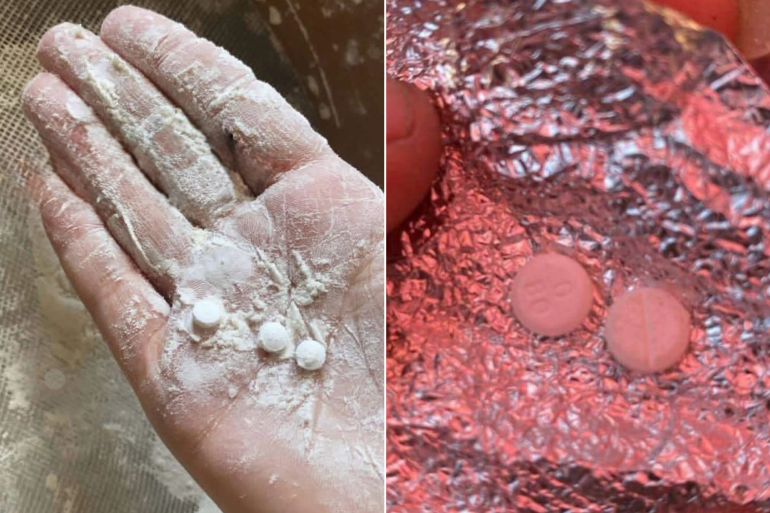
At a time when the Gaza Strip has been groaning under a stifling siege and ongoing genocide for nearly 21 months, the discovery of narcotic pills hidden inside flour bags intended as humanitarian aid adds a silent tool of genocide to the suffering of Gazans.
In separate interviews with "I," writers, political analysts, specialists, and university professors believe that this serious incident has refocused attention on accusations that humanitarian aid is sometimes used as a malicious means to undermine Palestinian society from within under the guise of support and relief.
They point out that this incident could be a new chapter in the "silent genocide" policy targeting the psychological and social fabric of Palestinians, as food, essential for survival, is transformed into a weapon that threatens the lives and resilience of civilians.
Given Israel's complete control over the crossings, writers, analysts, specialists, and university professors believe that aid manipulation is no longer merely a possibility, but rather a malicious pressure tool that threatens to quietly dismantle society and may even serve to damage the Palestinian image in the eyes of the world.
In the face of this silent threat, calls are growing for a transparent international oversight mechanism to oversee the inspection of every food shipment arriving in Gaza. Amid the blockade, hunger, and hidden toxins, the people of the Strip find themselves facing a new battle: defending their right to clean food, free from manipulation and humiliation.
Criminal methods that exceed the limits of human imagination
Dr. Dalal Erekat, professor of diplomacy and conflict resolution at the Arab American University, describes the discovery of narcotic pills inside flour bags intended as food aid to the Gaza Strip as a reflection of the "horrific terrorism of the occupation" and its persistence in employing criminal methods that exceed the limits of human imagination.
Erekat asserts that this incident is not merely a one-off violation, but rather part of a systematic series of crimes aimed at dismantling the psychological and health structures of the Palestinian people, exploiting the dire need for food amid the ongoing Israeli blockade.
She points out that the occupying state, which practices starvation as a weapon of war, has resorted to using food, specifically flour, as a tool for drug distribution, in an attempt to drown Palestinian society in addiction and weaken it in the face of the challenges imposed upon it.
Erekat considers this act "the most horrific in its method," a violation of all rules of war, and a crime against humanity that requires urgent accountability in international forums.
She points out that this is not the first incident in which silent genocide has been used against Palestinians, but it stands out as a stark example of the brutality of Israeli policies.
Erekat explains that the occupation's complete control over Gaza's crossings, the absence of effective international oversight, and Israel's control over aid entry open the door to systematic interference in humanitarian aid, whether by manipulating its quantity, quality, or even its content.
Erekat asserts that this incident confirms the realistic assumption that food shipments are being deliberately tampered with, making them a weapon in the hands of the occupation to destroy Palestinian society, both materially and psychologically.
The need to establish an independent and transparent international mechanism to inspect materials before they enter
Erekat calls for the establishment of an independent and transparent international mechanism to inspect all materials entering Gaza to ensure they are free of any interference that threatens the lives of the population.
Erekat attributes the continuation of these crimes to the occupation's chronic impunity, noting that the inability of international justice institutions or their submission to political pressure encourages Israel to persist in its use of inhumane methods.
Erekat asserts that what is happening in Gaza is not just a humanitarian tragedy, but a test of the world's conscience and the effectiveness of the international system.
Erekat calls on countries that support justice and human dignity to demonstrate strong political will to hold the occupation accountable and put an end to its brutal policies, which aim to undermine the resilience of the Palestinian people.
Part of a series of systematic crimes committed by the occupation
Writer and political analyst specializing in Israeli affairs, Nihad Abu Ghosh, asserts that the discovery of narcotic pills inside flour bags intended as food aid for the Gaza Strip is part of a series of systematic crimes committed by the Israeli occupation, which cannot be explained rationally or logically.
Abu Ghosh believes that the occupying state, which is deliberately practicing genocide, has gone beyond the boundaries of traditional criminality to include starvation, torture, the destruction of homes, hospitals, temples, and shelters, the execution of prisoners, and the distribution of poisons and drugs through its collaboration with hired gangs with criminal records.
He explains that the occupation has failed, over the course of 21 months, to impose socially acceptable local leadership in Gaza. Families, clans, and community representatives have rejected all attempts to create loyal alternatives. As a result of this failure, the occupation has resorted to cooperating with small criminal gangs, lacking any social support, to carry out dirty tasks, including managing aid distribution points through a dubious American-Israeli company.
Abu Ghosh points out that these checkpoints have turned into "death traps," resulting in the deaths of more than 500 Palestinians, highlighting the danger these gangs pose to the nation and society.
A deliberate attempt to poison the entire Palestinian community
Abu Ghosh believes that smuggling narcotic pills into flour bags may be a reward for these gangs, directed at them, or perhaps a deliberate attempt to poison Palestinian society as a whole, with the aim of weakening it and dismantling its social and health structures.
Abu Ghosh asserts that all materials entering Gaza are subject to interference under the pretext of security inspections, with the occupation imposing strict measures to prevent the entry of materials deemed "dual-use." He explains that Israeli inspectors often act on their own whims, preventing the entry of children's toys, prosthetic limbs, medical aids, and some food items on the grounds that they are "non-essential." They even ban prefabricated houses because they conflict with displacement plans.
Abu Ghosh emphasizes that the occupation may resort to introducing sensitive devices and sensors into the aid for spying purposes, or to locate resistance fighters or Israeli prisoners, as part of an open war aimed at maximizing Palestinian losses and transforming life in Gaza into perpetual suffering.
Abu Ghosh points out that these policies are in line with the so-called "Trump Vision," which essentially aims to ethnically cleanse and uproot Palestinians from their land.
The incident requires an urgent and transparent international investigation.
Abu Ghosh stresses that the incident requires an urgent and transparent international investigation to uncover the circumstances of this crime, along with the need to impose strict oversight on aid entering Gaza to ensure its safety.
Abu Ghosh asserts that the continuation of these crimes reflects the occupation's impunity, which requires serious international action to hold Israel accountable and halt its violations, which aim to destroy the Palestinian people both materially and morally.
Hybrid warfare in which new methods of extermination are developed
Writer and political analyst Imad Moussa warns of the escalation of genocidal strategies targeting the Gaza Strip, accusing global powers of developing hybrid warfare methods that combine conventional weapons with irregular means, including the use of chemicals and cyberattacks.
Musa points out that food tampering is part of this strategy, whereby drugs, carcinogens, and other substances that cause infertility are inserted into food, with the aim of causing long-term harm to the population.
Musa cites a similar history, citing the use of anthrax in clothing prepared for Native Americans, as an example of genocidal tactics used to destroy communities.
Musa asserts that Gaza is currently on the cusp of a hybrid war, with Israel employing classic combat tactics supported by asymmetric warfare, while employing advanced cyber and chemical weapons to enhance its destructive impact.
Musa called for urgent intervention by the World Health Organization and the Food and Agriculture Organization (FAO) to verify the safety of food supplies distributed in Gaza, warning that these practices are being carried out "with everyone's knowledge" as part of a systematic plan to develop new methods of genocide.
Moussa calls on the international community to take immediate action to halt these violations, stressing that Gaza faces unprecedented threats aimed at annihilating the will of its residents and destroying their social and health infrastructure.
He explains that this hybrid war is not limited to military operations, but extends to targeting vital infrastructure and public health, calling for an urgent international investigation to uncover these crimes and hold those responsible accountable.
A deliberate attempt to undermine public health and spread addiction.
Professor Dr. Jamal Harfoush, professor of scientific research methods and political studies at the University of the Academic Research Center in Brazil, asserts that the discovery of narcotic pills inside bags of flour sent as food aid to the Gaza Strip is extremely serious.
Harfoush points out that this incident reveals a malicious intent targeting Palestinian society in one of the world's most suffering regions due to the years-long Israeli blockade.
Harfoush explains that concealing narcotic pills inside bags of flour, a staple food that forms the backbone of the daily food basket for Palestinian families in Gaza, is a deliberate attempt to undermine public health and spread addiction among the population, particularly among the most vulnerable groups such as children and youth.
Harfoush asserts that this act, if proven to involve hostile parties, constitutes a form of psychological warfare and a crime against humanity, exploiting the dire need for food aid to achieve destructive goals aimed at weakening Palestinian society's resilience in the face of occupation and siege.
He points out that the tight blockade imposed by the Israeli occupation authorities on the Gaza Strip, which includes complete control over the movement of goods through border crossings, creates uncertainty regarding the safety of food shipments.
Harfoush points out that the Palestinian authorities' lack of full control over these crossings makes food vulnerable to tampering, both in terms of quality and content, exacerbating the risks to the lives of residents.
He cited previous incidents in which expired or contaminated food was seized, which reinforces suspicions that such violations are likely to recur.
Harfoush calls for an immediate, transparent investigation at both the Palestinian and international levels to uncover the circumstances of this incident and hold those involved accountable. He also calls for the authorities overseeing the crossings to implement strict monitoring procedures to ensure such disasters do not recur.
It calls for the activation of neutral Palestinian oversight mechanisms, in cooperation with international institutions specializing in food safety monitoring, to ensure safe delivery of aid to the population.
It emphasizes the international community's moral and legal responsibility to pressure the occupying authorities to lift the blockade on Gaza and ensure the entry of humanitarian aid free from any interference that threatens the lives and health of citizens suffering from catastrophic living conditions as a result of the ongoing blockade and recurring wars.
Harfoush asserts that this incident highlights the urgent need for concerted international efforts to protect the Palestinian people from these crimes, which aim to cripple their ability to persevere.
multidimensional crime
Journalist Nabhan Khreisha asserts that the discovery of narcotic pills inside flour bags intended as food aid to the Gaza Strip is a multi-dimensional crime that goes beyond being a trivial incident to becoming a blatant violation of international law and humanitarian ethics.
Khreisha believes that this incident, if proven, constitutes a potential conspiracy aimed at dismantling the Palestinian social fabric, sowing chaos, and spreading forced addiction under the guise of humanitarian aid in a society exhausted by a nearly two-year war amidst an ongoing siege.
He points out that the nature of the narcotic pills has not yet been officially determined, but there is speculation that they may be powerful stimulants such as Captagon or amphetamines, sedatives such as benzodiazepines, or even hallucinogenic substances that slowly destroy the nervous system.
Khreisha asserts that, regardless of the substance, the goal is the same: targeting the health of Palestinian citizens and drowning them in addiction, threatening the social and health infrastructure of Gaza's residents, especially in light of the catastrophic living conditions they face.
From an international legal perspective, Khreisha believes that this incident, if proven, constitutes a full-fledged international crime, violating the Geneva Conventions, which prohibit the exploitation of humanitarian aid to harm civilians, and violating international agreements related to combating drugs.
He asserts that the act may amount to a crime against humanity if it is proven that the goal was to systematically spread addiction to destroy Palestinian society.
Khreisha believes this crime is not merely a logistical error in the supply chain, but a clear violation of international laws protecting civilians in conflict zones.
Urgent action on two tracks: investigation and oversight
Khreisha calls for urgent action on two fronts: first, a transparent and independent international investigation under UN supervision to uncover the circumstances of the incident, determine responsibilities, and hold those involved accountable, regardless of their culpability. Second, tightening controls on aid at Gaza's entry points, subjecting aid to rigorous laboratory testing before distribution to ensure its safety.
He stresses the need to establish an advanced Palestinian monitoring system that includes random and periodic laboratory testing of food shipments, along with accurate documentation of the aid's route from entry to its arrival at the beneficiaries, while involving the local community in monitoring any suspicions.
Khreisha asserts that the Palestinian people have the right to take this case to international courts, calling on the international community to assume its responsibility in holding accountable those responsible for this crime.
He warns that the continued manipulation of aid raises serious questions about its safety, especially given the occupation's control over the crossings.
Khreisha points out that drug-laced bread represents another aspect of the war on Gaza, which aims to weaken the resilience of its residents.
Khreisha holds international organizations, particularly the United Nations and the World Food Programme, responsible for directly overseeing the safety of aid, rather than simply issuing statements of condemnation or denying responsibility.
Khreisha calls on human rights organizations to monitor, document, and expose these violations to the world, while demanding transparent investigations and strict accountability.
Khreisheh emphasizes that Palestinians are not demanding privileges, but rather a basic right to safe food, pure medicine, and uncompromised aid, to ensure a minimum level of human dignity amid their ongoing suffering.
A pretext for political and media use against the Palestinian cause
Writer and political analyst Adnan Al-Sabah warns that the story of the discovery of narcotic pills inside flour bags intended as aid to the Gaza Strip is being orchestrated in a manner aimed at demonizing the Palestinian people and distorting their image and cause.
Al-Sabah believes that the public and sensational publication of this novel aims to portray Palestinians, who are suffering from famine, murder, and historically unprecedented conditions, as drug addicts, which constitutes a deliberate insult to the Palestinian cause and its resistance.
Al-Sabah explains that the primary goal of this campaign is to damage the Palestinian character and reputation, portraying them as a society that consumes drugs amid its humanitarian suffering, providing a pretext for political and media exploitation against the Palestinian cause.
He points out that everything related to Gaza, including humanitarian aid, is completely under the control of the Israeli occupation, which controls its content, distribution, and form.
Al-Sabah asserts that the occupation forces are meticulously inspecting everything, which raises suspicions about their direct involvement in smuggling drugs into the aid as part of their schemes.
He explains that aid enters Gaza through what is known as the American-Israeli company, which he describes as a purely Israeli security company that uses food, water, and medicine as tools of death and murder.
He believes that smuggling drugs into flour bags and exposing them in this sensational media manner reflects an Israeli strategy to further harm the Palestinian people and distort their image.
Al-Sabah asserts that nothing happens in Gaza or the West Bank outside the control and planning of the Israeli security services, which operate according to carefully considered plans to harm the Palestinians and their resistance.
Al-Sabah calls for caution regarding the narratives promoted by the occupation authorities, stressing that this incident is not merely a random occurrence, but rather part of a media and psychological war aimed at destroying the image of the Palestinian people and their cause.
Al-Sabah calls for an independent investigation to uncover the truth about this incident, along with the need to establish Palestinian and international oversight mechanisms to ensure the safety of aid.
Al-Sabah stresses that the continuation of these practices reflects the occupation's attempts to achieve its goals by all means, including targeting Palestinian dignity and distorting the image of the resistance in the eyes of the world.

PALESTINE
Wed 02 Jul 2025 9:10 am - Jerusalem Time
Drugs in aid: A new episode of "silent genocide"
Tags
MORE FROM PALESTINE




Share your opinion
Drugs in aid: A new episode of "silent genocide"