






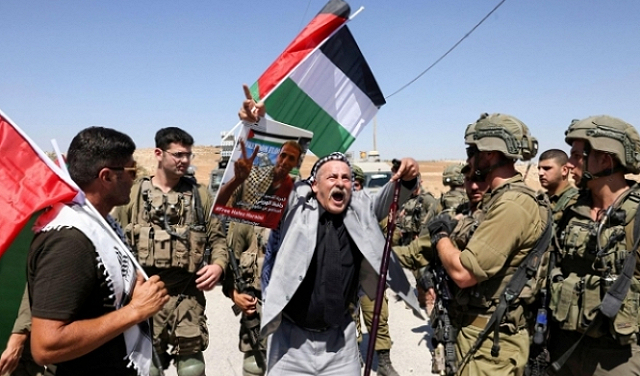
The occupation authorities continue to target Palestinians in Jerusalem, escalating their measures against them and preventing them from exercising their rights. This includes appealing the racist discriminatory policies practiced against them in the city, which place them in the path of forced displacement under various pretexts, in favor of the settlers and their settlement associations.
This is the opening statement of the "Weekly Settlement Report" from June 21, 2025 to June 27, 2025, issued by the "National Bureau for Defending Land and Resisting Settlements." The report notes that the town of Silwan and its neighborhoods are "once again at the forefront of developments and events, as the occupation authorities plan to displace approximately 800 Palestinians from the Batin al-Hawa neighborhood in Silwan from their homes and lands, in conjunction with similar plans to displace approximately 500 Palestinians from the Sheikh Jarrah neighborhood. Not far from the Batin al-Hawa neighborhood, more than 100 homes inhabited by 1,550 Palestinians in the Al-Bustan neighborhood in Silwan are threatened with demolition and displacement.
Families notified by these authorities of the demolition of their homes face a legal battle in the occupation courts, the report continues, with the demolition notices being renewed each time.
It should be noted here that the area of Silwan town is 5,640 dunams, and includes 12 neighborhoods inhabited by approximately 58,500 Jerusalemites. There are 78 settlement outposts in the town, inhabited by 2,800 settlers.
To further strangle the Palestinians, the occupation introduced Amendment 116 to the Planning and Building Law on October 25, 2017, known as the "Kaminitz Law," one of many racist laws against Palestinians. This amendment poses a significant threat to the Palestinian existence, as it increases the severity of penalties and the speed with which they are implemented without trial. This racist law also introduces amendments to the Israeli Planning and Building Law, limiting the courts' authority to freeze demolition orders, transferring the powers of law enforcement to the state's regional committees, and imposing heavy and ongoing fines on owners of unlicensed homes.
In this regard, the report states that Israeli Supreme Court Justice Noam Solberg last week rejected a request for leave to appeal filed by the Shweiki and Odeh families, who were ordered to vacate their homes in the Batn al-Hawa neighborhood in favor of settlers. The two homes are home to three families, comprising 19 Palestinians, who will be forced to vacate their homes in favor of settlers linked to the Ateret Cohanim settlement organization.
The eviction lawsuits are part of a broader campaign to forcibly displace the entire neighborhood, which has a population of about 700.
Last year, settlers seized three homes in the neighborhood after evicting the Palestinian families who lived there. The legal basis for the eviction claims is a discriminatory law that allows Jews to reclaim what these authorities call property lost in the 1948 war, while another law denies Palestinians the same right.
The case of these two families in the Batn al-Hawa neighborhood is of particular importance, the report notes, “as several other eviction cases are pending in Israeli courts. Former Supreme Court Justice Uzi Fogelman, who handled the case before retiring, asked the Attorney General in December 2022 to present the state’s position to the court, given the importance and ramifications of the issues at hand. However, the Attorney General did not submit his opinion. After Justice Fogelman retired, the case was referred to Supreme Court President Justice Amit. However, once it became clear that he was unqualified to hear the case due to his connection to one of the plaintiffs, the case was handed over to Justice Noam Solberg. This judge had previously rejected appeals in two other eviction cases in Batn al-Hawa, those of the Ghaith and Shehadeh families. He has now decided that there is no longer a need to wait for the state’s position, and he has also rejected the Shweiki and Odeh families’ request for leave to appeal. This means that in other pending cases as well, the state’s position will not be considered unless the state decides to present it independently in those cases.” procedures".
The case of the Shobaki and Abu Odeh families is not isolated from the cases of other families threatened with displacement. Five appeals following an eviction ruling issued by the Magistrate's Court in January 2025 are still pending in the courts: the home of Zuhair Rajabi – seven families and 39 individuals; the home of Abdul Fattah Rajabi – two families comprising 18 individuals; the home of Yaqoub Talal Rajabi – 11 families comprising 44 individuals; The Yusef Basbous home is home to four families comprising 21 people, and the Khalil Basbous home is home to three families comprising nine people, as well as five additional eviction lawsuits, involving dozens of families. All of these lawsuits are based on the same discriminatory and racist basis enacted by the Knesset in 1970 (the Legal and Administrative Affairs Law), which stipulates that Jews who owned property in East Jerusalem and lost it in 1948 can reclaim it from the Israeli Custodian General. This is in stark contradiction to the Absentee Property Law of 1950, which stipulates that Palestinians who lost their property in Israel in 1948 and became refugees are not entitled to reclaim it .
International law prohibits evictions, as confirmed by the Advisory Opinion of the International Court of Justice issued last July. The Court (in paragraphs 119, 122, 163, and 196) referred to Israel's settlement policy in East Jerusalem and the discriminatory legal regime, particularly the Absentee Property Law, which results in the eviction of Palestinians from their homes in favor of settlers. The Court ruled that this policy constitutes a violation of international law. In July of last year, the United Nations Human Rights Office in the occupied Palestinian territory expressed concern about the future of approximately 87 Palestinian families, comprising between 600 and 800 Palestinians, who are threatened with forced eviction from their homes in the Silwan neighborhood of occupied East Jerusalem, facilitated by the application of illegal and discriminatory Israeli laws against Palestinians in the occupied territory. After listing a number of cases targeted for eviction, the office emphasized that these cases are examples of an ongoing, systematic campaign waged by settlers and the discriminatory application of a set of laws, including Israel's Absentee Property Law and the Legal and Administrative Matters Law of 1970.
Not far from the Batn al-Hawa neighborhood in the town of Silwan, Palestinians in the Sheikh Jarrah neighborhood of occupied Jerusalem continue to suffer and fear for their existence. This neighborhood is home to approximately 600 Palestinians belonging to several families, including the Kurds, Skafys, and Qasems, among others. These families were displaced from their lands in Palestine in 1948, such as those in al-Baqa'a, Deir Yassin, Lifta, Haifa, and Jaffa. At that time, they resided in Karm al-Jaouni and Kabaniyat Umm Haroun.
The residents of this neighborhood, as is clear, are Palestinian refugees who were displaced from their lands and farms in 1948. The Kurd family is a refugee from Haifa, the Sabbagh family from Jaffa, the Dajani family from Beit Dajan and Jaffa, and the Dahoudi and Abu Arafa families, among others, came as refugees from the western neighborhoods of Jerusalem. The neighborhood is also home to families who gave up their UNRWA cards in exchange for a house and a small plot of land from the Jordanian administration. These families are struggling against the settlers living among them, who, with the support of the occupation authorities and especially the Minister of National Security, Itamar Ben-Gvir, are seeking to empty the neighborhood of its original inhabitants. They have seized three homes whose original owners were displaced and live in them. These homes have become the nucleus of a settlement that the settlers call "Shimon Sadik Neighborhood." Behind these lawsuits is the settler organization Ateret Cohanim, which operates in the Old City and the Batn al-Hawa neighborhood of Silwan. Meanwhile, the Nahalat Shimon company operates in Sheikh Jarrah alongside other settler organizations that have no connection to the Jewish residents of the properties. Instead, they seek out the heirs of these residents, purchase their properties, and file lawsuits to evict them on ideological grounds, with the goal of establishing settlements in the heart of Palestinian neighborhoods.
This "Nahalat Shimon" is the bottom line of a network of companies registered in various countries, including the United States, all of which aim to conceal the parties behind the costly legal efforts to expel Palestinian families.
In this context, the United Nations Office for the Coordination of Humanitarian Affairs (OCHA) recently revealed that more than 680 Palestinians were displaced in the first half of 2025 due to the demolition of their homes on the pretext of lacking building permits issued by the Israeli authorities in Area C of the West Bank, more than double the number during the same period in 2024. The office stated that since the beginning of the military escalation between Israel and Iran on June 13, Israeli forces have continued to tighten restrictions on movement to and within the West Bank. The main checkpoints on vital roads have been completely closed, all road gates leading to the city of Hebron have been closed, and residents of most Palestinian towns have been prevented from accessing Route 60, the main road linking the north and south of the West Bank. Meanwhile, settler movement on the roads has continued uninterrupted. Israeli authorities also carried out a mass demolition operation in the Khallet ad-Dabaa residential community in the Hebron Governorate, the fourth such incident in 2025. Of the 78 structures demolished in the community this year, 62 percent were provided as humanitarian aid.
settler terrorism
Meanwhile, settlers continued their rampage, with their violence and terror sweeping across vast areas of the West Bank. The Ramallah and al-Bireh governorate was the most targeted, followed by Nablus and Hebron. These terrorists roamed the Palestinian countryside armed with rifles, distributed by Ben-Gvir, and explosive devices.
Settler violence and terrorism range from the destruction of property, the burning of homes and cars, to the bulldozing of land, the establishment of new settlement outposts, and the installation of iron gates, as the occupation army does.
Settler terrorism reached its peak with the criminal act perpetrated by dozens of settlers in the town of Kafr Malik in the Ramallah and al-Bireh Governorate, which left three martyrs and several others injured.
The weekly violations documented by the National Office for the Defense of Land were as follows during the reporting period:
Jerusalem: Israeli occupation forces demolished a house, a parking lot, and razed a plot of land in the Ras Khamis neighborhood of Shuafat refugee camp, all of which are owned by Jerusalemite Anas al-Rajabi, without prior warning, for the benefit of settler associations. In the town of Hizma, the occupation authorities decided to seize land on the street adjacent to Wadi Azriq, starting from the main street leading to the town of Jaba' and reaching the Aqabat area. The authorities also demolished a two-story house in the town belonging to Mutawakil al-Khatib, without prior notice.
Ramallah: Dozens of settlers launched a large-scale attack on the town of Kafr Malik, opening fire, burning vehicles, and destroying property in the southern part of the town. Three civilians were killed and several others were injured. The Palestinian Red Crescent Society also confirmed eight cases of suffocation after settlers set fire to a house at the Karmelo Junction near the village of Taybeh.
Settlers continued bulldozing and uprooting ancient olive trees in the lands of Sinjil town for the third consecutive day. In the village of Al-Mughayyir, citizen Raqad Jumaa Abu Aliya was injured while he was grazing his sheep on his land, which led to his injury and bruises, in the "Marj Sa'i" plain between the villages of Abu Falah and Al-Mughayyir. In the town of Beit Liqya, west of Ramallah, occupation forces demolished an agricultural room belonging to citizen Rabhi Nimer Mustafa Asi and completely destroyed its contents. Settlers also attacked citizens' vehicles at the entrance to the "Shilo" settlement, near the town of Turmus Ayya, throwing stones at them, and assaulted their passengers by spraying them with pepper gas while they were stopped at a traffic light.
In Turmus Ayya, settlers set fire to the lands of citizens who had risen up to confront the settler attack. Settlers also attacked the Abu Fazaa al-Ka'abneh family, east of Ramallah, and burned a car parked in front of a house. This came days after provocative settler actions around Bedouin communities, including chanting religious slogans and making direct threats, in an attempt to impose a new reality on the ground.
Local sources reported that a number of settlers fired live ammunition at residents and their property in Sinjil after residents confronted a group of them who tried to bring their sheep between the town's homes. Another group also assaulted a citizen from the eastern farm while he was in his vehicle.
Hebron: Settlers released their livestock onto Palestinian agricultural land and seized a water well in Masafer Yatta, south of Hebron, under the protection of occupation soldiers.
In another attack, settlers unleashed their herds of livestock in the vicinity of citizens' homes in Khirbet Aqwawis in Masafer Yatta, south of Hebron, destroying farmers' crops, damaging orchards and fruit trees, and vandalizing agricultural infrastructure such as irrigation canals and wells. Citizen Muhammad Ahmad Mahmoud al-Hour, 48, was killed and another was seriously injured by settlers' bullets in Surif, who attacked the "Al-Qurainat" area under the protection of the Israeli occupation forces, firing live bullets at citizens while they were trying to extinguish a fire set by settlers on the lands there. A number of settlers from the "Susya" settlement attacked citizens and their property in Masafer Yatta and set them on fire.
Bethlehem: Israeli occupation forces demolished an agricultural room, razed land, and filled in a water well in the village of Wadi Rahhal. They also uprooted dozens of olive trees in the village of Husan. Settlers installed eight iron gates on agricultural roads in the town's lands, six of which were in the Wadi al-Abyar area and two in the Faghur and Wadi al-Walaja areas. This prevents farmers from accessing their lands, estimated at approximately 12,000 dunams, all of which are planted with grape vines, olive trees, and other crops.
In Wadi al-Nis village, the occupation authorities notified Saeed Fawzi Mahmoud Hammad to stop work on his agricultural land, where he is building cement retaining walls, which will be demolished later. They also seized a bulldozer belonging to Abdullah Yousef Ahmed Hammad, who was working on the land. The land is approximately 10 dunams in area and the owner intends to work on it for agricultural purposes. Settlers also attacked citizens' vehicles near al-Minya village and began bulldozing agricultural land in the Shoshala area planted with grapevines and almond trees, with the aim of expanding the borders of the "Daniel" settlement. The occupation forces also bulldozed areas of agricultural land in the al-Sana'a area in the town of Husan, near the "Beitar Illit" settlement junction, which led to the uprooting of dozens of olive trees.
Nablus: Settlers plowed and fenced off agricultural land in the village of Qaryut in the Khirbet Sarra area between the villages of Qaryut and Jalud. Others uprooted dozens of trees between the villages of Aqraba and Majdal Bani Fadel after they raided the lands located between the villages of Majdal Bani Fadel and Aqraba in an area called Suf, uprooting and breaking about 80 trees there. A citizen was injured in the head after settlers threw stones at him in the village of Asira al-Qibliya, south of Nablus. Settlers had previously set fire to lands in the village and prevented civil defense crews from reaching the fire to extinguish it.
In the village of Duma, settlers closed a street north of the village with earth mounds, connecting the village to the village of Majdal Bani Fadel to the north. Others resumed work on establishing a settlement outpost in the town of Huwara, south of Nablus, after cutting down olive and forest trees in the Jabal al-Ras area of the town, which is about 500 meters from citizens' homes. They rebuilt barracks and set up tents and supplied them with an electricity network. In the village of Einabus, occupation forces demolished a two-story house, each measuring 130 square meters, inhabited by 10 people, after forcing them to evacuate before the demolition was carried out.
Jordan Valley: Settlers stormed the village of Arab al-Malihat in the al-Mu'arrajat area, held a provocative party, chanted racist slogans, and attempted to steal an iron barn during the raid before being discovered by residents who confronted them, prompting them to flee. Others fenced off more land in the al-Farisiya area in the northern Jordan Valley.





Share your opinion
Report: Evacuation, displacement, and ethnic cleansing in occupied Jerusalem