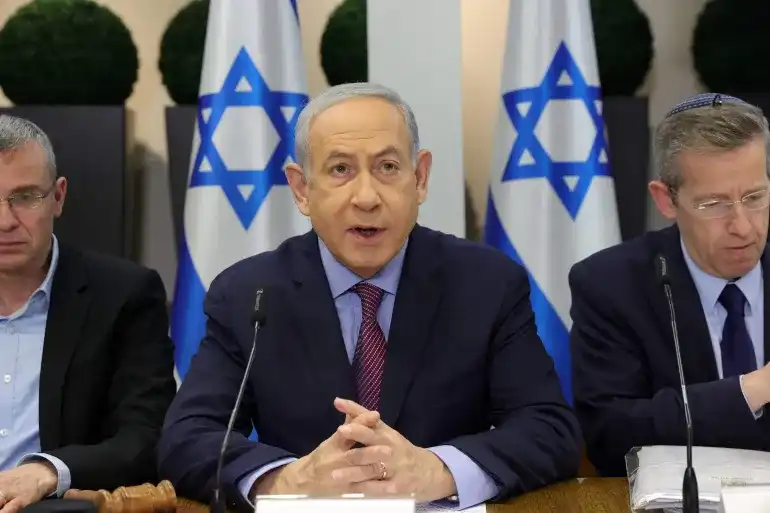







Israeli Prime Minister Benjamin Netanyahu again hinted Thursday at the possibility of assassinating Iranian Supreme Leader Ali Khamenei, saying he had instructed the military that "no one in Iran has immunity."
In an interview with the official Israeli Broadcasting Authority, in response to a question about previous statements by his Defense Minister, Yisrael Katz, regarding the assassination of Khamenei, Netanyahu said, "I have instructed the army that there will be no immunity for anyone in Iran."
Netanyahu added, "There is no need to disclose more than that. Let the actions speak for themselves."
Earlier Thursday, Katz threatened for the first time to assassinate Khamenei, indicating that this was part of the objectives of the Israeli military operation against Iran.
Netanyahu also hinted earlier Thursday at the possibility of assassinating Iran's Supreme Leader during a meeting with journalists at Soroka Hospital in southern Israel.
Asked about the possibility of assassinating Khamenei, Netanyahu told reporters: "No one is immune. I prefer not to dwell on headlines and let actions speak for themselves."
Regarding targeting Iran's nuclear program, Netanyahu claimed during the interview with the Israel Broadcasting Authority that Israel "can strike all of Iran's nuclear facilities."
Regarding "toppling the Iranian regime," Netanyahu claimed that "the primary goal is to eliminate the nuclear threat, and secondarily, to eliminate the ballistic missile threat."
Claiming that Israel does not aim to overthrow the Iranian regime, he said: "Destabilizing the regime may be an outcome, but it is not the goal. That is a matter for the Iranian people to decide."
Netanyahu said that Israel did not wait for a "green light" from the United States to launch an attack on Iran, but he praised the support of the Trump administration, saying, "They are helping us tremendously in defense. There are American pilots intercepting the drones."
He added, "The United States is helping us on the defense level through the THAAD (air defense) system."
Since dawn on June 13, Israel, with US support, has launched a massive attack on Iran, targeting nuclear facilities, missile bases, military leaders, and nuclear scientists. Tehran responded by launching ballistic missiles and drones into Israeli territory, in the largest direct confrontation between the two sides to date.
According to the latest official death toll announced by the Iranian Ministry of Health on Monday, the Israeli strikes killed 224 people and injured 1,277 others, most of them civilians.
In the absence of any new official updates, the Washington-based Human Rights Activists reported that the death toll in Iran had risen to approximately 639, with more than 1,329 injured, as of Thursday morning, according to a tally based on field documentation.
In contrast, the latest Israeli estimates, citing Hebrew media outlets, including Channel 12, indicate that 25 people were killed and more than 800 others were injured as a result of the Iranian strikes, which included intense waves of missiles and drones.
The risk of an escalation of the conflict looms, with Western and Israeli reports suggesting the United States could join Israel in its aggression against Iran. This coincides with statements by US President Donald Trump calling on Tehran to surrender unconditionally and threatening to target Supreme Leader Ali Khamenei.


Share your opinion
Netanyahu on Khamenei's assassination: I instructed the army not to grant immunity to anyone in Iran