






Israel bombed nuclear targets in Iran on Thursday, while Iranian missiles hit an Israeli hospital overnight, as the week-long war escalates with no sign of abating.
Iran yesterday vowed to make Israel "regret and pay the price" for its attacks on the seventh day of the unprecedented war between the two countries.
Iranian media reported that thousands of people were fleeing Tehran and other major cities as Iran and Israel exchanged new missile strikes despite US President Donald Trump's call for Iran to surrender unconditionally.
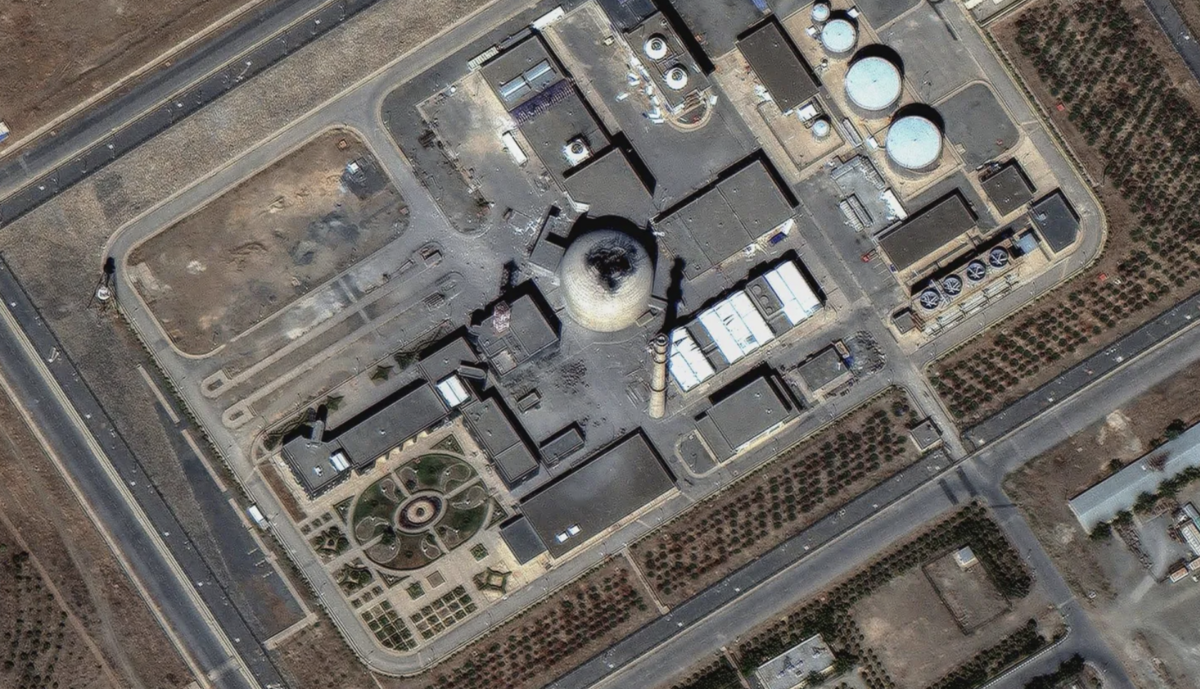
Israel said Thursday it had struck Iran's Natanz and Isfahan nuclear sites. A military spokesman initially said the attack also hit Bushehr, the site of Iran's only operating nuclear power plant, but a spokesman later said it was a mistake to say so.
Earlier, Israel announced that it had struck the Arak (Khandab) heavy water reactor overnight, where Iran was building a heavy water reactor. It stated that the goal was to prevent the reactor from being rehabilitated for military purposes. Heavy water reactors produce plutonium, which, like enriched uranium, can be used to make the core of an atomic bomb.
Under the 2015 nuclear agreement, Iran agreed to redesign the reactor and pour concrete into its core to prevent its use. However, a former Iranian official revealed in 2019 that Tehran had stockpiled replacement parts for later restart.
State television reported that the facility was evacuated before the attack, and no damage was reported to the surrounding civilian areas. It also indicated that the site does not currently pose a radioactive risk.
Following the airstrike that damaged Soroka Hospital in the southern Israeli city of Beersheba, Prime Minister Benjamin Netanyahu declared that Tehran's "tyrants" would pay "the full price."
The UN's International Atomic Energy Agency reported that it had received information that the heavy water research reactor had been bombed, but that it did not contain radioactive material. It had not received any information that another heavy water facility there had been bombed.
Confrontation with missiles and drones
Iranian media reported that air defenses shot down an Israeli drone over the Arak reactor. It was also reported that Israeli drones were shot down over Baghershahr and Kahrizak, south of Tehran, after being detected immediately after entering the capital's airspace. Reports indicated that air defenses shot down a "Haroon" drone.
Iran claims to have shot down three F-35 fighter jets during the seven days of war. It also noted the crash of more than ten drones, some of which were advanced.
Information outage
Seven days into the conflict, assessing the impact of the bombing in Iran has become increasingly difficult, as authorities impose strict restrictions on information in an attempt to control public opinion and prevent panic. Official casualty counts have ceased, images of the devastation have disappeared from the media, the internet has been almost completely cut off, and photography in affected areas has been banned.
According to a Washington-based Iranian human rights organization, at least 639 people were killed in Iran, including 263 civilians, and more than 1,300 others were injured. In response, Iran launched more than 400 missiles and hundreds of drones, killing at least 24 people in Israel and wounding hundreds more.
Iranian police announced Thursday the arrest of 24 people on charges of spying for Israel and working to distort the country's image, according to a statement carried by the Tasnim news agency, affiliated with the Revolutionary Guards. "Twenty-four people were arrested who were spying for the Zionist enemy in person and online," said Kioumars Azizi, commander of the western Tehran police, in the statement. "They were trying to destabilize public opinion and distort and destroy the image of the sacred system of the Islamic Republic of Iran."
Katz threatens Khamenei
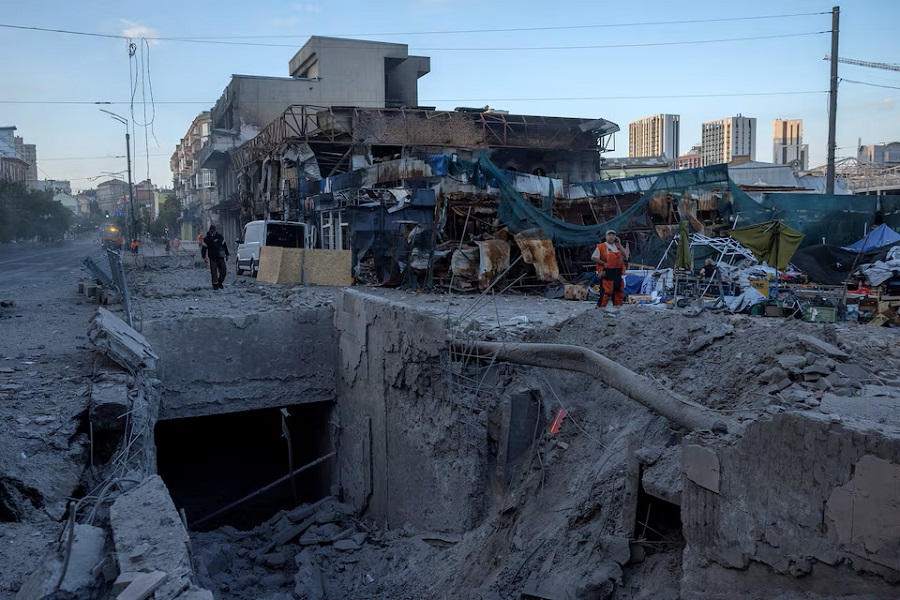
On the Israeli front, a new wave of Iranian missiles caused damage to the main hospital in southern Israel and multiple injuries, in addition to targeting residential buildings near Tel Aviv. The Fars News Agency, affiliated with the Revolutionary Guards, reported that "advanced missiles are roaring toward Tel Aviv," while Iranian state television broadcast live footage from Israeli cities.
The Iranian General Staff's operations room said in a statement, "Our forces launched precise and direct strikes against Israeli enemy positions in response to its attacks, and we affirm that operations will continue until the threat is completely eliminated." It added, "Any direct intervention will be met with a harsh response and will expand the scope of the confrontation."
An Israeli military official said that Iran used a missile with multiple warheads in its latest attack, posing a new challenge to defense systems, as the Iron Dome is unable to deal with more than one warhead at a time.
For its part, the Revolutionary Guards' media reported the use of the Sejjil ballistic missile, which is launched from mobile platforms. The Sejjil ballistic missile has a range of 2,000 kilometers and was first tested in November 2008. It consists of two stages and a combined solid-fuel engine.
Netanyahu vowed to eliminate the Iranian nuclear and missile threat. Speaking to reporters outside Soroka Hospital, he said, "Our goal is twofold: to eliminate the nuclear threat and the ballistic missile threat. We are in the final stages of eliminating this threat." He added, "We are fully committed to eliminating the nuclear threat."
Netanyahu has previously said that Israeli military strikes could topple the Iranian regime, and that Israel will do everything in its power to eliminate the "existential threat" Tehran poses to Israel. He said at a press conference on Monday, "The Iranians are realizing that their regime is much weaker than they thought, and this could lead them to certain outcomes."
Israeli Defense Minister Israel Katz said Thursday that Supreme Leader Ali Khamenei "cannot be allowed to remain" in power, days after reports that the United States had rejected an Israeli plot to assassinate him.
The movements of Iran's supreme leader, who has not left the country since assuming office in 1989, are subject to top-secret security measures during times of crisis. US officials said this week that President Donald Trump rejected an Israeli plan to assassinate Khamenei, while he later said there was no current intention to kill him, "at least not at this time." Speaking to reporters in Holon, near Tel Aviv, after a hospital in the southern city of Beersheba was hit in an Iranian attack this morning, Katz said: "A regime like Khamenei's is very dangerous. Its ideology aims to destroy Israel, and it constantly invests all of its state's resources to achieve such a goal." He added: "Such a person cannot be allowed to remain."
In response, the Iranian Revolutionary Guard Corps claimed it had targeted an Israeli military and intelligence headquarters located near the hospital. An Israeli military official denied the presence of any military targets nearby and said the attack on the hospital was deliberate.
The Israeli military announced that air raid sirens sounded in northern Israel on Thursday afternoon after detecting missiles launched from Iran.
"Meanwhile, the Israeli Air Force is intercepting the missiles... to eliminate the threat," the army said in a statement.
Israeli air and missile attacks on Iran over the past week have eliminated the top leadership of the Revolutionary Guard, damaged its nuclear capabilities, and killed hundreds. In response, Tehran's retaliatory attacks have killed more than 20 civilians in Israel.
"backstage"
Iranian Foreign Minister Abbas Araqchi wrote on Twitter: "Iran will continue to exercise its right to defend itself with dignity and courage, and we will make the aggressor regret its grave mistake and pay the price," accusing his country's arch-enemy, Israel, of seeking to "expand the conflict in the region and beyond."
Chief of Staff of the Armed Forces, Abdolrahim Mousavi, said that Iran "will continue to attack any Israeli target without any restrictions."
Iran's Supreme National Security Council said, "The response will continue until the enemy is punished and pays the price for its actions." It added, "If the Zionist enemy commits a different type of aggression, it will be met with different responses that have been prepared in advance. If a third party intervenes in this aggression, it will be confronted immediately, according to a predetermined plan," according to the state-run Mehr news agency.
Iran's Guardian Council warned the United States on Thursday that any military intervention alongside its ally Israel would be met with a "harsh response."
"The criminal US government and its foolish president must know for certain that if they make a mistake and take action against Iran, they will face a harsh response from the Islamic Republic of Iran," the council said in a statement.
For his part, Iranian Deputy Foreign Minister Kazem Gharibabadi warned against any direct US intervention in the conflict between Israel and Iran, saying that Tehran has "all necessary options on the table."
"If America wants to intervene directly to support Israel, Tehran will be forced to use its tools to teach the aggressors a lesson and defend itself... All necessary options are on the table for military decision-makers," he was quoted as saying by state media. "Our advice to Washington is not to intervene at least if it does not want to stop the Israeli aggression."
"Point of No Return"
Israel launched its unprecedented attack on Iran, asserting that it possessed intelligence indicating that the Iranian nuclear program was approaching the "point of no return." On Thursday, Iran accused the International Atomic Energy Agency (IAEA) of being a "partner" in Israel's "war of aggression," in light of its report on the Iranian nuclear file that preceded the Israeli strikes on Tehran.
"You have betrayed the non-proliferation regime and made the IAEA a partner in this unjust war of aggression," Iranian Foreign Ministry spokesman Esmail Baghaei said in a post on Twitter addressed to IAEA Director General Rafael Grossi.
In a post on X, Baghaei responded to a CNN interview with Grossi, in which he said there was no evidence of systematic Iranian efforts to build nuclear weapons.
"This came too late, Mr. Grossi," Baghaei said, adding that the IAEA's decision to declare Iran in violation of its obligations under the Nuclear Non-Proliferation Treaty was used by Israel as a pretext to launch its attack on Iran.
For his part, former Foreign Minister Mohammad Javad Zarif called for Grossi's dismissal and prosecution, writing on Twitter: "Grossi must be prosecuted for his complicity in the killing of innocent people in Iran, as a result of the Israeli aggression for which his report was used as a pretext."
For his part, Ali Larijani, advisor to the Iranian Supreme Leader and former Parliament Speaker, issued a threat to Grossi in a video message, saying, "The day will come when these people will be held accountable."
Russian warning
Meanwhile, Russia warned the United States on Thursday against military intervention against Iran, considering any such move "extremely dangerous" and with unpredictable consequences, according to Foreign Ministry spokeswoman Maria Zakharova.
This comes amid speculation that Washington might join the war alongside Israel, although Trump has not ruled out a confrontation with Tehran over its nuclear program.
Trump kept the world in the dark about whether the United States would join Israel in airstrikes on Iran. He backed away from a proposal to use diplomatic means to quickly end the war, hinting at the possibility of the United States joining. He spoke on social media on Tuesday about the idea of assassinating Khamenei, then demanded Iran's unconditional surrender.
Although Tehran maintains that its nuclear program is peaceful, 60 percent uranium enrichment brings it technically closer to the 90 percent level used in nuclear weapons. Iran is the only non-nuclear state to enrich to this level.
In contrast, Israel is the only country in the Middle East believed to possess nuclear weapons, although it has not officially acknowledged this.
Khamenei has rejected US calls to abandon the program, warning that any US military intervention would cause "irreparable damage."
Trump said he was not just seeking a ceasefire, but a "much bigger" agreement, and did not rule out the United States formally joining the Israeli campaign.
In a sign of a possible diplomatic opening, Iranian Foreign Minister Abbas Araqchi announced his intention to meet with his counterparts from Britain, France, Germany, and the European Union representative in Geneva tomorrow, Friday.
Three diplomats told Reuters that US Special Envoy Steve Witkoff and Araghchi have spoken by phone several times since Israel began its attacks on Iran last week, in an attempt to reach a diplomatic end to the crisis.
The diplomats, who requested anonymity due to the sensitivity of the issue, said that Araghchi said that Tehran would not return to negotiations unless Israel stopped the attacks that began on June 13.
They added that the talks included a brief discussion of a US proposal presented to Iran in late May aimed at establishing a regional nuclear alliance to enrich uranium outside Iran, an offer Tehran has so far rejected.
A regional diplomat close to Tehran said that Araghchi told Witkoff that Tehran "could show flexibility on the nuclear issue" if Washington pressured Israel to end the war, adding that "the (first) contact was initiated by Washington, which also proposed a new offer" to overcome the deadlock over conflicting red lines.
A European diplomat said, "Araghchi told Lutkov that Iran is ready to return to the nuclear talks, but it cannot do so if Israel continues to bomb it."
"Civilians pay the price"
The United Nations on Thursday condemned Israel and Iran's treatment of civilians as collateral damage in their ongoing war, urging maximum restraint.
"It is horrific to see civilians being treated as collateral damage in the course of hostilities. The threats and inflammatory rhetoric from senior officials on both sides indicate a disturbing intent to harm civilians," UN High Commissioner for Human Rights Volker Türk said in a statement.

Share your opinion
Intensive Israeli airstrikes target Iranian nuclear sites, and Tehran warns Washington.