





Sawsan Sarour: Iran, which did not start the war, will not submit or surrender and will return to negotiations on its own terms, but America cannot be an acceptable mediator.
Dr. Muhannad Hafizoglu: Iran, America, and Israel are participating, albeit unannounced, in a plan targeting Arab countries and Turkey by keeping them in a state of permanent instability.
Osama Al-Sharif: Netanyahu opened the gates of hell and thought the path to expanding Israel's influence in the region passed through Tehran.
Imad Abu Awad: If the war continues, we are facing a scenario of open war, into which many parties may be drawn, and which may have repercussions for the entire world.
Adel Shehadeh: The United States wants to pressure Iran by using Israel as a striking force in the region to force it to accept a settlement on American terms.
Dr. Munther Hawarat: The United States' entry into the war could expand its scope and push Iran to take escalatory steps, such as closing the Strait of Hormuz.
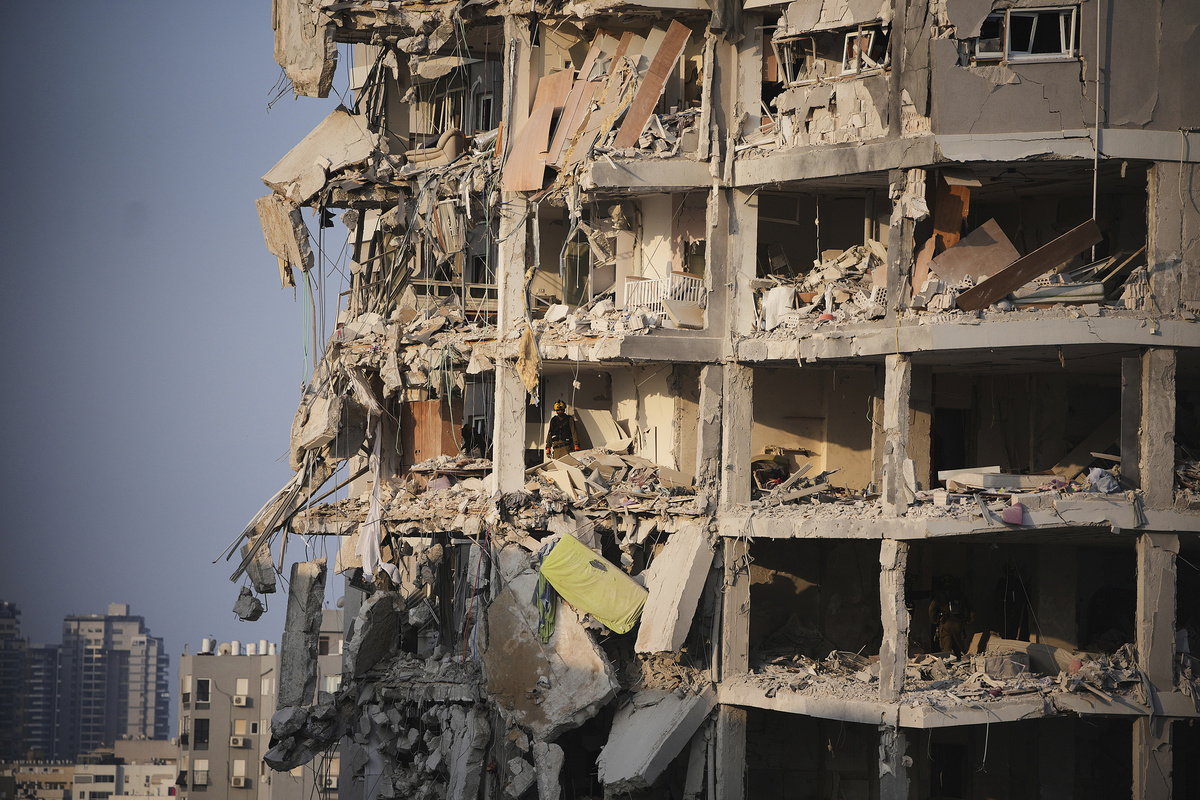
Israelis woke up yesterday morning to scenes of unprecedented destruction, whether in Haifa, Tel Aviv, or its suburbs, especially Rishon LeZion and Bat Yam, which looked as if an earthquake had struck. Did Benjamin Netanyahu's government, which has left no stone unturned in the Gaza Strip and has perpetrated killing and brutality on a scale unprecedented in history, expect that some of what its war machine has inflicted on others would befall it, or did it only imagine seeing destruction and killing in other people's arenas?
The frequency with which Iran is launching attacks on Israel is causing panic and confusion among the Israeli public, especially given the devastation the attacks have caused. This prompted Israeli Prime Minister Benjamin Netanyahu, Defense Minister Yisrael Katz, and the racist minister Itamar Ben-Gvir to conduct an inspection tour of the Bat Yam area south of Tel Aviv in an attempt to boost morale.
Writers, analysts, and experts who spoke to Al-Quds said that Netanyahu has opened the gates of hell and believes that the path to expanding Israeli influence in the region passes through Tehran. They explained, "If the war drags on, we are facing a scenario of open warfare that could draw in multiple parties and have repercussions for the entire world."
They pointed out that the United States seeks to pressure Iran by using Israel as a regional power to force it to accept a settlement on American terms. They emphasized that Iran, which did not start the war, will not submit or surrender and will return to negotiations on its own terms, but that the United States cannot be an acceptable mediator.
Scenes of destruction in the heart of Israel, not in the Gaza Strip
Journalist Susan Sarour, an observer and critic of the Israeli political scene, said that with the rising of the sun, some scenes that are permitted to be revealed become clear. The Israeli public sees the extent of the total destruction and begins to count its dead and wounded, with scenes of the search for missing persons under the rubble of buildings destroyed by Iranian missiles in the violent and hot hours of the night.
She pointed out that these scenes are not taking place in the towns surrounding the Gaza Strip or in the distant northern towns, but rather in the heart of the State of Israel, its political and economic pulse and its societal diversity, primarily in the Tel Aviv area.
Sarour emphasized that these difficult days and major, suspicious events prove that the war imposed by Israel on Iran has not succeeded in halting the emergence of Iranian missiles from their platforms, which possess tremendous destructive capabilities.
She said that the state of alert, the identification centers for bodies and remains, the multiple-casualty incidents, the centers for receiving the dead, and the centers for searching for the missing are all scenes that Israelis cannot tolerate or get used to. The longer this war continues, with the scenes of destruction continuing and the number of dead, wounded, and missing rising, the more Prime Minister Netanyahu will lose consensus around him and public support for this war, and the burden on society will increase, which will negatively impact the days of the war, and thus the end of Netanyahu's government.
Netanyahu did not take into account the Iranian reaction.
She continued: Although Netanyahu seized the historic moment he had dreamed of for decades by striking Iran, he failed to anticipate the Iranian response. This is a disastrous failure as long as Iranian ballistic missiles and drones continue to breach Israel's sophisticated defense systems and fall on Israelis daily. He will inevitably lose consensus around him the longer the war continues.
Sarour believes that while Netanyahu is dragging Israel and the region into dangerous situations, driven by ideological and personal agendas, driven by expansionist tendencies and dreams of dominance, Iran, which possesses missiles capable of evading Israeli defenses, could curb Netanyahu's impulsiveness and rationalize his megalomania, which has surpassed all bounds.
Despite the ongoing conflict between Tel Aviv and Tehran, the situation in the region does not appear likely to deteriorate, and no countries or cities in the region will be affected. Despite Israeli Prime Minister Benjamin Netanyahu's efforts to push US President Trump to actively participate in this war against Iran, Iran, known for its strategic patience, is raising the slogan of not expanding and not getting the war out of control. The best evidence of this is Iran's treatment of the British destroyer that entered the northern Indian Ocean to guide Israeli missiles that were advancing towards the waters of the Arabian Gulf, and Iran forced it to change course.
The war will be confined to Israel and Iran.
She stressed that the US president would not officially join the war with Israel as long as Iran did not bomb American targets and interests in the region, which she strongly believed was likely.
Sarour added: "The war will be confined to Israel and Iran and will not affect any country or city in the region. The heavy military stick that US President Trump gave Israeli Prime Minister Benjamin Netanyahu will not succeed in forcing Iran to comply with their terms in the nuclear negotiations, and the Iranian leadership will not submit to it."
She explained that the time factor plays against both sides, Israel and Iran, and the extent to which each side can withstand the attrition. The question remains: who will raise the white flag first?
She said: While the Israeli army succeeded in eliminating the Iraqi nuclear project with a single strike in 1981, and in Syria with a single strike on the Deir ez-Zor reactor in 2007, striking the Iranian reactor would not be that easy, given Iran's vast area, which is more than 1,648,000 square kilometers, and the distribution of its nuclear facilities over vast areas, which makes the idea of eliminating the Iranian nuclear reactor a near impossibility.
Iran will intensify its strikes deep inside Israel.
She wondered, "What's next?" adding that Iran would intensify its strikes deep inside Israel, which would place increasing pressure on the Israeli government and demand an end to the war. Perhaps the clearest evidence of this is Trump's demand, an ally of Israel, to halt the war in less than 48 hours.
She emphasized that Netanyahu failed in Gaza and will fail in Iran. She believed that the war would end within days, not weeks, and that Iran, which did not start the war because it did not want it, would not submit or surrender and would return to negotiations on its own terms. However, America could not be an acceptable mediator because it was a party to this war, and perhaps a solution to the Iranian crisis would be accompanied by an end to the war on Gaza as well.
In contrast, Surur pointed out that Israel, which started the war, will not withdraw from it unless it feels it is in a predicament, and Iran will not make any concessions unless it feels it will fall. It is an existential war for both of them.
Netanyahu believes that while he doesn't want to miss this historic moment, the internal burden will undermine him and he will be unable to control the bloodshed. The Iranian problem will not be resolved militarily, but rather by sitting down at the negotiating table.
Today's IAEA Governors' Meeting is Crucial
She said: Despite the lack of consensus in Iran on the idea of nuclear negotiations, and despite calls to boycott them, especially after the Israeli attack on Iran, Iranian rationality will bring it back to negotiations as a strategic option and on its own terms, based on the fact that its upper hand at the end of this confrontation will be based on the lifting of all sanctions imposed on it and the preservation of nuclear and enrichment facilities on its territory.
Sarour concluded by saying: The emergency meeting of the International Atomic Energy Agency (IAEA) governors today, Monday, regarding Israel's attacks on Iran's nuclear facilities, will serve as Iran's starting point in the nuclear file negotiations, as Iran is asking the attendees to condemn the Israeli attack on the nuclear reactor facilities and to submit a resolution to the Security Council to impose sanctions on Israel. Otherwise, Iran will announce its withdrawal from the IAEA agreement banning the proliferation of nuclear weapons, dismantle the cameras installed inside Iran, and may announce its possession of a nuclear bomb if the United States declares war on it. Perhaps Iran's voice is saying, "You start the war, and we write its end."
The region has entered a dangerous turning point.
For his part, international relations researcher Dr. Muhannad Hafizoglu stated that the region has entered a dangerous juncture, and that the situation is heading either toward Iran submitting to the will of the new international order, by sacrificing some leaders and scholars in exchange for preserving the mullahs' regime and the "Khamenei throne," or toward its continuation of the "axis of resistance" approach, which would mean further escalation.
He added: "The issue is not limited to Israel and Iran alone, but rather the entire region is targeted. The current scene, which appears to be a mutual conflict between Tehran and Tel Aviv, conceals, at its core, a state of comprehensive regional instability. This idea—that the region remains in a state of permanent tension—is where both Netanyahu and Khamenei intersect, even if the tools and methods they employ differ."
Accordingly, Davutoglu explained, the situation is likely to escalate in a long-term manner, but will ultimately lead to some kind of agreement, either to end the mullahs' regime or to keep it in place after clipping its nails and removing its "claws and fangs," referring to its proxies in the region and the Iranian nuclear file.
The region is heading towards further escalation.
He predicted that an agreement would be reached in which Iran would take a step back, hoping to retain some of its leverage over the nuclear issue over the next five years.
He continued, "Let's agree that Iran, the United States, and Israel are all participating, albeit undeclared, in a plan targeting Arab countries, Turkey, and their peoples by keeping them in a state of permanent instability, which will have a negative impact on their political systems and open the way for chronic internal crises."
Cavusoglu explained that the long-term goal, as he sees it, is Israel's pursuit of the dream of "Greater Israel," a goal that the countries of the region naturally reject. Therefore, we witness conflicts whose intensity increases or decreases depending on the data and issues being negotiated or bartered.
America will intervene if its interests are targeted
Cavusoglu pointed out that the region is heading towards further escalation, and that the lives of ordinary people are not currently in imminent danger. However, regimes and countries face increasing security, military, and political threats, something both Tehran and Tel Aviv are seeking to address.
According to Davutoglu, US participation would be crucial, especially if its interests were directly targeted by Iran, or if Iran were content to target Israel from a distance.
Cavusoglu concluded by saying, "I believe the United States will intervene militarily, even with a single strike, to force Iran to reverse its policies that have overstepped its bounds. Washington, despite its use of Iran in a number of issues, believes Tehran has crossed red lines, and therefore ordered Netanyahu to take military action against it."
Israel started the war intentionally and without justification.
For his part, political writer Osama Al-Sharif believes that Israel started the war intentionally and without justification. It is a war Netanyahu has wanted and promoted for decades. But it is a war with complex calculations; Iran is not Hezbollah, Hamas, or the Houthis.
He said that Iran is a vast and complex country, overlooking the Arabian Gulf and oil and gas fields, controlling the Strait of Hormuz, and located only hundreds of miles from US bases in the Gulf.
He added: "Netanyahu dragged President Donald Trump into this war, hoping that America and the West would join him. We are talking here about the many military options that Iran possesses, even if it has lost many of its military capabilities. Netanyahu started the war, but he has no clear vision of its consequences."
Al-Sharif pointed out the importance of considering the position of the right-wing political bloc in the United States, which supports Trump and rejects involving America in other people's wars, particularly Israel's.
He said that this critical mass could exert significant pressure on Trump to distance himself from this conflict. What does this mean for Israel, which does not have the capacity to wage a long war against Iran?
Geopolitical repercussions for the region and the world
He continued: There are also potential geopolitical repercussions for the region and the world. How will Pakistan interpret an Israeli attack on its neighbor? Netanyahu's position on nuclear Pakistan is no secret.
Al-Sharif asked: What does this war mean for the Gulf states? Can they withstand the risks of a conflict that could escalate into an international war? If Iran is defeated, what would that mean for the balance of power in the region? Will Israel emerge as a superpower dominating the region from its Gulf to its ocean? Would that serve the interests of the countries in the region? And what about Türkiye and its regional ambitions?
Al-Sharif concluded by saying, "Netanyahu has opened the gates of hell, thinking that the path to expanding Israel's influence in the region passes through Tehran. Let us wait and see whether his calculations are correct this time, or whether he has pushed Israel down a path of no return."
The impact of war on people's lives in the region
Israeli affairs expert Imad Abu Awad believes that the repercussions of the Israeli-Iranian war on the region are actually linked to the extent of its continuation or cessation.
He said: "If it continues for a longer period, it will begin to impact people's lives across the region, primarily by disrupting many economic activities, such as imports, exports, production, freight transportation, and more."
Abu Awad pointed out that these effects have already begun to appear, for example, in the West Bank, where people's fears have begun to grow. In the first two days of the war, it was noted that some gas stations no longer had enough fuel.
He added that prolonging the war, which is likely to expand, could lead to its spread to other cities, capitals, and countries. If the United States enters the war, Iran may begin attacking American air bases deployed in some Arab countries, which could lead to skirmishes and possibly retaliation from those countries.
Abu Awad pointed out that this could require the involvement of other countries besides Iran, of course, and other countries besides Israel and the United States, which would threaten to widen the scope of the confrontation.
Each side will present itself as the victor.
He emphasized that the issue truly hinges on the ability to control this war. If it is brought under control in the next few days, the effects will be limited, and a specific agreement may be reached. In that case, each side will promote itself as the victor.
Israel, in his view, considers its first strike a "successful and distinctive security achievement," and if an agreement acceptable to it is reached, it will present it as an achievement and victory. In contrast, the Iranian response, which was much stronger than expected, gave the Iranian public the impression that their country is strong and capable of responding.
Abu Awad concluded by saying that if the war continues, we are facing a scenario of open warfare that could draw in numerous parties, impact everyone in the region, and even have repercussions for the entire world.
The decision to wage war on Iran is American
For his part, Israeli affairs expert Adel Shehadeh said that the decision to wage war on Iran is purely an American one, and the United States cannot allow Israel to decide on this matter.
He added that without the green light, approval, coordination, and American knowledge of all the details, Israel cannot embark on this war against the Islamic Republic of Iran, explaining that the responsibility for protecting it from an Iranian response falls on the United States.
Shadid asked, "What does the United States want?" He pointed out that the US seeks to pressure Iran by using Israel and Netanyahu as a striking force in the region to force Iran to accept a settlement based on American conditions related to the nuclear project, the missile project, the space program, Iran's role in the region, and its relationship with all the resistance forces resisting and confronting Israel in Yemen, Gaza, Iraq, Syria, and Lebanon.
Shadid believes that America wants Iranian surrender, but he stressed that Iran will not accept this, as evidenced by Iran's refusal to negotiate on American terms, which has led to the current state of war and Iran's response with this large number of missiles.
Submission is not on Iran's agenda
He said that Iran's continued escalating rhetoric against the US and Israel confirms that submission, surrender, and raising the white flag are not on Iran's agenda.
He pointed out that Israel wants to bring down the Iranian state, not just destroy the nuclear project, in order to send a message to every official, every leader, and every Arab leader that anyone who thinks about resisting Israel or confronting Israeli arrogance will be brought down, crushed, and destroyed, and will pay a heavy price. Israel believes that this approach will enable it to control the entire Middle East, impose Israeli influence on all Arab countries, and turn all Arab regimes and countries into slaves and servants of Israel.
Shadid believes that the current war, specifically the Iranian response over the past two days and the responses we will witness in the coming days, are capable of changing the equation Benjamin Netanyahu believed he had successfully imposed on Friday morning after assassinating top-tier Iranian military and security leaders and launching powerful military strikes against numerous Iranian nuclear, military, and missile facilities.
Remote confrontation between Israel and Iran
In turn, writer and political analyst Dr. Munther Hawarat said that the war between Israel and Iran has, so far, been limited to a remote confrontation, meaning it has not reached direct contact between the two sides, making it difficult for it to transform into a ground war at this stage.
He added: This "remote" nature may keep it within certain limits, as long as the United States does not directly intervene on the side of either party.
However, he noted that the United States' entry into the war could expand its scope and push Iran to take escalatory steps, such as closing the Strait of Hormuz or impacting global trade.
"Iran, so far, has been reluctant to use the Strait of Hormuz card, lest it provoke the United States into direct intervention, especially if Washington believes the war threatens global trade and international supply chains," Hawarat added. "Therefore, Iran is keen, for now, to limit the confrontation between itself and Israel to itself, without expanding it regionally or internationally."
Air traffic and trade disruptions
He explained that Israel targets Iran with aircraft, missiles, and drones, while Iran responds with conventional or ballistic missiles and drones.
Regarding the popular impact, he noted that the tension created by this war is having a significant impact on the region's people. He noted that the past few days have witnessed disruptions to air traffic and trade, which could lead to higher commodity prices and a decline in trade between different countries.
He continued: "However, the landscape could change completely if Iran decides to expand the war by directly responding to the United States, due to its support for Israel. Tehran may target American bases in the region, most of which are located in Arab countries, with the exception of those located at sea."
The Gulf states, Jordan, and Iraq would, in his estimation, be vulnerable to the consequences of such Iranian strikes, if Iran were able to carry them out.
Israel is in control so far
He said: "Then we will be talking about a comprehensive war that will affect energy, trade, and regional stability. It will not be limited to the military aspect alone, but will also affect the economy, logistics, air and sea navigation, and will have very serious repercussions for the people."
He emphasized that the strategic impact of the war at this stage is clear: Israel, so far, dominates the situation through effective strikes deep within Iran, which could enhance its chances of dominating the region in the coming period.
Concluding his remarks, the writer said, "We heard an Israeli official say that the road to Tehran is now paved. This is a dangerous statement, as it indicates the absence of a real deterrent force within Iran that would prevent or hinder Israeli aircraft from carrying out operations against nuclear facilities."
He added: "This shift reflects a major strategic shift in the balance of power and gives Israel a leadership position in the region, which could lead us into dangerous pitfalls and countless regional complications in the near future."

PALESTINE
Mon 16 Jun 2025 9:36 am - Jerusalem Time
Iran's sequential response: Will it curb Israel or spiral into a regional war?
Tags
MORE FROM PALESTINE
Share your opinion
Iran's sequential response: Will it curb Israel or spiral into a regional war?