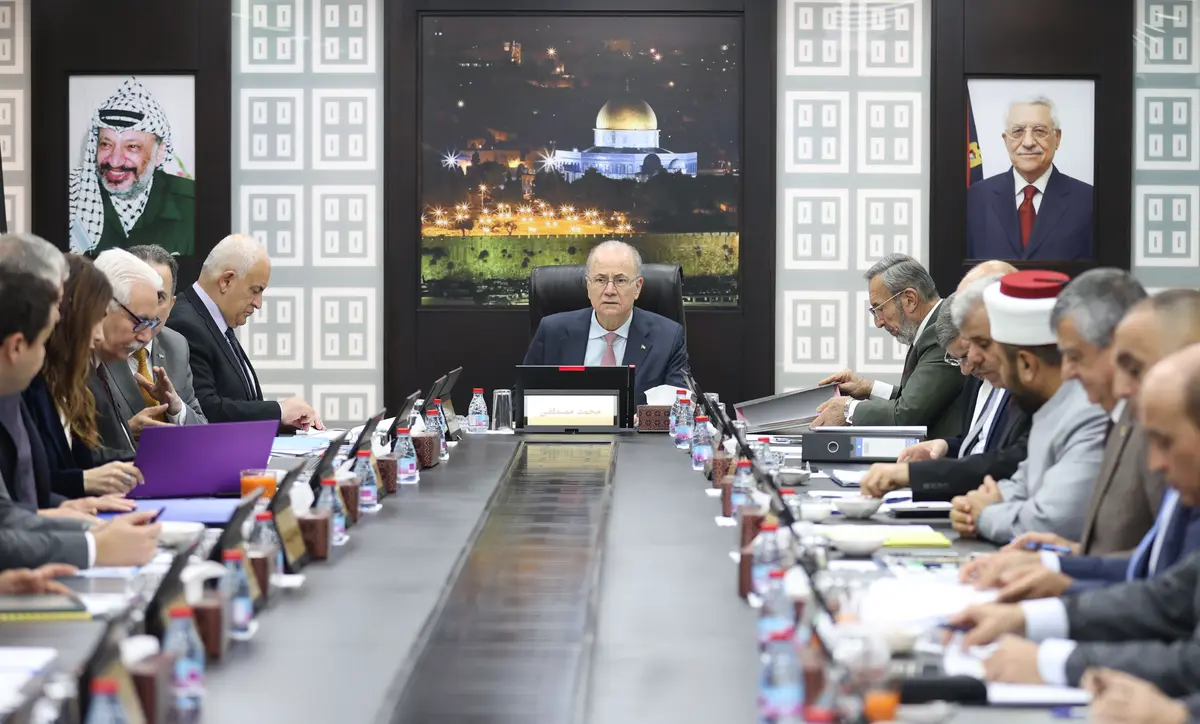







The Council of Ministers renewed its call on the international community to enforce international law to protect our people and stop the policy of collective punishment, especially the ongoing genocide in the Gaza Strip and the increasing number of deaths due to famine as a result of the occupation's closure of the Strip's crossings and the prevention of the entry of aid, in conjunction with the expansion of aggression against our people in various regions, especially the continued demolition operations in the Tulkarm and Jenin camps, and the widespread aggression, sabotage and attacks on citizens' property in the city of Nablus since dawn today.
In its weekly session held today, Tuesday, the Council directed the Ministry of Foreign Affairs, with all its missions and staff, to intensify its international efforts to pressure the occupation and its settlers to stop their crimes. This comes at a time when Palestinian diplomatic efforts continue, under the President's directives, to garner the greatest international support for Palestine at the international peace conference to be hosted by the United Nations in New York and led by Saudi Arabia and France next week. The conference will discuss executive mechanisms for the establishment of a Palestinian state and support for the Palestinian government and its programs.
In addition, Mustafa congratulated the Ministry of Labor, the Ministry of Foreign Affairs, the Palestinian Mission to the United Nations and international organizations in Geneva, and the General Federation of Palestinian Trade Unions for their efforts in obtaining the State of Palestine's membership as an observer member of the International Labor Organization, by consensus of the vast majority of the organization's members. He also extended his sincere thanks, on behalf of Mr. President, to all countries, especially the Arab Ministers of Labor, for their support and keenness to raise the representation of the State of Palestine in this international organization, and for their praise and confidence in the official Palestinian institution and government programs, especially since this membership will support the issues of Palestinian workers internationally, provide legal defense for them, and benefit from international labor agreements in the areas of training, qualification, and the creation of better job opportunities.
As part of the government's efforts to strengthen the national economy, and following the Cabinet's decision requiring the purchase of local products in government tenders, the Cabinet approved the formation of a national team comprising representatives from a number of relevant ministries and private sector representatives to establish standards to regulate the specifications and quality of imported goods and prevent dumping in the Palestinian market.
In addition, the Cabinet began discussing the preparation and implementation of strategic plans for a number of ministries and government agencies for the next three years, in line with the government's reform plans and programs to improve the quality of services provided to our people and develop national resources.
As part of the government's reform efforts, the Council approved the terms of reference for the standards and controls for government building projects and public facilities. This is intended to ensure that government buildings comply with international standards, while also taking into account the sovereign nature of the Palestinian people's culture and civilization. This will facilitate citizens' access to public services by consolidating them in government complexes.
The Council stressed the importance of protecting the social fabric and societal cohesion, particularly in light of the expanding scope of the comprehensive Israeli aggression against our people. It also emphasized the need to respect religious and national symbols and ensure that they are not offended, and that law enforcement agencies must fulfill their role in protecting the social fabric, pluralism, and respect.
The Council referred to the President a draft law amending the 1995 Press and Publications Law, which replaces the Ministry of Information with the Ministry of Culture, with the latter overseeing the media sector's requirements, particularly after its assignment to the Ministry of Culture. This step is important in promoting the Palestinian narrative and regulating the work of this broad sector.
The Council also commended the President for ratifying the Arab Agreement for Exporting Goods by Land Transport, highlighting the importance of this step in supporting Palestinian trade.
The Cabinet approved a memorandum of understanding between the Palestinian National School of Administration and the Tunisian National School of Administration.
He also approved a number of funding requests received from non-profit companies related to activities and programs to enhance the resilience of our people, including relief, treatment, and humanitarian programs.





Share your opinion
Palestinian Council of Ministers reiterates its call for the enforcement of international law to stop the policy of collective punishment against our people.