





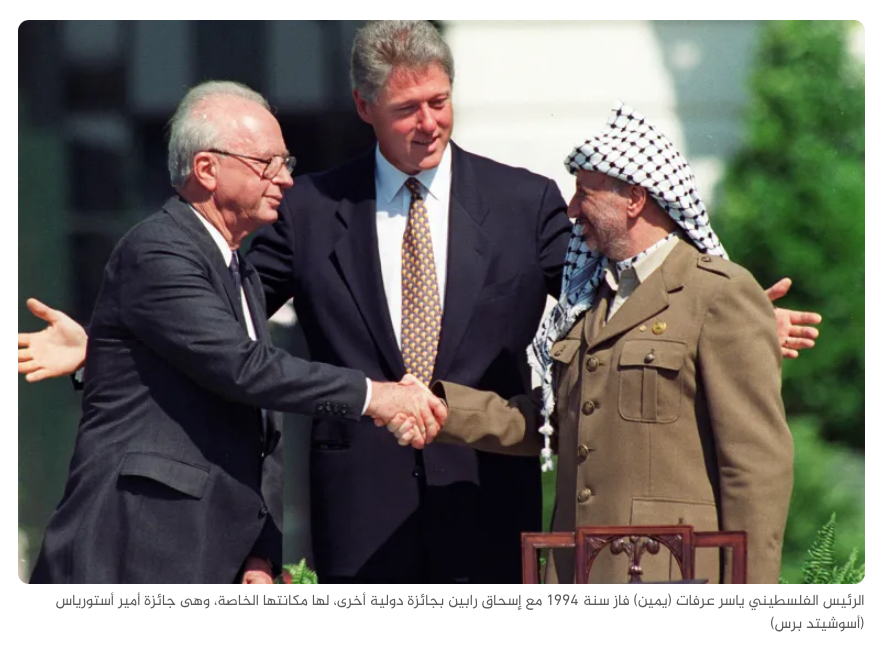
Many remember that the late leader Yasser Arafat shared the Nobel Peace Prize in 1994 with Yitzhak Rabin and Shimon Peres. However, few may remember that in the same year, he and Rabin won another prestigious international award: the Prince of Asturias Award.
Abu Ammar was thus the first Arab figure to be awarded this prestigious Spanish prize, which has been awarded since 1981 and honors prominent figures and institutions in the fields of communication, the humanities, scientific research, the arts, social sciences, literature, international cooperation, reconciliation, and sports. Arafat was honored that year in the International Cooperation category in recognition of their "decisive efforts to create conditions for peace, in accordance with the process initiated at the Madrid Conference in October 1991, which would lead to final peace in the Middle East."
The award came a year after the signing of the Oslo Accords between Israel and the Palestine Liberation Organization, which stipulated "an end to decades of confrontation and conflict, and the recognition of their mutual legitimate and political rights," and included several provisions relating to the structure and composition of the Palestinian Authority, and the establishment of a Palestinian transitional self-governing authority. The following year (1995), Arabs were present on the list of winners of the award in the "Reconciliation" category, which went to the Jordanian King Hussein in recognition of "his contribution to serving peace in the Middle East region," and in the field of sports, to the Algerian runner Hassiba Boulmerka in honor of her achievements in the middle-distance race at the World Athletics Championships in Tokyo (1991) and the Barcelona Olympic Games (1992).
King Hussein's honoring came in the same year that Jordan signed a peace agreement with Israel known as the Wadi Araba Treaty, with the aim of "achieving a just and comprehensive peace between the two countries based on Security Council Resolutions 242 and 338 within secure and recognized borders."
In 2002, the "Reconciliation Category" award was shared by Palestinian intellectual Edward Said (1935-2003) and world-renowned composer Daniel Barenboim, who "worked selflessly and competently to promote coexistence and peace" through artistic projects involving young musicians from Palestine and Israel.
Edward Said was a prominent figure in Arab and Palestinian culture, renowned for his criticism of Western Orientalism. Until his death in 2003, he remained one of the most vocal advocates of the Palestinian cause in Western media and academic circles, particularly in the United States, where he earned a doctorate from Harvard University and worked as a lecturer at Columbia University.
Edward Said's works cover a wide range of fields, encompassing disciplines such as political analysis, particularly those related to Palestinian affairs, both domestically and internationally, English literary criticism, and musicology. His writings also addressed the complex background of relations between East and West.
The last Arab winner of the award was in 2010, in the literature category. The Lebanese writer Amin Maalouf (born 1949) won because "his works, which have been translated into more than 20 languages, prove that he is one of the contemporary writers who have most deeply explored Mediterranean culture, which represents a symbolic space for coexistence and tolerance."
Maalouf previously won the Prix Goncourt, France's highest literary award, in 1993 for his novel "The Rock of Tanios." He has since received several other awards in recognition of his prolific and profound output, which combines narrative and long essays on contemporary issues such as identity and the clash of civilizations. Since 2023, Maalouf has served as Permanent Secretary-General of the Académie Française.
It is worth noting that the Prince of Asturias Award for Literature differs from the Cervantes Prize for Literature in the Spanish Language, which was established in 1976 and is considered "the most prestigious and rewarding award given to Spanish-language literature" and has been won by prominent writers from Latin American countries.
In the latest edition of this prestigious award, the Literature category was awarded to Spanish author Eduardo Mendoza, whose works have been translated into several languages and "usually set in Barcelona, are characterized by a style that combines elements of Gothic fiction, science fiction, and crime novels, as well as a deeply personal sense of humor, satire, and parody."
The award was known as the Prince of Asturias Award and is awarded by the Prince of Asturias Foundation (non-profit), headed by Felipe, Prince of Asturias, who was then Crown Prince of Spain. When he assumed power as Felipe VI in 2014, it was renamed the Princess of Asturias Award and is awarded by the Princess of Asturias Foundation, headed by Princess Leonor, daughter of King Felipe. From: Al Jazeera

ARAB AND WORLD
Mon 26 May 2025 10:04 am - Jerusalem Time
From Yasser Arafat to Amin Maalouf: Arabs who have won Spain's Prince of Asturias Awards
Tags
MORE FROM ARAB AND WORLD





Share your opinion
From Yasser Arafat to Amin Maalouf: Arabs who have won Spain's Prince of Asturias Awards