







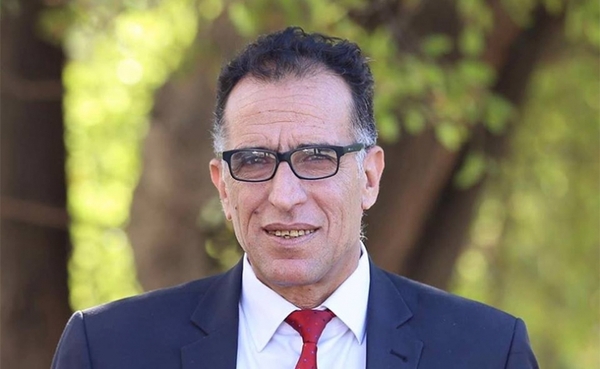
Yaniv Kubovich and Bar Peli
Content
Without proper procedures or a tender, a team headed by the prime minister's military secretary recruited an unknown and inexperienced company to coordinate humanitarian operations in the Gaza Strip. Although the company presented itself as American, Israeli elements were also behind it, and there also appeared to be a number of question marks.
On the surface, this was an innocent advertisement. A company working in coordination with the military was seeking partners to establish a site for distributing humanitarian aid in the Gaza Strip. There was basic information there: the expected operating hours, the location, and, of course, that the company had been selected by the countries mediating efforts to reach a ceasefire in the Gaza Strip. Three messages that appeared there caught the attention of aid organizations operating there: SRS – the American security company; the name of the operating company, completely unknown among those who have worked in the aforementioned profession for years; lacks experience in distributing humanitarian aid. And this is not exclusive to those working in the Strip. An investigation by Haaretz revealed that many sources in the security establishment, both current and former, were also surprised by the choice of the anonymous company. They were surprised, but not astonished.
This newsletter was distributed during March, in preparation for the start of work immediately after the conclusion of the first phase of the hostage deal, around mid-April. It has since become clear that the end of the first phase marked the end of the last, with Israel's return to fighting on March 18. But the issue of humanitarian aid distribution has remained relevant and has even intensified since then. The question marks surrounding the unknown company, which may begin operating this week, have not diminished; quite the contrary.
SRS was selected in a secret process, without a tender or exemption from tender, and in fact without going through the usual channels, including the Coordinator of Government Activities in the Territories (CGAT), the entity responsible for bringing in the aid to date. Overall, it emerged that the IDF and the Defense Ministry were completely excluded from the company selection process conducted by Major General Roman Goffman, military secretary to Prime Minister Benjamin Netanyahu. Haaretz has learned that businessmen drafted into the reserves alongside reserve officers now form the "Goffman team," which encouraged the selection of the anonymous company.
Several sources in the security establishment describe how the team in question managed contacts with the company, in meetings in Israel and abroad, and even approved the transfer of millions of shekels for "headquarters operations," all behind the backs of senior officials in the security establishment. Senior officials involved in the matter claimed to Haaretz that the contacts raised suspicions of inappropriate behavior and the personal interests of some of those involved. According to several sources, another name involved in the selection process was Shlomi Fogel, a businessman close to Netanyahu. In response to a query from Haaretz, Fogel himself denied any connection to the affair.
SRS describes itself as an American company. The people who head this company, including Phil Riley, a former senior CIA official, are also behind another company called Orbis, which already has some experience operating in Gaza. Its men were hired to secure the Netzarim road during the ceasefire, using "mercenaries" it employed. But Orbis also has another name—Security Solutions. On its website under that name, they have begun recruiting US Army veterans—those with at least four years of combat experience in security missions and humanitarian efforts. It states that priority will be given to Arabic speakers fluent in Egyptian, Jordanian, Iraqi, or Lebanese dialects.
The issue of exemption
The issue of humanitarian aid distribution has accompanied the war almost from its beginning. In fact, only a few weeks after the ground maneuvers in Gaza began, sometime in late 2023, the defense establishment began discussing the day after, when Israel would be obligated to provide aid. Too late, and in light of a series of incidents in which trucks were sabotaged, Palestinians killed, and Hamas looted the aid, international pressure mounted, and with it the need for the defense establishment to find a different solution to the method of distributing the aid that had been provided—one that has remained unchanged to this day.
At the time, Yoav Galant was the defense minister and had begun serving as chief of staff. As part of this effort, he received offers from two companies that presented themselves as capable of distributing aid to citizens. One was Australian, and the other was owned by an Israeli-American businessman named Moti Kahana. Kahana's company had gained experience assisting the US military in Iraq and Syria, as well as in Operation Good Neighbor in Syria, which treated wounded from the civil war there in Israel. Kahana submitted a detailed 28-page proposal. "Galant told me it sounded excellent," he told Haaretz. "He asked the army to start promoting it."
According to him, this matter has already progressed, and in June of last year, the Israeli military informed him that they were interested in two areas in the Gaza Strip: Beit Lahiya and Beit Hanoun. The pilot project will include the establishment of humanitarian spaces, where small teams will arrive to provide assistance. Each team will include a convoy of vehicles, as well as fighters carrying lethal and non-lethal weapons, to maintain order and prevent outbreaks. He said that the green light was given, and what's more, he was also asked if he could address the issue of security checks on the Netzarim axis. He replied in the affirmative - and then, surprise: communications had been frozen for several months.
Kahana says he contacted figures in the Israeli military and security establishment several times, and only last October was he finally asked to find an Israeli team to oversee the area. However, during a meeting on the matter with a senior reserve officer, he said it became clear to him that he was not the first to be "expelled." The same officer informed him that he had received a similar request from businessman Shlomi Fogel. He is not the only one to mention the name; numerous sources from the military, the security establishment, and humanitarian companies operating in the Gaza Strip—both past and present—confirmed that they were in contact with Fogel or someone on his behalf regarding aid distribution or inspections at the Netzarim corridor.
Weeks passed, and Kahana came across recruitment advertisements for the Gaza Security Forces, advertisements that did not belong to him. He recalls, "I began to see 96 people being recruited at a salary of $1,100 per day for 45 days." Orbis was responsible for these recruitments.
In the intervening period, two things happened. The first was the dismissal of Galant last November and his replacement by Israel Katz. The second was the departure of Netanyahu's military secretary, Avi Gil, and the appointment of Goffman in his place. Meanwhile, the issue of humanitarian aid, as well as the selection of the civil society group that would handle it, was transferred to the Prime Minister's Office. This move caught the Israeli military by surprise.
Goffman was familiar with this issue. Before being appointed military secretary, he was head of the government's operations headquarters in the territories, dealing with humanitarian aid. He then formed a team to coordinate all of the headquarters' activities, including two reserve recruits: Major Liran Tankman and Officer Yotam Hacohen. The former had started a startup whose company, Resilion, collapsed.
The second is the son of Major General (res.) Gershon Hacohen, founder and CEO of Dialog and OpenFox, companies that provide organizations with knowledge management systems. The company's clients include government ministries. "We had no idea who they were, but they had been present in the Southern Command for a long time," says a senior officer in the command. "They were fighting a war within the command, and as for the commander, Major General Yaron Finkelman, he made it clear that he wasn't involved in this issue, and that when they asked him for help, he would provide them with operational cover and that's it."
Among the senior officers involved from the outset were Brigadier General (res.) Erez Weiner and Colonel (res.) Gabi Siboni, two figures close to senior government ministers. Siboni, who participated in the final discussions between the Southern Command and the IDF, also appeared frequently on television and in several podcasts, expressing his support for the operation of civilian companies for the purpose of bringing in aid. Then, when Goffman accepted the new appointment and left the IDF Strategic Command, his team remained with him, but now under the command of Brigadier General Weiner, who was then head of the Southern Command's operational planning team (Wiener would later be dismissed after secret documents were removed from an army base and lost in a civilian parking lot).
Under Weiner's leadership, Goffman's team became an advisory group. Senior IDF and defense officials say that in closed discussions at the time, Weiner and Siboni "continuously pushed for the involvement of civil society in monitoring the return of Gaza residents to the northern part of the Strip, and that the issue of aid distribution should also be transferred to their responsibility," says a source involved in the discussions.
In those days, says a security source, senior officials in the security establishment began asking questions. “The feeling was that everything was happening behind the scenes and that no one knew anything,” he says. The IDF tried to find out whether there was a working arrangement with the selected company, who the candidates were, and what terms and responsibilities would be given to the winner. But those involved in the matter received no answers, only evasiveness. “Almost a year later, when they started talking about a hostage deal and it was clear they would reach a long-term ceasefire,” says the security source, “the need for civil society to enter Gaza resurfaced in the discussions.”
In general, the leadership felt uncomfortable with the advisory team's presence in the discussions and tried to exclude it, but Haaretz learned that a directive arrived from Jerusalem to allow the team members to continue participating. "It became clear to us very quickly that the company's issue and the contacts with it were being handled by the Prime Minister's Office, and that the person coordinating the issue in the office was Minister Ron Dermer," says a source familiar with the details. "From that moment, responsibility shifted to the Shin Bet security service—which was supposed to conduct all the tests—and to Dermer, who was assisted by the team Goffman had left behind in the Southern Command."
At some point, the security establishment realized that negotiations were underway with a company behind its back. "Wiener talked a lot about the need to contract with an American company that knew how to carry out these tasks," says the source involved in the discussions. "Everyone understood that there was a company here called Orbis, and that they wanted it to be awarded the project. This was something that had already been decided at the top. They were actually talking about when, not who or how."
In retrospect, it turns out that Tankman was sent to the United States, without the knowledge of the IDF and the Shin Bet, to meet with representatives of Orbis, even before he was selected. Sources familiar with the details estimate that this was done with Goffman's knowledge. But this wasn't the detail that surprised the Defense Ministry officials most. It came when they were asked to pay Orbis approximately NIS 3 million for a presentation to be prepared for representatives in Israel, all without being selected and without knowing that negotiations were taking place with other companies. Then one day, says one source, "Orbis employees show up in Israel and prepare to enter the Netzarim road to conduct inspections of people crossing from south to north in the Gaza Strip."
When they arrived, the security establishment was once again surprised: They didn't have any basic equipment or even uniforms. "A Shin Bet representative and an officer from the Southern Command took them to a clothing store and bought them all the equipment they needed," a Southern Command officer recalled. "People quickly began to wonder if this was appropriate for a company of the size they had presented to the army during discussions."
But there were other surprises. For example, during the inspection phase. Before the company's employees, including the Egyptian workers (who were assigned to conduct physical searches and interrogate the Palestinians), entered the Strip, they were supposed to undergo a Shin Bet inspection, like any civilian entering the Strip. But for reasons that remain unclear, they were not inspected by the General Security Service (GSS). Equally puzzling is that the GSS never investigated the company—not who was behind it, what its sources of income were, or what its previous experience was. At least not comprehensively (according to security sources, specific inspections were conducted in certain locations). "This makes no sense," explains an officer in the Southern Command. "There is no such thing as a company that doesn't receive approval from the GSS and that doesn't thoroughly check itself and its employees, especially when they arrive from Egypt."
The other issue is money. It's a lot, to say the least. Kahana estimates that the sum will reach $200 million every six months, and there's no doubt that this sum is no less. This figure doesn't help solve the mystery; it only deepens it. Certainly, given the fact that many details about the Orbis or SRS companies are difficult to find online. Senior officials in the Southern Command and the Defense Ministry also have difficulty determining their nature or their past. "To this day, it's not clear who these Americans are who run this company, and who the people they met with in Israel are," says a senior security source involved in the headquarters' work. What is known is that these companies are linked to each other, and are also linked to a seemingly anonymous non-profit organization—established in recent months in Switzerland—called the "Gaza Aid Fund" (GHF).
Israeli Ambassador to the United States Yehiel Leiter recently revealed in an interview published by Yedioth Ahronoth that Israel was a partner in establishing the fund. Leiter said, "We established, in cooperation with the United States—primarily the United States—a company composed of Special Forces veterans who participated in providing American humanitarian aid around the world, most recently in Haiti, and they also established a company that distributes aid in Gaza." In his remarks, Leiter shed light on what goes on behind the scenes at this organization, which has so far attempted to present itself as purely American.
Another aspect of the World Humanitarian Relief Foundation's apparent involvement in what is happening in Gaza is the views of the relief organizations currently operating there. Haaretz has learned that these organizations, as well as the United Nations, disavow the anonymous fund and have no intention of cooperating with it. Sources familiar with the matter say they doubt the fund's ability to act on behalf of the population of Gaza.
In light of all the question marks that have arisen and continue to arise, there is a growing sense among many in the security establishment that personal and economic interests are involved in this affair. These concerns are growing as the war continues, the humanitarian crisis in the Gaza Strip worsens, and the need for a new entity to undertake the task of providing aid to this part of the country grows. But if you ask Moti Kahana, he is convinced that the matter is already closed. He said he has accepted the fact that his company, whatever proposals it presents, has no chance of winning. “In fact, the company that will enter now is the same company that participated in the Netzarim harvest, Orbis, perhaps just under a different name,” a security source explained to Haaretz.
Ultimately, these are small companies within a larger corporation that provides a variety of services: food distribution, security, bomb disposal, and more. They claim to be an American company, but the IDF and the Ministry of Defense have never seen the Americans. Perhaps the Shin Bet and the Prime Minister's Office know this. We should ask them.
"Contrary to what is claimed, Shlomi Fogel is not affiliated with companies operating in Gaza," a representative for Shlomi Fogel said.
The IDF Spokesperson responded on behalf of Major General Roman Gofman: “In his previous position, Major General Roman Gofman served as Acting Chief of Staff of the IDF Joint Operations Command. All reservists who served under his command were duly drafted and received the necessary security clearances. In this role, the Major General, among other things, examined options for managing humanitarian aid in the Gaza Strip, including the possibility of integrating civilian security companies. All actions were carried out with approval and in accordance with procedures.
Today, in his role as Military Secretary to the Prime Minister, the General maintains direct and ongoing dialogue with all security agencies on a wide range of issues.
The Prime Minister's Office, the Shin Bet security service, and the Ministry of Defense declined to comment on the article. An Israeli military spokesperson declined to comment on the army's involvement.
“In a crisis of this magnitude, it’s no surprise that things move quickly, evolve over time, and remain dynamic. This is the reality when working urgently to save lives in a massive humanitarian crisis. To succeed in the mission of feeding the people of Gaza, we must be flexible, agile, and adapt quickly,” the Global Relief Foundation (GHF) stated. They added that at this stage, “GHF is an independent organization operating according to its own plan: establishing safe distribution sites and expanding them to reach all of Gaza.”
Share your opinion
Haaretz investigation: The Prime Minister's Office chose a party to distribute aid in the Gaza Strip behind the back of the security establishment.