






When US President Joe Biden took office three years ago, he announced in an enthusiastic tone that “America is back!” To assume its international responsibilities after the isolationist policy pursued by his predecessor, Donald Trump, but Washington finds itself today in increasing international isolation. Because of its firm support for "Israel" in its war on Gaza.
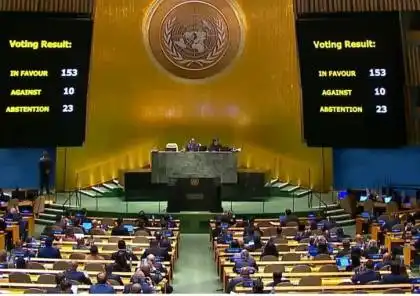
Since the war began on October 7, Washington has more than once been forced to stand alone in international forums to defend its ally.
In the UN Security Council, for example, the United States used its veto power twice in a row to prevent the issuance of two resolutions calling for a “humanitarian ceasefire” in the Palestinian Strip.
However, on Friday, the most powerful country in the world emerged timidly from its isolation in the UN Security Council by deciding not to support a resolution calling for the introduction of “large-scale” humanitarian aid into the Gaza Strip.
Contrary to the position taken by some of its closest allies, such as Britain, France, and Japan, which voted in favor of the resolution, the United States abstained from voting.
A week before that, in the United Nations General Assembly, the United States found only Austria and the Czech Republic among its other European partners to vote against a resolution calling for a ceasefire in the Gaza Strip. This situation continues to have a negative impact on the image of the United States in the world.
Leslie Vinjamuri, an expert at the Chatham House Research Center in London, says: “The way all this is viewed in the rest of the world is that the United States cares about the Israelis and the Ukrainians,” and pays less attention to non-Western peoples.
Unlike his Republican predecessor, who supported “Israel” without any reservation, Biden lost his patience more than once with the Hebrew state, to the extent that he brought his differences with the government of Benjamin Netanyahu to public.
In his defense of the war that Israel is waging, US Secretary of State Anthony Blinken urged the world to put pressure on Hamas and not just the Hebrew state, reminding that the fuse of this war was lit by Hamas.
US administration officials repeatedly say: The pressure they are exerting on the Israeli government behind the scenes is bearing fruit, as the Hebrew state agreed to allow fuel tankers to enter Gaza, restore Internet service to the Strip, and open the crossings.
But Vinjamuri says; This narrative that Biden “hugs Netanyahu while pressing in secret” will not hold true for long.
"Total bias"
An opinion poll conducted by the Independent Organization on a sample of Arab people, the results of which were published at the end of November, showed that only 7 percent of those polled believed that the United States’ role in the war on Gaza was positive.
Twenty years ago, the invasion of Iraq damaged the reputation of the United States in the world.
Munqith Dagher, an official in the Al-Mustaqla organization, says: Until recently, America “still represents this image, of a country that embodies (...) democracy, human rights, freedom of expression (...), and many values that befit the famous American dream.”
But the torrent of horrific scenes from Gaza, circulated en masse on social media, “turned the situation upside down,” he added.
Dagher considers that this showed the Arabs "the United States' complete bias toward the Israelis, and their lack of respect for human rights when it comes to the Palestinians."
The first to benefit from this shift in public opinion were China and Russia, but the most prominent beneficiary was Iran.
China has greatly intensified its diplomatic efforts in the region, but the Biden administration has besieged it by urging it to use its influence with Tehran to stop attacks launched by the Houthis, from areas under their control in Yemen, on commercial ships in the Red Sea. While China has a limited military presence in the Middle East, the United States has recently established a military alliance to protect ship traffic in the region.
Brian Katulis, from the Middle East Research Institute, says: Many of the Arab countries that denounce Washington's foreign policy "are the same ones that benefit from the security system established by the United States."
He adds: "I notice a certain form of schizophrenia in many of the statements coming from the Arab world. They cannot live with us, but they cannot live without us either."


Share your opinion
Washington faces increasing international isolation due to its steadfast support for “Israel”