





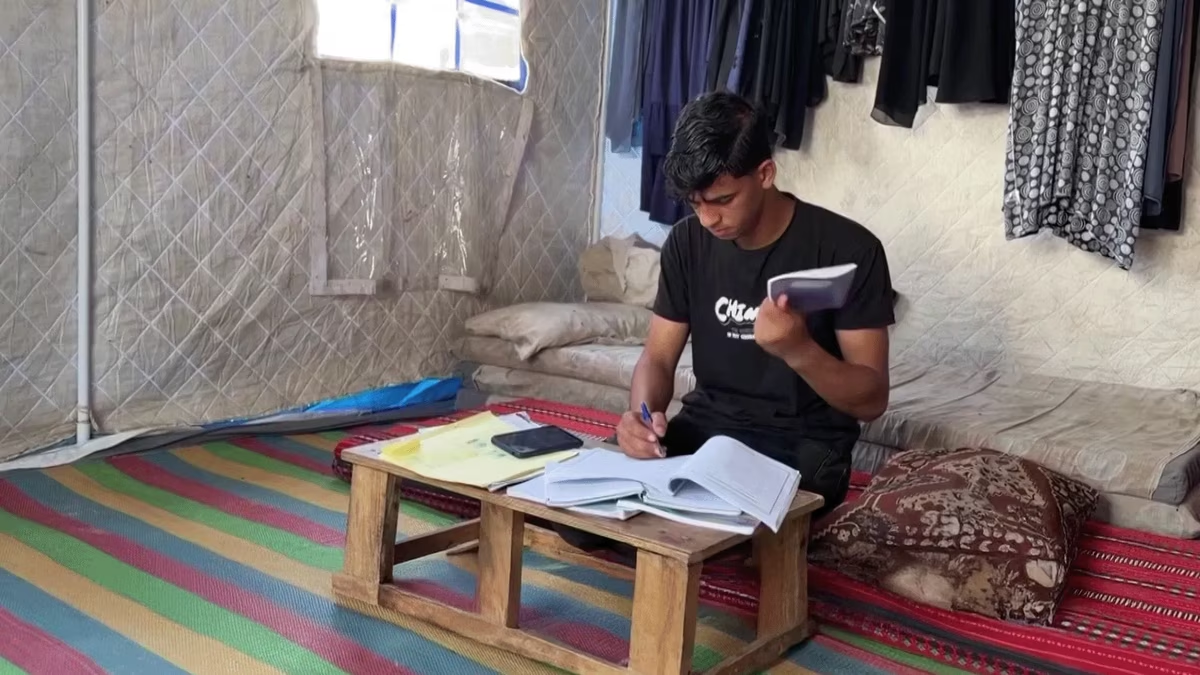
Tens of thousands of high school students in Palestine are preparing for their final exams under exceptional circumstances imposed by the ongoing aggression. Students in the Gaza Strip face a bitter reality that forces them to seek virtual examination halls in cafes and tents. These students lack traditional seat numbers and known school addresses, replaced by anxiety and the search for a stable internet signal and a power source to ensure they can take their exams via the electronic system.\n\nStudent Suwar Mohammed, displaced in Deir al-Balah, embodies the tragedy of an entire generation that has not set foot in regular schools for three years. After her home in Gaza City was destroyed, a tent became her only study place, lacking the basic elements of quiet and privacy amidst the intense drone surveillance that never leaves the sky, putting students' nerves on constant alert hours before the fateful exams begin.\n\nIn the town of Al-Zawaida, student Tala Affana lives a daily struggle with noise and explosions that deprive her of concentration at night. Tala, who lost her father and home at the beginning of the war, insists on continuing her education despite having to walk long distances, up to 6 kilometers daily, to reach rudimentary educational centers, trying to maintain her academic excellence for which she was known before the outbreak of hostilities.\n\nStudent Abdullah Nour expresses his concern about technical obstacles that could undermine years of self-study. Abdullah, who was displaced from the Shuja'iyya neighborhood after his home was destroyed, had to print educational materials at his own expense and rely entirely on his mobile phone. He now fears a sudden internet outage in the middle of the examination process, which could threaten his university future.\n\nIn contrast to this determination, stories of brokenness and oppression emerge. Student Hamza Abu Bayd decided not to take the exams this year, feeling unprepared. Hamza, who replaced school desks with arduous tasks of securing water and firewood for his family, believes that the conditions of displacement and forced labor in bakeries have robbed him of his right to education and made studying a luxury he cannot afford.\n\nFor its part, the Ministry of Education and Higher Education confirmed the completion of all arrangements for holding the exams, stating that the total number of applicants reached about 91,000 male and female students. The ministry indicated that exams would be held in person in the West Bank, while the field conditions in the Gaza Strip necessitated the adoption of a fully electronic system for the period from June 20 to 29.\n\nOfficial sources reported that the ministry conducted experimental tests to simulate the electronic system in Gaza to ensure technical issues were addressed before the official launch. However, the biggest challenge remains the students' ability to access the internet amidst the widespread destruction of infrastructure and the complete reliance on personal initiatives and public cafes to provide network connectivity.\n\nStatistics issued by the ministry indicate the scale of the catastrophe that has befallen the education sector, with more than 21,000 students and educational staff martyred since October 2023. These figures reflect the enormity of human losses affecting the high school generation, with estimates indicating the martyrdom of about 4,000 students who were supposed to be in examination halls today.\n\nIn the West Bank, exams continue until July 8 in regular classrooms, with technical teams providing support to students. Despite relative stability compared to Gaza, the occupation prevented 65 students from taking exams due to their continued detention in prisons, adding another dimension to the suffering of Palestinian students under occupation.\n\nStudents in Gaza rely entirely on PDF files and digital materials stored on their phones, in the absence of paper textbooks and notebooks. This forced shift towards digital education was not a choice but a necessity imposed by the siege and the destruction of printing presses and educational warehouses, making mobile phone charging a difficult daily task preceding studying.\n\nBereaved families in Gaza remember their children who passed away before achieving their academic dreams, such as the brilliant student Omar Nour, who was martyred while studying on his mobile phone. These stories cast a shadow of sadness over the exam atmosphere, as survivors proceed, carrying the wills of their colleagues who perished under the rubble, trying to snatch success from the heart of the tragedy.\n\nEducational sources confirm that the success of this exam session in Gaza represents a challenge to policies aimed at keeping the Palestinian generation ignorant and destroying its future. Despite the absence of direct institutional care within the Strip, the individual will of students and their families remains the primary driver for the continuation of the educational process at any cost, even if it is from inside a displacement tent.\n\nConcerns about "technical glitches" remain the biggest worry for applicants in Gaza, as any server malfunction or coverage interruption could mean the loss of an entire academic year. Families appeal to international bodies to provide protection for facilities that offer internet services to students during this sensitive period to ensure exams proceed without obstacles.\n\nThe sight of students spread out on the ground in cafes and tents, holding their phones to take fateful exams, will remain a testament to a harsh historical phase in the life of the Palestinian people. It is a battle of awareness and survival fought by the high school generation in Gaza, affirming that the desire to learn transcends the limits of destruction, displacement, and systematic killing.\n\nThe mobile phone has become the school, the desk, and the library; there are no paper books or notebooks, just digital files exhausted by the continuous search for a means of charging and an internet signal.

الأحد 21 يونيو 2026 7:48 صباحًا - بتوقيت القدس
Exams Amidst Rubble: Gaza Students Face High School Exams in Cafes and Tents
شارك برأيك
Exams Amidst Rubble: Gaza Students Face High School Exams in Cafes and Tents