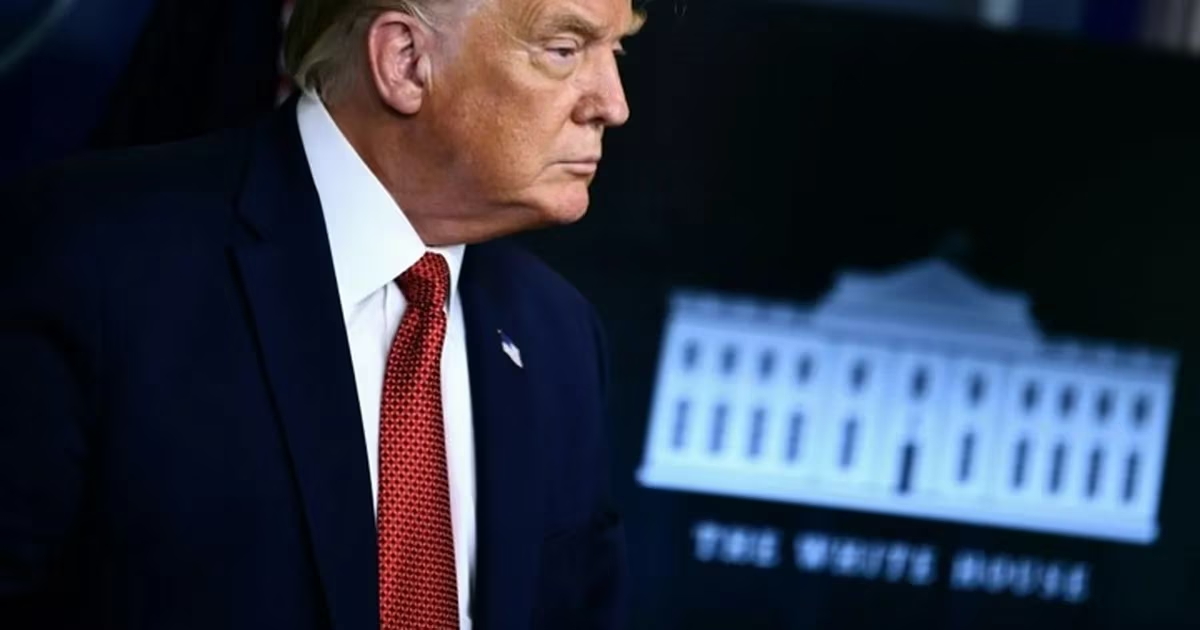







Hebrew press reports indicate that US President Donald Trump finds himself today mired in what they described as the 'Middle East quagmire,' after one hundred days have passed since the outbreak of military confrontation in which the United States is participating alongside Israel against Iran. These developments contradict Trump's electoral promises to avoid bloody conflicts in the region at all costs.
In recent days, Trump has tried to demonstrate his full control over the course of political and military events, stating in a press interview that he is the ultimate decision-maker in Washington. Trump affirmed that the Prime Minister of the occupation, Benjamin Netanyahu, will find himself compelled to accept the formula that the US administration is preparing for an agreement with Tehran, emphasizing that Tel Aviv's options have become limited.
However, the realities on the ground imposed a different rhythm, as the US President was forced to issue urgent appeals via social media platforms demanding an immediate ceasefire between the two parties. These calls came in the wake of an escalation on the ground that revealed the difficulty of controlling the pace of direct confrontation between Tehran and Tel Aviv, putting American credibility on the line.
In a related context, international press sources indicated that the war, which began on February 28, has clearly started to show the limits of American military power in the region. Despite periods of tactical calm, the strategic dilemma persists without a clear horizon for resolution, amid ongoing major security challenges.
Washington faces a tangible failure in imposing a counter-naval blockade on Iranian ships, which has enabled Tehran to impose an effective closure of the vital Strait of Hormuz to navigation. Strategic experts warn that this field failure could translate into a harsh diplomatic defeat for the United States, weakening its influence in other international issues.
For his part, Trump defended his policy in recent media interviews, denying that he had backed down on his promises to end 'endless wars.' He described the current conflict as merely a 'short trip' that would soon end, but security reports confirm that Iranian capabilities exceeded the US administration's expectations, leading to the dissipation of illusions about a quick resolution to the conflict.
The crisis of dwindling US ammunition stockpiles stands out as one of the most dangerous repercussions of this confrontation, as it has begun to directly affect America's deterrent capability on other fronts such as Europe and Asia. Analysts believe that the depletion of military resources in the Middle East weakens the US position against rival great powers and creates security vulnerabilities in vital spheres of influence.
Regarding bilateral relations, sources revealed a sharp and personal tension between Trump and Netanyahu, reaching the point of exchanging insults in closed phone calls. The reason for this American anger stems from the large-scale Israeli military operations in Lebanon, which Trump believes complicate his efforts to reach a comprehensive settlement with the Iranian side.
Despite the pressures exerted by the White House on the Israeli government, which is politically dependent on Washington, the US administration has not yet succeeded in extracting any substantial concessions from Tehran. This stalemate places Trump in a complex political dilemma, as no easy exits are in sight that would preserve the US administration's face.
At the conclusion of a media meeting with press sources, Trump showed clear irritation with questions addressing the possibilities of Netanyahu rebelling against American wishes. When asked if he would support Israel if it decided to return to war against Iran unilaterally, the US President abruptly ended the interview, evading a clear answer about future scenarios.
I make all the decisions, and Netanyahu will have no choice but to accept the agreement we are preparing with Tehran.
شارك برأيك
One Hundred Days of Confrontation: Trump Faces a Strategic Dilemma in the Iran-Israel Conflict