






By: Said Arikat
May 6, 2026
News Analysis
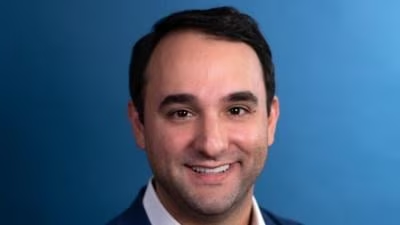
Washington, D.C-The quiet insertion of a senior operative from the Foundation for the Defense of Democracies (FDD) into Donald Trump’s Iran negotiating team is not a routine staffing decision. It is a revealing moment—one that exposes the deeper ideological architecture driving U.S. policy in the Middle East. Nick Stewart’s appointment to Steve Witkoff’s team signals not a turn toward diplomacy, but a consolidation of a long-standing agenda rooted in confrontation, coercion, and alignment with Israeli strategic priorities.
To understand the significance of this move, one must first confront what FDD is and what it represents. Established in the aftermath of 9/11, the organization has consistently positioned itself as a hardline advocate for militarized U.S. foreign policy in the Middle East. Critics have long argued that FDD functions less as an independent think tank and more as an ideological extension of Israeli security doctrine. Its intellectual framework has repeatedly mirrored the priorities of successive Israeli governments, particularly in its uncompromising stance on Iran and its rejection of Palestinian political claims.
Beyond its policy advocacy, FDD’s influence is inseparable from the network of donors who have sustained and amplified its reach. Chief among them was the late casino magnate Sheldon Adelson, alongside his wife Miriam Adelson. Adelson, until his death in 2021, was one of the most prominent financial backers of hawkish pro-Israel causes in Washington, and a central figure in Republican political funding. Miriam Adelson has since carried forward that role, emerging as one of Donald Trump’s most significant donors in the 2024 presidential election cycle. Their financial support has not only underwritten institutions like FDD but has also helped align political power, policy advocacy, and ideological messaging in ways that continue to shape U.S. Middle East policy at its highest levels.
This alignment has had tangible consequences. During Trump’s first term, FDD played a pivotal role in shaping some of the most consequential—and controversial—decisions in modern U.S. Middle East policy. Chief among these was the relocation of the U.S. embassy from Tel Aviv to Jerusalem in 2018. While presented as a recognition of “reality,” the move effectively endorsed Israel’s unilateral claim over the contested city, disregarding decades of international consensus and diplomatic precedent. FDD figures were among the most vocal proponents of this shift, lobbying aggressively within the administration and framing it as both strategically necessary and morally justified.
The embassy move was not an isolated act. It was part of a broader policy package that systematically dismantled the already fragile infrastructure of U.S.-Palestinian engagement. The closure of the American Consulate in East Jerusalem—an institution that had operated for more than 130 years as a direct channel to Palestinians—was another decisive step. Its absorption into the newly relocated embassy symbolized the erasure of a distinct American diplomatic presence in Palestinian affairs. Once again, voices aligned with FDD supported the move, arguing that separate diplomatic tracks for Israelis and Palestinians were unnecessary—a position that effectively denied the political reality of occupation.
Equally consequential was the Trump administration’s decision to cut off all U.S. funding to the United Nations Relief and Works Agency for Palestine Refugees (UNRWA). This move targeted one of the most critical lifelines for millions of Palestinian refugees across the region. FDD had long campaigned against UNRWA, portraying it as an obstacle to peace rather than a humanitarian necessity. The funding cut not only exacerbated an already dire humanitarian situation but also aligned with a broader effort to redefine—and ultimately diminish—the Palestinian refugee issue itself.
Against this backdrop, Stewart’s appointment takes on a deeper meaning. It suggests continuity, not change. It indicates that the same ideological forces that shaped Trump’s earlier Middle East policies are once again asserting influence—this time in the context of escalating tensions with Iran.
The timing is particularly telling. Reports indicate that Iran has submitted a proposal aimed at de-escalation and a potential end to hostilities within 30 days. Yet Trump’s response has been dismissive, framing the proposal as insufficient and reiterating a preference for continued pressure. The inclusion of an FDD figure in the negotiating team reinforces the perception that diplomacy is not the primary objective. Instead, the goal appears to be the maintenance—and intensification—of a pressure campaign designed to weaken Iran economically and strategically.
This approach is consistent with FDD’s long-standing advocacy. The organization was a key supporter of the U.S. withdrawal from the Joint Comprehensive Plan of Action (JCPOA) in 2018, a move that dismantled a functioning multilateral agreement in favor of a “maximum pressure” strategy. The results of that strategy are now evident: increased regional instability, accelerated Iranian nuclear activity, and a near-total collapse of diplomatic trust.
What makes the current moment particularly dangerous is the convergence of ideology and power. When a think tank with a clear and consistent bias toward confrontation gains direct access to policymaking, the line between analysis and advocacy becomes blurred. Policy is no longer shaped by a balance of perspectives but by a singular worldview—one that sees compromise as weakness and diplomacy as concession.
The broader implications extend beyond Iran. They speak to the erosion of U.S. credibility as a neutral actor in the Middle East. Decisions such as the embassy move, the consulate closure, and the UNRWA funding cut have already signaled a departure from even the pretense of balance. The re-emergence of FDD’s influence risks further entrenching this perception, making it increasingly difficult for the United States to function as an effective mediator in regional conflicts.
Moreover, the reliance on ideologically aligned institutions raises fundamental questions about the policymaking process itself. To what extent are U.S. foreign policy decisions being driven by national interests, and to what extent are they shaped by external agendas and lobbying networks? The case of FDD suggests that these lines are increasingly difficult to distinguish.
In the end, Stewart’s appointment is not just about one individual or one negotiation team. It is about the persistence of an approach that prioritizes pressure over dialogue, alignment over independence, and ideology over pragmatism. If history is any guide, this path is unlikely to produce stability—let alone peace.
Instead, it risks repeating the same cycle: escalation, isolation, and missed opportunities for diplomacy. And in a region already burdened by decades of conflict, that is a cost the world can ill afford.
شارك برأيك
The Ideology Behind the Policy: How FDD’s Worldview Is Shaping Trump’s Iran Strategy