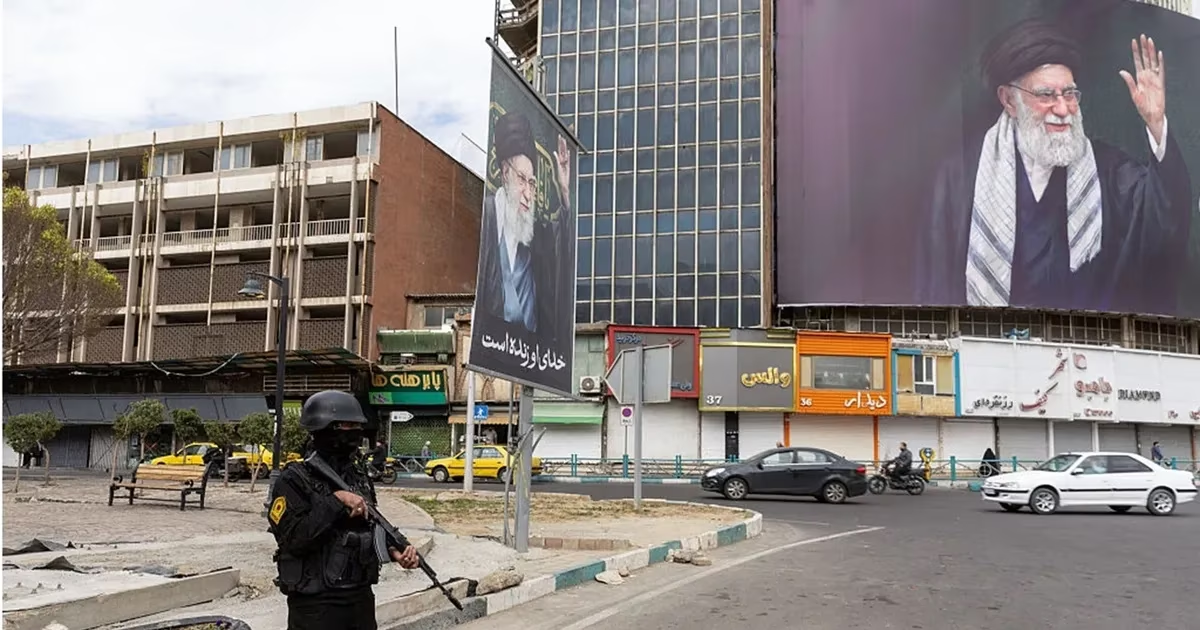







Traditional rules of warfare suggest the necessity of maintaining room for maneuver and negotiation, yet the recent American step of assassinating Iranian Supreme Leader Ali Khamenei has burned all bridges of return with Tehran. This dramatic development transcends the concept of changing political regimes, entering into a conflict of identity and religious symbols that constitute the essence of the Iranian state.
Khamenei is not merely the head of the power pyramid who can be replaced in 'day after' arrangements; rather, he is the highest religious and moral authority who holds a special sanctity among followers of the Shiite doctrine. His shrine and his status in the Iranian consciousness make targeting him an act that touches national and religious dignity, which fundamentally differs from other political models the world has witnessed.
America's interpretation, which attempted to apply the Venezuelan model to the Iranian situation, is a form of excessive political naivety, given the fundamental differences in culture and social structure. Iran possesses a human depth three times the population of Venezuela, in addition to a military arsenal and defensive capabilities that make direct confrontation an unsafe gamble with unpredictable consequences.
Iran's response was swift and violent, targeting American interests in several Gulf capitals simultaneously, reflecting Tehran's desire to expand the conflict. This field escalation sends a clear message that the Iranian leadership has nothing left to lose after targeting its primary symbol, which places the region on the brink of a volcano.
The decision to close the Strait of Hormuz represented the peak of Iranian escalation, aiming to strike the vital arteries of the global economy and pressure the international powers standing by. This step means transforming theoretical threats into a tangible reality that threatens global energy supplies and confronts the international community with serious and unprecedented economic and security challenges.
In contrast, the American administration is suffering from clear confusion in managing the crisis, as domestic support for President Trump's decisions has begun to decline due to fears of sliding into an all-out war. This confusion in Washington fuels a state of uncertainty among international allies who are watching the scene with great concern for their strategic interests.
The Gulf states find themselves in a critical situation, as trust in the American security umbrella has vanished, which did not prevent the sparks of conflict from reaching their territories despite the presence of military bases. The targeting of vital interests in the region proves that no party is immune from the repercussions of the major military explosion caused by the American move.
Observers raise urgent questions about the real motives behind Trump's decision, and whether he realized the size of the fireball he unleashed in the region. Some believe that the recklessness in making such fateful decisions may be an attempt to escape internal pressures or thorny personal issues plaguing the president in Washington.
Exhausting the Gulf states and plunging Europe into a dark economic tunnel seems an inevitable consequence of the continued military escalation without a horizon for a solution. Nevertheless, the White House insists on showing strength to avoid admitting falling into the trap of a long-term war of attrition whose end or human and material cost cannot be predicted.
History teaches us that wars, no matter how fierce, always end at the negotiating table, but the price paid by peoples in blood and destruction cannot be compensated. Decisions that prioritize individual and power interests over human security always lead the world to humanitarian disasters that could have been avoided by adopting the language of reason and diplomacy.
Millions today live under the weight of terror and imminent danger as a result of the absence of political wisdom and the triumph of the logic of force over the logic of international law. Turning the region into an arena for settling personal and political scores reflects a decline in the diplomatic values that once governed relations between major powers and regional powers.
The question remains about the ability of the international community to intervene to curb this accelerating deterioration before the conflict reaches a point of no return. The current American confusion may push other parties to intervene, transforming the conflict from a bilateral confrontation into a widespread regional war that consumes everything in its path.
Comparing what is happening today with previous wars that Trump criticized and described their presidents as 'stupid' puts the American president's credibility to the test before his voters. Involvement in a conflict with a country the size of Iran and its capabilities requires a clear strategy, which seems completely absent from the current scene full of recklessness.
Ultimately, the cannons will one day fall silent, and everyone will sit down to find a way out, but the wounds left by the assassination of a religious and political symbol will remain deeply etched in Iranian memory. The cost of peace after this escalation will be very high, and may require concessions that Washington could not have imagined making before taking this suicidal step.
Khamenei's assassination is not merely the end of a political authority, but an affront to a religious symbolism and dignity that is non-negotiable in Iranian custom.
شارك برأيك
Repercussions of Khamenei's Assassination: Has Washington Burned the Bridges of Return with Tehran?