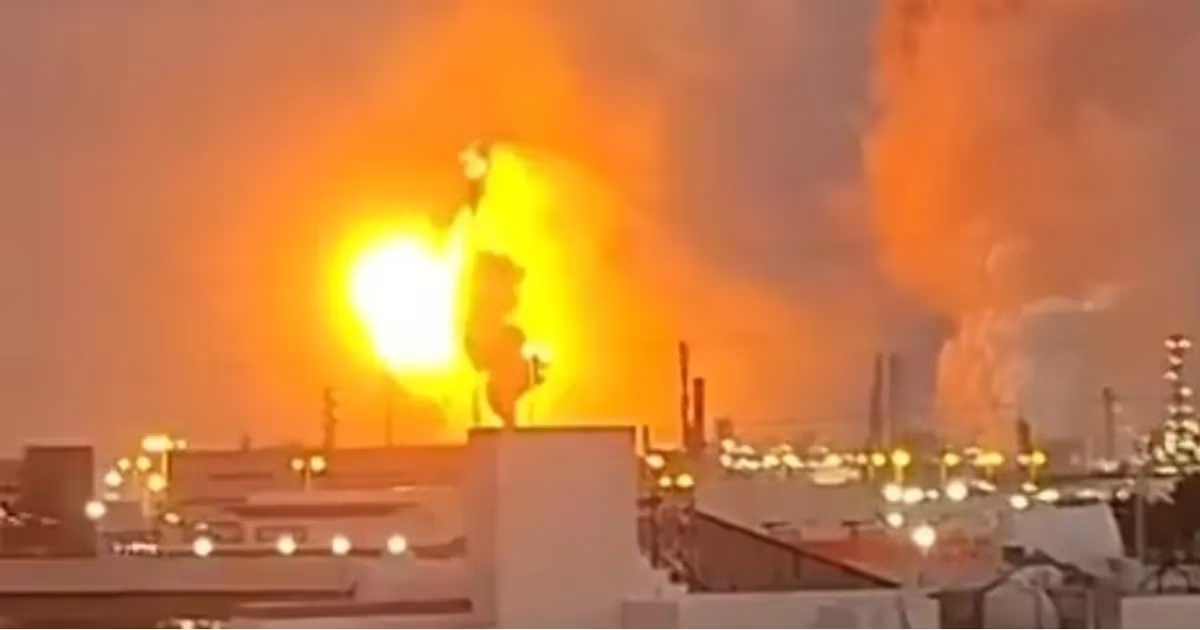







The Middle East region is witnessing an unprecedented escalation in military tension, driven by a series of American and Israeli strikes that targeted Iranian territory in recent days. This dramatic shift clearly reflects the transition of active powers from traditional deterrence strategies and crisis containment to a phase of actual and direct engagement in field military operations.
The biggest challenge in this escalation lies in the possibility of military operations expanding to include the Arab Gulf states, which could transform the entire region into an open regional war zone. The nature of the reciprocal targets indicates that the confrontation is no longer confined to specific geographical points but now threatens regional stability as a whole.
Today, the Gulf states find themselves in a highly sensitive and complex position within the current conflict equation, given that they host American military bases and vital strategic facilities. These facilities represent an essential part of the military infrastructure of the Western presence, making them potential targets in any scenario of expanding the scope of Iranian retaliation.
In addition to the military dimension, the geographical location of the Gulf states plays a crucial role in increasing the level of risks, as these countries are located on the direct line of contact with Iran. This proximity makes Gulf territories vulnerable to the direct security repercussions of any large-scale military explosion, whether through missiles or drones.
These facts place Gulf capitals under immense political and security pressure to choose between engaging in the confrontation or taking more severe stances towards Tehran. However, any slide towards military participation could lead to the transformation of Gulf cities and facilities into a direct theater of combat operations, a heavy price these countries seek to avoid.
The risks of dragging the Gulf into war are not limited to military aspects but extend to include existential threats to global economic security. The region is the main artery for energy production and export, and any widespread security disruption will inevitably lead to a paralysis in the flows of oil and gas to international markets.
The Strait of Hormuz stands out as one of the most critical points in this conflict, representing the most important waterway for global trade and energy. Any threat to the security of navigation in this strait would mean the global economy entering a dark tunnel of successive crises and a crazy rise in fuel prices.
Ambitious economic visions of the Gulf states fundamentally depend on sustainable regional stability to attract foreign investments and stimulate trade. Therefore, the outbreak of armed confrontation will erode confidence in the region's investment environment, threatening major development projects that have been planned for years.
By reading Tehran's behavior in recent responses, it is clear that it is still trying to keep the confrontation within calculated and limited rules of engagement. This Iranian strategy aims to send strong deterrence messages to the United States and Israel without fully sliding into an all-out war whose end cannot be predicted.
Under these circumstances, a collective Gulf stance becomes a crucial factor in curbing escalation and preventing the situation from exploding. Adopting policies based on extreme caution and self-restraint in dealing with mutual provocations represents the only safety valve to prevent limited strikes from turning into a major regional war.
Wisely managing the crisis requires the region's countries to strike a delicate balance between their security commitments with international allies and the necessity of preserving their national security. Mutual escalation could open doors to confrontations that are difficult to contain later, making preventive diplomacy an urgent necessity at present.
Wars in this geographical part of the world do not remain confined to military borders but quickly turn into humanitarian and economic crises that cross continents. Therefore, the stability of the Gulf is not just a local matter but a fundamental pillar of international peace and security in light of global economic interdependence.
Analysts confirm that the real danger at the current stage goes beyond mere mutual military strikes between the three main parties. The danger lies in the 'rolling dynamic' that may force other parties to enter the conflict in defense of their interests or territories, thus expanding the circle of fire.
In conclusion, avoiding being drawn into direct confrontation remains the most prominent challenge for leaders in the region to prevent the Middle East from turning into an international conflict arena. The cost of war in the Gulf will be very high at all levels, making de-escalation the only rational path to overcome this critical stage.
The real danger is not only in mutual strikes but in the possibility of the confrontation turning into a comprehensive regional conflict in which the Gulf states find themselves at its heart.
شارك برأيك
Risks of Regional Confrontation Escalation: Will Gulf States Be Drawn into War?