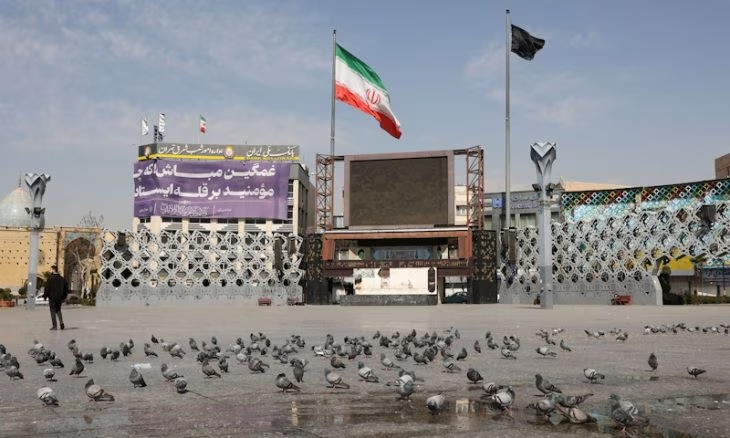







International efforts aimed at bringing about a radical change in the structure of Iranian rule face complex challenges, foremost among them the state of fragmentation experienced by opposition forces. Despite the launch of extensive military and security operations by the United States and Israel, including the elimination of the Supreme Leader of the Islamic Republic, the absence of a unified vision for the future remains the biggest obstacle for forces aspiring to overthrow the regime.
US President Donald Trump, coinciding with the launch of 'Epic Fury' operation, called on the Iranian people to take direct action to seize the reins of power. However, the US administration began sending mixed signals, with official sources clarifying that overthrowing the regime itself might not be the absolute priority at the moment, compared to the necessity of ensuring stability and preventing widespread chaos.
Political analysts believe that the fundamental question is not limited to the desire for regime change, but rather to what extent the absence of supreme leadership can cause a complete institutional collapse. Informed sources indicated that the vacuum left by the Supreme Leader may not necessarily lead to the fall of the state, especially given the presence of security and military forces that still hold their positions.
On the part of the opposition abroad, Reza Pahlavi, son of the former Shah of Iran, stands out as one of the figures trying to present himself as a legitimate alternative to the current authority. Despite the support he enjoys in some Western circles and among segments of protesters, his father's authoritarian legacy and his current proximity to Israel raise widespread reservations among ethnic minorities and liberal forces.
In contrast, the People's Mojahedin Organization of Iran continues its activities under the slogan 'Neither Shah nor Mullahs,' considering itself the most organized and capable force to lead the transitional phase. However, the organization in turn faces widespread popular rejection within Iran, as a result of its history of fighting alongside Iraq during the 1980s war, which makes it a highly polarizing party.
Experts on Iranian affairs confirmed that the opposition is now more polarized than ever, despite repeated attempts to hold unifying conferences in European capitals. These initiatives failed to formulate a national charter that brings together monarchist, leftist, and nationalist forces, which weakened the momentum generated during the 'Woman, Life, Freedom' protests.
US President Donald Trump appears to be inclined to search for a leading figure from within Iran instead of relying entirely on the exiled opposition. Trump stated that figures residing inside the country, who enjoy popularity or relative moderation, may be more capable of managing political transition and ensuring that the mistakes of the 2003 US invasion of Iraq are not repeated.
Most external opposition groups lack extensive operational networks and the actual ability to mobilize the street inside Iran in an organized manner. This structural weakness prompts international powers to consider elements from within the existing regime, who may defect or show flexibility in negotiations, as a more realistic option than betting on fragmented forces.
Human rights reports indicate that the violent repression practiced by Iranian authorities in recent years has resulted in the killing of thousands, generating great popular resentment. However, this anger still lacks the leadership that can transform spontaneous protests into a comprehensive political project capable of taking the initiative.
Reza Pahlavi previously called for international intervention to support the Iranian people, warning that waiting could lead to more bloodshed. But his calls were met with mixed reactions, as a large segment of Iranians fear that external military intervention could destroy the country's infrastructure without guaranteeing a real democratic alternative.
Ethnic minorities in Iran, such as Kurds, Balochis, and Arabs, remain a difficult number in the equation of change, as they feel marginalized by the central exiled opposition. These components demand clear guarantees regarding federalism and minority rights in any future system, which the aspiring ruling powers have not convincingly provided so far.
Trump criticized the previous US strategy in Iraq, which relied on 'de-Ba'athification' of all elements of the old regime, describing it as wrong. Observers believe that Washington may this time try to preserve some of the structures of the Iranian state to avoid a comprehensive security collapse that extremist groups or other regional powers could benefit from.
In light of this complex landscape, it appears that protesters inside are currently focusing on one goal: getting rid of the current authority, without prior agreement on the identity of the next ruler. This 'nihilistic' approach to a political alternative may prolong the internal conflict and make the political transition process fraught with risks and internal disputes.
In conclusion, the fragmentation of the Iranian opposition remains an indirect lifeline for what remains of the regime's structure, as the 'national consensus' necessary to convince the international community and the Iranian street of the feasibility of change is absent. With continued military strikes, Iran remains facing open scenarios ranging from an internal coup to extended chaos.
No prominent opposition figure has been able to form a broad enough coalition to unite its ranks.
شارك برأيك
Fragmentation of Iranian Opposition Hampers Regime Change Plans After Leader's Assassination