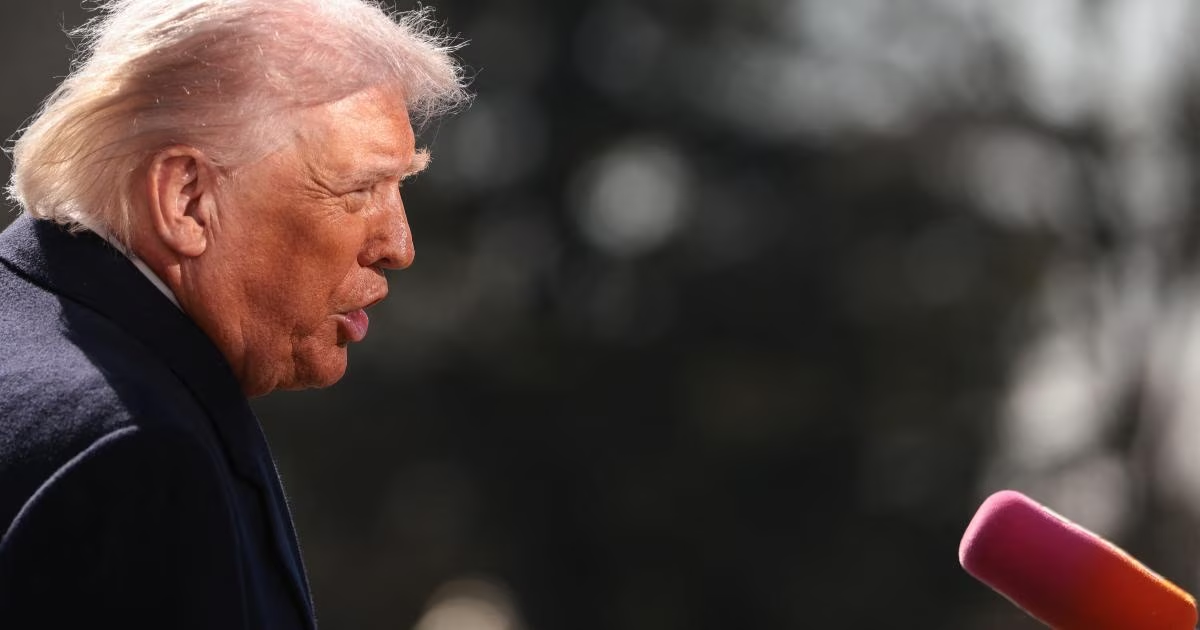







US President Donald Trump, early Sunday morning, issued a stern warning to the Iranian leadership, affirming that any attempt to carry out a military strike against American interests would be met with an unprecedentedly powerful response. Trump indicated that the US administration had detected clear Iranian intentions to escalate the field situation in the coming hours.
The US President clarified in a post on his 'Truth Social' platform that Tehran had announced its intention to launch a strike it described as very powerful, emphasizing that the United States would not stand idly by in the face of these threats. He added that Washington-led military operations in the region would continue as long as security necessities dictated.
In the context of his controversial statements, Trump considered that the absence of Iranian Supreme Leader Ali Khamenei opens the door for the Iranian people to have a historic opportunity to change the ruling regime. He hinted at communication with or knowledge of individuals who might lead the transitional phase in Iran, describing them as good elements capable of governance.
On the other hand, the Iranian Revolutionary Guard issued a statement vowing a comprehensive and widespread response to the assassination of Supreme Leader Ali Khamenei, asserting that targets would not be limited to Israeli territory but would include US military bases deployed in the region. The statement indicated that air raid sirens would not cease in Israeli cities due to the expected missile intensity.
On the ground, military sources confirmed the activation of air defense systems in several areas after detecting waves of missile projectiles launched from Iranian territory. Reports from the Israeli Home Front stated that air raid sirens sounded in various locations, while attempts to intercept a number of aerial targets were successfully carried out.
Observers believe that Trump's threats come within the framework of his adopted maximum deterrence strategy, which relies on raising the level of confrontation to non-material levels to force adversaries to retreat. Sources reported that Washington had received accurate intelligence information about Iranian preparations to launch the most violent attack of its kind since the beginning of the current round of escalation.
Domestically, Trump faces increasing political pressure due to his involvement in extensive military operations without official authorization from the US Congress. This move raises constitutional questions about the President's powers to declare war, prompting the White House to classify current movements as limited military operations.
Democratic lawmakers and some Republican voices criticized this escalatory approach, warning against the United States sliding into an open regional war whose end cannot be predicted. The 'America First' movement expressed concern about being drawn into external conflicts that could drain American resources and contradict electoral promises to withdraw from Middle East wars.
Leaks from within the US administration indicate that military coordination between Washington and Tel Aviv has significantly strengthened since the meeting between Trump and Israeli Prime Minister Benjamin Netanyahu in Florida. These discussions focused on ways to curb Iran's missile program and deal with direct threats facing allies.
Recently, the US President has been trying to regulate his media appearances and avoid delving into precise field details, in order to avoid any political vulnerabilities that his opponents at home might exploit. Despite his usual inclination for lengthy appearances, the sensitivity of the military situation forced him to limit himself to brief and firm statements via social media.
Risks surrounding US forces deployed in military bases in the region are increasing, as these bases are considered easy targets for any retaliatory Iranian action. This reality places the US administration before the challenge of protecting its soldiers and diplomats while maintaining the prestige of military deterrence simultaneously.
Amidst this internal division, questions are escalating in Washington about how far this confrontation can go, and whether the anticipated Iranian strike will be the spark for a comprehensive war. Estimates fluctuate between the possibility of containing the situation through international mediation or heading towards a direct confrontation that changes the map of influence in the region.
In conclusion, the scene remains open to all possibilities with continued mutual military buildup, as the international community cautiously monitors the outcomes of the escalation between Washington and Tehran. All eyes remain on the coming hours, which will determine whether the region will move towards an enforced calm or a widespread military explosion.
Iran has just stated that they will be hitting us very hard today... It would be best if they don't do that, because if they do, we will hit them harder than they have ever been hit before!
شارك برأيك
Trump Vows 'Unprecedented' Strike on Iran Amid Military Alert and Rising Regional Tensions