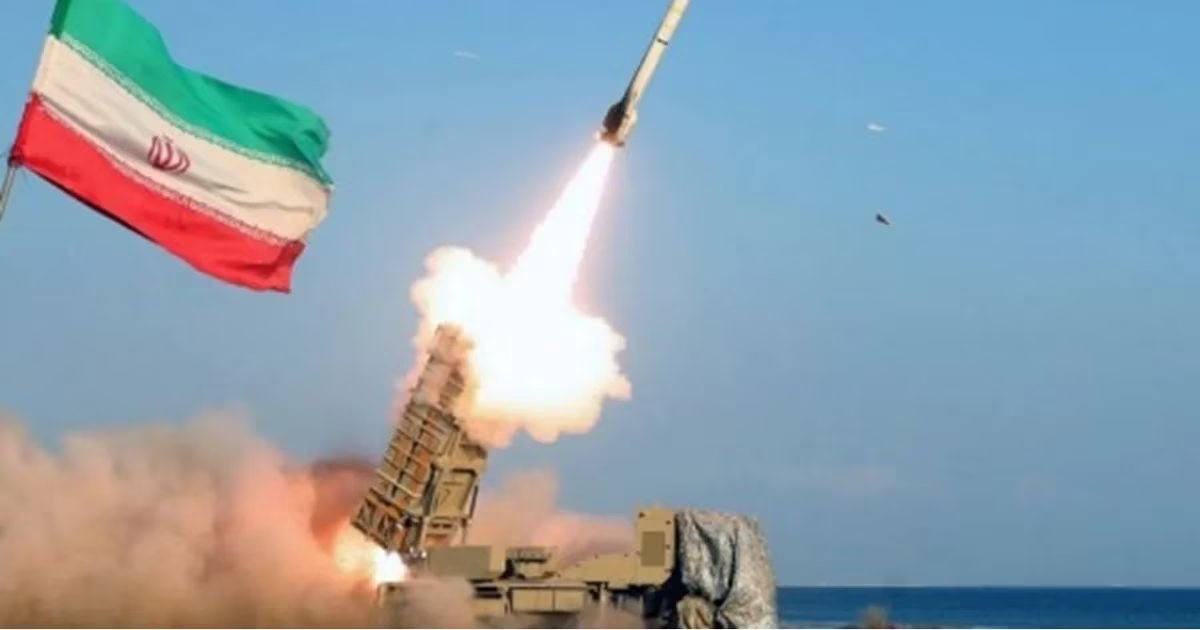







The strained relationship between the United States and Iran goes beyond the stated pretexts that have surfaced in recent weeks, as a clear contradiction appears in the context of events. From objecting to the handling of internal protests to the sudden return to the negotiating table, and then to military movements such as sending the aircraft carrier 'Gerald Ford', the scene seems disjointed and raises questions about the true objectives.
Arab interest in Iran is linked to deep historical roots, the most prominent pioneer of which was the late journalist Mohamed Hassanein Heikal, who paid early attention to Tehran since the oil nationalization crisis in the 1950s. Heikal documented his vision in his first book 'Iran Above a Volcano' in 1951, where he witnessed events from the heart of the Iranian capital and met with various active parties at that time.
This historical interest continued until the Iranian Revolution in 1979, when Heikal met Imam Khomeini in Paris before his triumphant return to Tehran. This connection indicates that Iran has always been at the heart of the concerns of political and journalistic circles close to decision-making centers in the Arab region, especially in Egypt.
In parallel with Heikal's efforts, the contributions of journalist Fahmy Howeidy emerged, who provided a deep ideological and intellectual reading of the Iranian interior. Observers note a great similarity in the jurisprudential and intellectual information between Howeidy's and Heikal's writings, which reflects the extent of journalistic effort made to understand the nature of the nascent regime in Tehran and its ideological orientations.
Regarding the nuclear file, observers believe that the atomic bomb has not been a traditional military weapon since its use in Hiroshima in 1945, but rather has become a political tool to impose international hegemony. This is clearly demonstrated in the balance of power between India and Pakistan, where nuclear weapons act as a political deterrent rather than a means of direct engagement.
The qualitative development in conventional and missile weapons has reduced the superior advantage of nuclear weapons in modern warfare. Recent confrontations have proven the ability of conventional missiles to achieve strategic goals and bypass advanced defense systems, making the focus on the 'nuclear bogeyman' merely a cover for negotiations with other dimensions.
Questions arise as to whether the American strategy aims to bring Iran back into the 'American orbit' to counter growing Chinese and Russian influence in Asia. However, this hypothesis seems far-fetched given the complexity of the economic and military ties that Tehran has forged with Eastern powers over the past decades.
Regarding the conflict with the Israeli occupation, analysis suggests that Tehran links its hostility to Tel Aviv with its general stance on American policies in the region. Despite available military capabilities, direct intervention remains subject to precise calculations related to Iranian national interests and avoiding comprehensive existential confrontations.
Operation 'Al-Aqsa Flood' constituted a historical turning point in the conflict, revealing the fragility of the Israeli occupation's internal front. Analysts believe that the real problem facing the Zionist entity is not only external threats but also internal disintegration that could lead to the collapse of the state from within.
Reports indicate that Israel has asked Washington to postpone any military action against Iran until it restores its defensive capabilities and internal front. This hesitation reflects a deep understanding that any widespread confrontation could open fronts that cannot be closed, seriously threatening the survival of the Zionist project in the region.
The political system in Iran possesses internal deterrence power derived from its ideological and ethnic composition, which makes it resistant to collapse through external pressures or limited strikes. History proves that external threats often lead to the cohesion of the Iranian internal front behind its political leadership.
The question remains about the nature of the 'desired outcome' from Iran at this sensitive stage of negotiations. Media frenzy and American military mobilization may be a means of pressure to achieve specific gains in regional files, far from the declared slogans about nuclear weapons or human rights.
Forecasting the future of the region after major transformations indicates that American and Israeli hegemony is undergoing a phase of strategic decline. What we see today as a 'staging' of military power may be nothing more than an attempt to delay historical entitlements that have begun to assert themselves on the ground since the October events.
In conclusion, the relationship between Washington and Tehran remains a political enigma governed by history, geography, and conflicting interests. While negotiations continue under the shadow of threat, the only certainty is that the region is being reshaped away from the old rules that prevailed for many years.
In the modern era, nuclear weapons are no longer a war tool as much as they are a political tool for inaugurating imperial powers.
شارك برأيك
Between History and Politics.. A Reading of the Complexities of the Iranian-American Scene