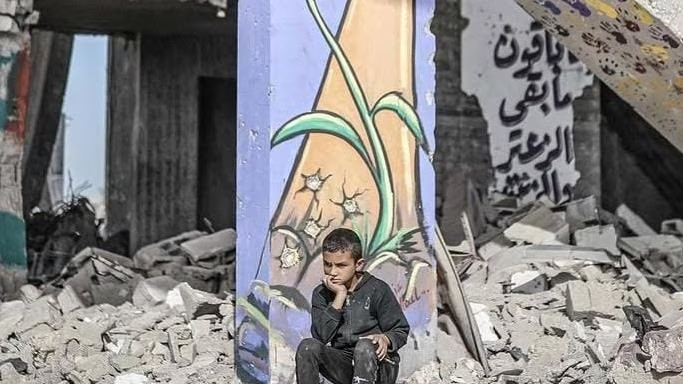







In the Gaza Strip, where unprecedented destruction prevails, art has emerged as a witness to the Israeli genocide and a means to resist Tel Aviv's attempts to erase and deny its crimes, as well as a tool to revive hope in the hearts of Palestinians.
Among the rubble and displacement centers, Palestinian artists document the details of suffering due to the genocide, including loss, displacement, and starvation.
While some have transformed the debris of homes destroyed by Israel into colorful artworks that break the grayness of war and instill hope for life in the residents.
Israel began the genocide in Gaza on October 8, 2023, lasting two years, resulting in more than 70,000 Palestinian deaths, over 171,000 injuries, and massive destruction affecting 90% of the civilian infrastructure in the sector.
This war ended with a ceasefire agreement that came into effect on October 10 last year, which Israel violated hundreds of times, resulting in the killing and injury of hundreds of Palestinians.
During the months of genocide, Israel denied many of the crimes it committed in the Gaza Strip, including deliberately targeting children and practicing starvation against civilians, which facts have proven.
In this context, Palestinians are trying through art to preserve the memory of the genocide and remind of the crimes committed by Tel Aviv against civilians.
**Documenting Crimes and Suffering
Palestinian artist Muhammad Al-Mughari, holder of a bachelor's degree in fine arts from Al-Aqsa University, is one of these artists who document the genocide crimes and the suffering of Palestinians.
Despite limited resources, Al-Mughari launched these artworks from his small room made of tin sheets in the city of Deir al-Balah.
Along the walls of the room, Al-Mughari's paintings are scattered, who previously participated in local and international exhibitions and festivals, narrating daily stories from the depths of Palestinian suffering in Gaza.
One of those paintings depicted a child with exhausted features, holding an empty pot, expressing the famine that struck the sector's joints during the war and whose repercussions still gnaw at Palestinians' bodies despite the ceasefire.
In the same painting, he drew an elderly man wandering the camp's streets in search of food for his children, and at the same time pointed to Israel's dehydration policy by drawing a woman making her way through the rubble pulling heavy water gallons.
During the Israeli genocide war, Palestinians suffered from acute shortages in water, food, medicine, and fuel, leading to the death of dozens due to the Israeli siege accompanied by starvation and dehydration policies.
On August 22 last year, the "Global Initiative for Integrated Food Security Phase Classification" announced in a report the occurrence of "famine in Gaza City (north)".
Al-Mughari also embodied in his paintings the crimes of killing Palestinian civilians and injuring them, and bombing tents over their heads.
In addition, he addressed the details of the primitive life to which the Israeli genocide transferred Palestinians, whether in terms of life inside the tents and its harsh consequences, or providing and cooking food where they relied on lighting fires with wood and papers, or regarding transportation where carts pulled by animals formed its basis.
Al-Mughari said in an interview that he dedicated part of his works to embodying the symbolism of the tent, considering it a witness to the ongoing Palestinian suffering since 1948, referring to the Nakba of displacing hundreds of thousands of Palestinians from their lands.
He added that he documented in his paintings all the details that Palestinians lived in displacement camps with the aim of "documentation and preserving the human memory of the war".
**Reviving Hope
In the Maghazi camp in the center of the sector, Palestinian artists transformed the rubble of buildings destroyed by Israel during the genocide months into colorful paintings pulsating with life.
In one of their artworks, the artists embodied the mythical phoenix on a pile of rubble, indicating Gaza's ability to rise despite the destruction.
Under the bird, the artists drew a Palestinian woman who wrote "Gaza" on her dress, embracing buildings between her arms, indicating Palestinians' attachment to their land.
On the remains of a demolished wall, artists wrote the word "Gaza" in English, with missiles falling from the sky on it, while flowers bloom in its soil.
In other paintings, they recorded words that give Palestinians hope, including some words from the late poet Mahmoud Darwish: "On this land, what deserves life", and "We remain as long as the thyme and olive trees remain".
**Lack of Tools
Despite limited resources, Palestinian artist Muhammad Al-Maghribi continues his artworks, the latest of which was reviving a national figure by painting a portrait of the late President Yasser Arafat.
This painting was drawn by Al-Maghribi using pens he retrieved from under the rubble of his studio, which Israel destroyed during the genocide months.
He said that the army destroyed his home and private studio during the genocide, which contained a number of his artworks, all of which turned into rubble.
He explained that he tried to integrate Palestinian national symbols alongside the character of "Abu Ammar", including Al-Aqsa Mosque and the key of return, which represents the Palestinians' dream of returning to their lands from which they were displaced in 1948.
He mentioned that the Palestinian artist faces major challenges in continuing his art due to Israel's closure of crossings and preventing the entry of necessary materials.
In the face of that, he indicated that they replaced charcoal pencils with charcoal produced from lighting fires with wood, and reused it in the field of art and drawing.
Despite the ceasefire agreement, Israel reneges on fulfilling its commitments, including opening crossings and importing the sector's basic needs, according to what Palestinian government reports confirmed.
Art in Gaza has emerged as a witness to the Israeli genocide and a means to resist Tel Aviv's attempts to erase and deny its crimes, and a tool to revive hope in the hearts of Palestinians.
شارك برأيك
Art in Gaza.. Witness to the Israeli Genocide and a Means to Revive Hope