






The greatness of nations is not measured by the absence of calamities or defeats in their history, but by their extraordinary ability to rise from the rubble and regain their balance after every upheaval. Islamic history, full of strife and occupations, poses a fundamental question about the secret of this nation's survival and its ability to emerge from the heart of crises towards new effectiveness. The answer lies in a recurring truth; which is the production of exceptional leaders who possess the foresight to read the historical moment and transform existential threats into a project of renaissance.
In the moment following the death of the Prophet (peace be upon him), the Islamic state faced an existential challenge represented by the apostasy movement that threatened to dismantle the nascent entity. Abu Bakr Al-Siddiq did not view the scene as a fleeting political crisis, but as a battle to preserve the message and history. Thanks to his steadfastness and resilience, he was able to make the first major historical transformation, preventing collapse and paving the way for a phase of construction and global expansion.
Following the Great Fitna (civil strife) that tore apart the social fabric, leaders emerged who moved the nation from the spiral of internal conflict to a square of stability and state-building. The goal was not merely to stop the bloodshed, but to restore the minimum unity necessary for the continuation of civilization. This transition paved the way for the emergence of leadership models that focused on institutions and moral values as a fundamental pillar of good governance.
Umar ibn Abd al-Aziz came to provide historical proof that transformation is not made by the sword alone, but by absolute justice and comprehensive reform. In his leadership, he relied on restoring lost trust between authority and society, transforming ethics into a practical political methodology. His experience proved that when justice becomes a method of governance, it possesses a power that surpasses military might in consolidating the pillars of the state and rejuvenating it.
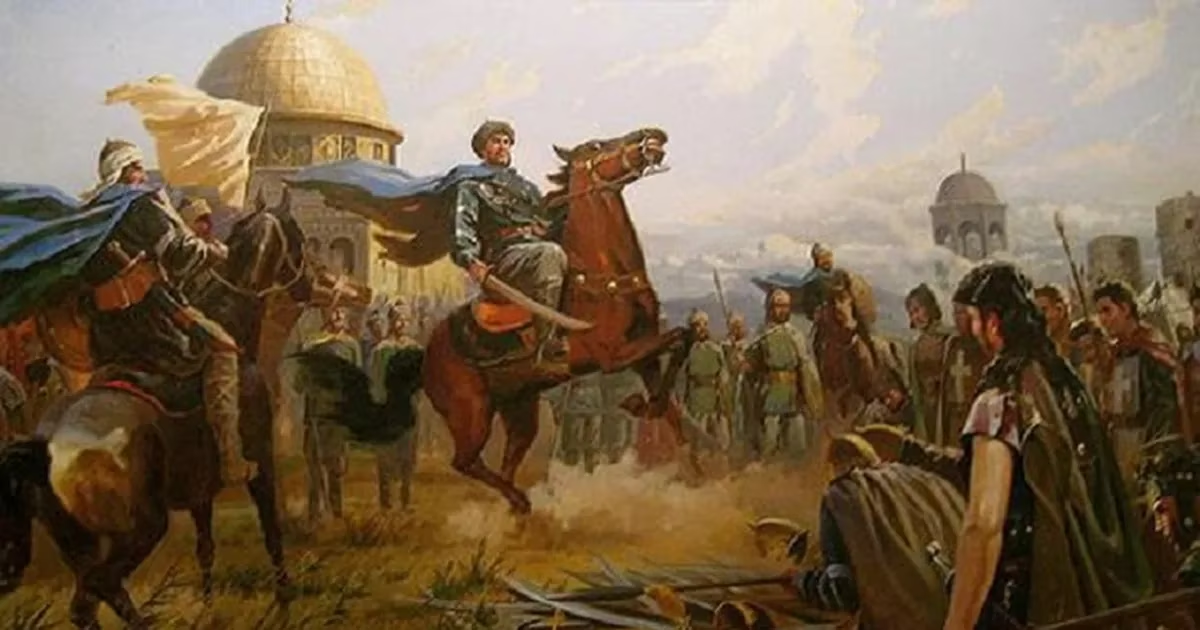
When Jerusalem fell into the hands of the Crusaders, the defeat was not merely military, but an expression of a deep state of disintegration that afflicted the Islamic world. Liberation did not begin with direct confrontation at the walls, but began with the reformulation of collective will and the building of the human being. Imad al-Din Zengi and Nur al-Din Mahmud led an integrated project that focused on knowledge and institutions before embarking on the decisive battle.
Salah al-Din al-Ayyubi was not an isolated phenomenon or a hero who suddenly appeared out of nowhere, but was the ripe fruit of a preparation project that extended for decades. Reducing major transformations to a single battle is an error in reading historical patterns that confirm that victories are made by long-term visions. Salah al-Din was the last link in a long chain of psychological and material construction that restored the nation's self-confidence.
The dramatic scene was repeated with the fall of Baghdad at the hands of the Mongols, where it was believed that Islamic civilization had ended irrevocably under the weight of the shock. But the nation gave birth to Qutuz, Baybars, and Izz al-Din Abd al-Salam, who proved at Ain Jalut that the will to live is stronger than the logic of defeat. The victory was not only military, but a restoration of morale after one of the harshest historical catastrophes.
The nation later moved from the stage of defending its existence to the stage of major civilizational initiative led by Mehmed the Conqueror. The conquest of Constantinople was not merely a geographical expansion, but a declaration of the nation's return to making history by possessing the tools of knowledge and vision. This transformation confirmed that a nation with will can overcome centuries of decline to lead the global scene again.
In the modern era, the Islamic world faced a fierce colonial wave that directly targeted its identity and resources. Leaders such as Omar al-Mukhtar, Izz al-Din al-Qassam, and Abd al-Karim al-Khattabi emerged, who carried the banner of resistance despite the imbalance of material power. These succeeded in keeping the spark of rejection alive, transforming temporary military defeats into fuel for comprehensive national independence movements.
After the fall of the Ottoman Caliphate, the nation entered a phase of political disorientation, direct colonial dependence, and intellectual turmoil. In this phase, a new type of leaders emerged who focused on the battle of awareness and building renaissance from the grassroots. Jamal al-Din al-Afghani and Muhammad Abduh led an intellectual movement aimed at awakening and restoring civilizational reference in the face of Westernization and dependence.
Thinkers and leaders such as Hassan al-Banna, Malek Bennabi, and Maududi continued to work on the question of civilization and the conditions of renaissance in contemporary reality. They realized that defending borders is not enough if the mind is enslaved, so they worked to renew Islamic thought and connect it to reality. The goal was to reconnect the nation with its civilizational project and renew its confidence in its global message after decades of setback.
The common denominator among all these personalities across different eras is the possession of a vision that transcends the current crisis towards future horizons. They possessed the ability to see the opportunities hidden in the heart of ordeals, and to transform moments of fear and despair into energy for work and construction. True leadership is that which knows how to manage crises and transform them into new starting points instead of surrendering to the bitterness of reality.
The reality of the nation today, with its internal conflicts, international pressures, and disintegration, greatly resembles previous historical moments that the nation successfully overcame. History tells us that the future is not made by passive waiting, but by the ability to produce a new generation of transformational leaders. The nation that gave birth to great men in the darkest circumstances still possesses the latent ability to repeat the experience and regain its role.
The fundamental question remains not about the possibility of return, but about the ability to restore the making of leaders who transform weakness into strength. The seeds of renaissance are still alive deep within this nation, and the current ordeals may be the laboratory that forges the coming leaders. Islamic history teaches us that dawn often emerges from the darkest womb of darkness, provided there is will and vision.
The nation may fall ill and weaken, but as long as it is capable of producing leaders of major transformations, it remains a nation that possesses the seeds of renaissance, no matter how severe the storms.
שתף את דעתך
The Making of Leadership in Times of Ordeal: How the Nation Regained its Balance Throughout History?