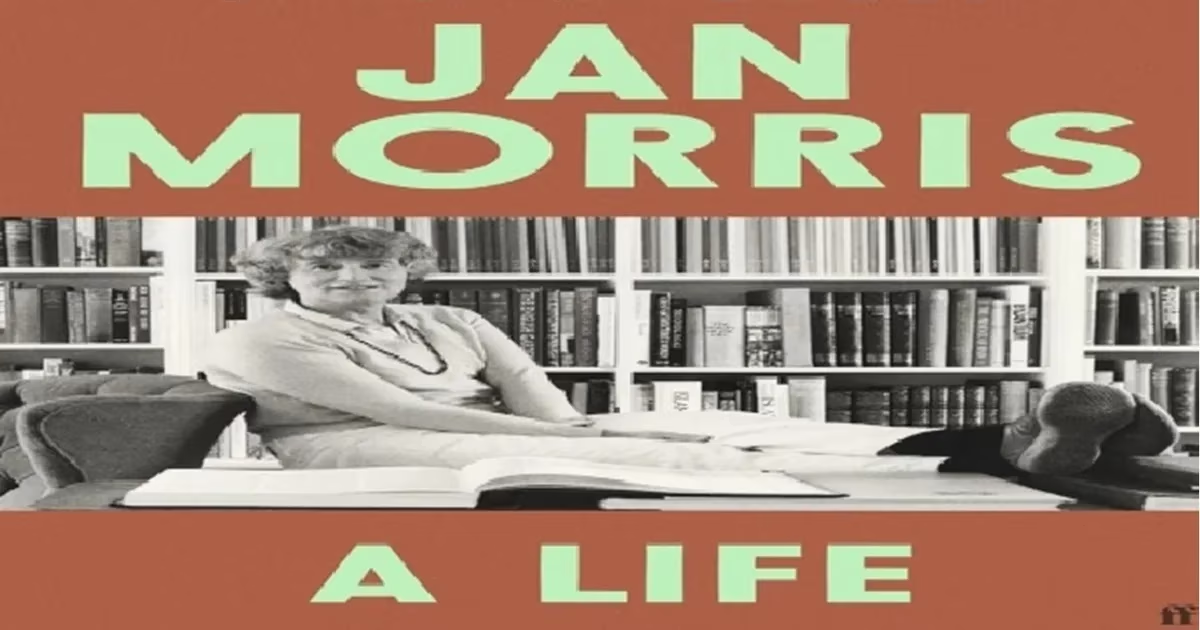







A recent critical reading shed light on the new biography of the late British historian and writer Jan Morris, prepared by writer Sara Wheeler under the title 'Jan Morris: A Life'. This biography reveals the features of an exceptional personality who managed to engrave her name in the memory of world literature, yet remained burdened with deep human contradictions that affected her immediate surroundings.
Morris's career began in the mid-20th century when she was known as James Morris, where her star shone as an adventurous journalist for 'The Times'. Her name was historically associated with the global scoop she achieved when covering the first successful ascent of Mount Everest in 1953, an achievement that opened the doors to widespread fame for her.
Morris's ambitions did not stop at field journalism; she transitioned to become one of the most prolific writers, especially in the fields of history and travel literature. Her works exceeded fifty books, characterized by a unique narrative style and an exceptional ability to describe places and analyze the cultural identities of peoples and cities.
The 1970s marked the most prominent turning point in Morris's personal and professional life, as she made the decision to undergo gender transition, which she later documented in her famous book 'Conundrum'. This book was not just an autobiography; it became rich material for cultural and social debate in Britain and beyond, placing her in confrontation with diverse intellectual currents.
Despite the fame she gained as an advocate for what she called 'the religion of kindness', the new biography reveals a different side of Morris in her private dealings. According to family testimonies included in the book, her children suffered from her domineering behavior and emotional absence, which created a large gap between her public image as a gentle writer and her reality as a mother.
Her daughter, Suki, described the experience of motherhood with Morris in harsh words, indicating that individual ambition and self-focus always overshadowed family obligations. These testimonies redraw the features of the literary legend and confront the reader with questions about the human cost paid by creators in order to achieve their selves.
In contrast, the long and complex marriage between Morris and her wife Elizabeth stands out as one of the most astonishing and enduring aspects of her life. Their relationship continued despite all radical transformations, in a unique blend of emotional commitment and loyalty to old vows, as Elizabeth dedicated her life to preserving the family unit.
The exchanged letters cited in the biography indicate a deep love between the two parties, but this love did not prevent the emergence of sharp tensions resulting from Morris's desire to break free from traditional constraints. This relationship reflects the nature of the internal conflicts experienced by those around Morris in light of her continuous transformations.
The critical reading of the biography concludes that Morris was an exceptionally complex personality, who cannot be confined to molds of veneration or condemnation. She was the great writer who inspired millions, and at the same time, the human being who placed her personal success above all else, making her human image appear fragile in the face of the brilliance of her achievements.
The biography raises a fundamental question about the role of literature when it becomes a means of expressing shocking identity conflicts with human nature. Can creativity stemming from sharp psychological conflicts remain inspiring for future generations, or does it remain confined to the individual experience of its author and her own contradictions?
Considering the Western context in which Morris grew up, we find that she challenged a traditional patriarchal society that imposed strict restrictions on women's identity and status. Her literary achievements at that time represent a rare experience in breaking historical constraints, which contributed to opening new horizons for understanding the female experience in the West.
The development that women have achieved in Western societies today was not a coincidence, but rather the result of the accumulation of sacrifices by women like Morris and others. Nevertheless, the feminine dimension in her writings remains a محور of creativity, as she used her own experience to explore the human self in a depth that transcends traditional frameworks.
When comparing Morris's experience with Arabic literature, we find interesting intersections with female writers such as Nazik Al-Malaika, Fadwa Touqan, and May Ziadeh. These writers also faced societies that imposed restrictions on freedom of expression, and were forced to engage in bitter internal struggles between their personal ambitions and the social obligations imposed on them.
Ultimately, Jan Morris's experience remains a living example that genius does not protect its owner from error or contradiction. Whether in the Western or Arab context, true creativity is that which dares to reveal the fragility of the human soul and transform suffering into works that transcend the boundaries of time and place.
As Jan Morris's achievements expanded, the fragility of her human image and her emotional gap with her surroundings increased.
שתף את דעתך
Jan Morris in a New Biography: Literary Genius and Human Contradictions Behind the Legend