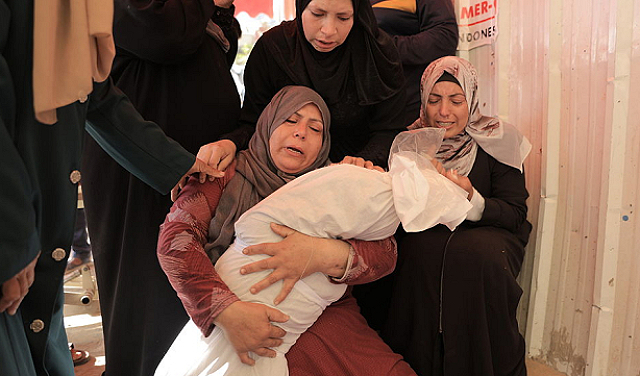







The United Nations General Assembly witnessed a sharp confrontation on Wednesday between Israel's ambassador to the UN and the UN Special Rapporteur on human rights in the Palestinian territories, Francesca Albanese, after the latter presented her latest report on what she described as "the complicity of third countries in the genocide being committed by Israel in Gaza."
The Israeli ambassador to the UN, Danny Danon, known for his lack of diplomatic decorum and his use of almost vulgar language to describe Palestinians and anyone who criticizes Israel, chose to respond to Albanese with an aggressive tone that went beyond the minimum standards of diplomatic norms, calling her a "witch" and accusing her of trying to "curse Israel with lies and hatred." Danon stated before the audience: "Every page of your report is an empty incantation, and every accusation is a spell that is ineffective because you are a failed witch." This verbal attack surprised observers, especially since it replaced a substantive response to the accusations in the report.
Albanese, for her part, responded calmly and with poise, considering that the Israeli ambassador's statements reflect his country's inability to confront the facts. She said: "It is strange that a country accused of committing genocide cannot respond to the essence of my conclusions and instead resorts to accusing me of witchcraft." She added with sharp sarcasm: "If I truly had the power of magic, I would use it to stop your crimes, not to take revenge on you."
It is noteworthy that Albanese's report, titled "Gaza Genocide: A Collective Crime," explicitly accuses more than sixty countries, including the United States and several European nations, of participating in enabling Israel to commit the crime of genocide against Palestinians in the Gaza Strip through ongoing military, political, and economic support. The rapporteur emphasized that "international law is clear: no state should assist another in committing international crimes," calling for the suspension of military and trade relations with Israel and pressing for a permanent ceasefire.
Because the administration of U.S. President Donald Trump imposed American sanctions earlier this year, Albanese was unable to travel to New York and presented her report from Cape Town in South Africa, the country leading the case against Israel before the International Court of Justice. This detail added additional symbolism to her appearance, as it seemed that Cape Town, with its historical memory of resisting apartheid, had become an alternative platform for the international voice demanding justice.
The Israeli attack on Albanese cannot be read in isolation from a broader pattern of ongoing attempts by Tel Aviv to undermine international voices that accuse it of committing war crimes or apartheid. Instead of refuting the evidence and facts, Israel relies on a strategy that aims to discredit the personal credibility of critics and shift the discussion from the essence of legal accountability to emotional or personal arguments. In this way, it seeks to divert attention from the fundamental questions regarding its legal and moral responsibility for what is happening in Gaza.
Observers say that the attack on Albanese also carries a deterrent message directed at other UN officials, indicating that anyone who dares to document Israeli violations may face public smear campaigns. Additionally, Israel is attempting, through this aggressive rhetoric, to limit the growing international influence of reports by UN rapporteurs, especially in light of ongoing investigations before the International Court of Justice regarding war crimes and genocide.
Ultimately, the battle between Albanese and Israel does not seem to be merely a dispute over a UN report, but part of a broader struggle over the narrative: who has the right to interpret what is happening in Gaza, and who determines whether it is self-defense or a crime against humanity. While Albanese chooses the language of international law to describe the facts, Israel responds with language of insult and distortion, in an attempt to undermine the voice that insists on naming things as they are, regardless of the political cost.
On a deeper level, Tel Aviv's attack on Albanese can be read as part of a complex strategy aimed first at neutralizing the legal and political impact of reports that threaten to open pathways for accountability at the level of courts and international institutions, and second at sending a deterrent message to UN staff and international decision-makers that the cost of continuing to document and claim may be personal and political, not just legal.
This rhetoric also serves an internal goal for Israel and its allies in the West: shifting the discussion from accountability for military policies and international support to debates about bias and moral imbalance among the rapporteurs, which facilitates justifying ongoing diplomatic and military actions and isolates the accusers before a wavering Western audience. Collectively, reports like Albanese's exert increasing pressure on cases before the International Criminal Court and other UN institutions, making the strategy of responding with contempt and distortion a quick and effective means to halt the momentum of accountability before it finds its way into enforcement mechanisms with far-reaching effects.
שתף את דעתך
Israel attacks UN rapporteur Francesca Albanese for revealing details of the genocide in Gaza.