OPINIONS

Thu 19 Oct 2023 7:00 am - Jerusalem Time

The end of the Netanyahu doctrine

Ramallah - “Al-Quds” dot com

Ramallah - “Al-Quds” dot com

Opinion Writer

By Meron Rapoport

The events of recent days are unprecedented. The last time units of Jewish and Palestinian fighters — military or paramilitary — went to battle on such a broad front in Israel-Palestine was in 1948. There have, of course, been various battles over the years in Gaza as well as West Bank cities like Jenin, and Israeli and Palestinian units fought one another in Lebanon in 1982. But there is no parallel to the scope of what has taken place here since Saturday morning, and not since 1948 have Palestinian fighters occupied Jewish communities on this scale.


This fact is not just a historical anecdote; it has a direct political meaning. This murderous and inhumane attack by Hamas arrived just as it seemed Israeli Prime Minister Benjamin Netanyahu was about to complete his masterpiece: peace with the Arab world while completely ignoring the Palestinians. This attack has reminded Israelis and the world, for better or for worse, that the Palestinians are still here, and that the century-old conflict here involves them, not the Emiratis or the Saudis.  


In his speech at the UN General Assembly two weeks ago, Netanyahu presented a map of “The New Middle East,” depicting the State of Israel stretching from the Jordan River to the Mediterranean Sea and building a “corridor of peace and prosperity” with its neighbors across the region, including Saudi Arabia. A Palestinian state, or even the collection of shrunken enclaves that the Palestinian Authority ostensibly controls, does not appear on the map.


Since he was first elected prime minister in 1996, Netanyahu has tried to avoid any negotiations with the Palestinian leadership, instead choosing to bypass it and push it aside. Israel does not need peace with the Palestinians to prosper, Netanyahu repeatedly claimed; its military, economic, and political strength is sufficient without it. The fact that during the years of his rule, especially between 2009 and 2019, Israel experienced economic prosperity and its international status improved, was, in his eyes, proof that he is following the right path.

Israeli forces take cover from shelling in Sderot, October 9, 2023. (Oren Ziv)


The Abraham Accords signed with Bahrain and the United Arab Emirates, and later also Sudan and Morocco, reinforced this belief conclusively. “For the past 25 years, we have been told repeatedly that peace with other Arab countries will only come after we resolve the conflict with the Palestinians,” Netanyahu wrote in an article in Haaretz before the last election. “Contrary to the prevailing position,” he continued, “I believe that the road to peace does not go through Ramallah, but bypasses it: instead of the Palestinian tail wagging the Arab world, I argued that peace should begin with Arab countries, which would isolate Palestinian obstinacy.” A peace agreement with Saudi Arabia was supposed to be the icing on the “peace for peace” cake that Netanyahu has spent years preparing.


Netanyahu did not invent the policy of separation between Gaza and the West Bank, nor the use of Hamas as a tool to weaken the Palestine Liberation Organization and its national ambitions to establish a Palestinian state. Then-Prime Minister Ariel Sharon’s 2005 “disengagement” plan from Gaza was built on this logic. “This whole package called the Palestinian state has fallen off the agenda for an indefinite period of time,” said Dov Weissglas, Sharon’s advisor, explaining the political goal of disengagement at the time. “The plan provides the amount of formaldehyde required so that there will be no political process with the Palestinians.”


Netanyahu not only adopted this way of thinking, he also added to it the preservation of Hamas rule in Gaza as a tool for strengthening the separation between the strip and the West Bank. In 2018, for example, he agreed that Qatar would transfer millions of dollars a year to finance the Hamas government in Gaza, embodying the comments made in 2015 by Bezalel Smotrich (then a marginal Knesset member, and today the finance minister and de facto West Bank overlord) that “the Palestinian Authority is a burden and Hamas is an asset.”


“Netanyahu wants Hamas on its feet and is ready to pay an almost unimaginable price for it: half the country paralyzed, children and parents traumatized, houses bombed, people killed,” Israel’s current information minister, Galit Distel Atbaryan, wrote in May 2019, when she was yet to enter politics but was known as a prominent Netanyahu supporter. “And Netanyahu, in a kind of outrageous, almost unimaginable restraint, does not do the easiest thing: getting the IDF to overthrow the organization. 


“The question is, why?” Distel Atbaryan continued, before explaining: “If Hamas collapses, Abu Mazen [Mahmoud Abbas] may control the strip. If he controls it, there will be voices from the left that will encourage negotiations and a political solution and a Palestinian state, also in Judea and Samaria [the West Bank] … This is the real reason why Netanyahu does not eliminate the Hamas leader, everything else is bullshit.”


Indeed, Netanyahu himself had effectively admitted as much a couple of months before Distel Atbaryan made her comments, when he declared in a Likud meeting that “anyone who wants to thwart the establishment of a Palestinian state needs to support strengthening Hamas. This is part of our strategy, to isolate Palestinians in Gaza from Palestinians in Judea and Samaria.”


Strengthening the Gaza fence became another aspect of Netanyahu’s strategy. “The barrier will prevent terrorists from infiltrating our territory,” Netanyahu explained when he announced the start of work in 2019 to add an underground barrier that would end up costing more than NIS 3 billion. Two years later, Israeli journalist Ron Ben-Yishai wrote in Ynet that the ultimate goal of the fence, which was considered to be an impenetrable barrier for terrorists, is to “prevent a connection between Hamas in Gaza and the Palestinian Authority in Judea and Samaria.”

Israelis in Ashkelon look on at the damage caused by a rocket launched from Gaza, October 7, 2023. (Oren Ziv)


On Saturday morning, that fence was torn down, and with it the broader Netanyahu doctrine — adopted by the Americans and many Arab states — that it is possible to make peace in the Middle East without the Palestinians. As hundreds of militants crossed the border unhindered on their way to occupy army posts and infiltrate dozens of Israeli communities as far as 18 miles away, Hamas declared in the most clear, painful, and murderous way possible that the conflict that threatens Israelis’ lives is the conflict with the Palestinians, and the idea that they can be bypassed via Riyadh or Abu Dhabi, or that the 2 million Palestinians imprisoned in Gaza will disappear if Israel builds a sufficiently elaborate fence, is an illusion that is now being shattered at a terrible human cost.


This is not necessarily good news. It is impossible not to define the actions of Hamas as war crimes: the massacre of civilians, the murder of entire families in their homes, the kidnapping of civilians including the elderly and children into captivity in Gaza — all of these violate the laws of war, and if the International Criminal Court does exercise its jurisdiction over Israel-Palestine, then those responsible for these actions will have to be prosecuted. In other words, Hamas’ “declaration” that the Israeli-Palestinian conflict still exists came at the price of the blood of hundreds of innocent people. 

It is also not necessarily good news because it seems that the conclusion Israel is currently drawing from the understanding that the conflict is here in Israel-Palestine, and not in Saudi Arabia, is to “overthrow Hamas” or “flatten Gaza.” Likud MK Ariel Kellner and right-wing journalist Yinon Magal likely represent a significant portion of the Israeli public — and certainly the government — when they call for the response to be another Nakba.


And yet, beyond the moral judgments, the attack by Hamas has brought all of us — especially the Israelis — back to reality, reminding us that the conflict began here, in 1948, and that no magic cure can make it disappear. And since Hamas, as strong and capable of surprises as it may be, cannot murder 7 million Jews, and since Israel — I believe — is not capable of carrying out another Nakba (or even recapturing Gaza), it is possible that from the trauma of the past few days will grow the idea that the conflict must be resolved on the basis of freedom, national and civic equality, and the end of the siege and the occupation. 

After the trauma of the 1973 war, which many are comparing to what is happening today, it dawned on Israelis that peace could come at the expense of withdrawing from the Egyptian territory it had occupied. The same realization can happen after the trauma of 2023.


Source: 972 Magazine
OPINIONS

Thu 19 Oct 2023 6:52 am - Jerusalem Time

Danger for US deepens as Gaza crisis escalates

Ramallah - “Al-Quds” dot com

Ramallah - “Al-Quds” dot com

Opinion Writer

By PAUL R. PILLAR


Hamas’s attack on Israel last week was what any reasonable person would consider an atrocity deserving of moral outrage. Hundreds of innocent civilians were killed, and dozens more were taken into captivity. It thus is understandable that such an event would elicit intense emotion and a thirst for revenge.


Being understandable is not the same as being wise or effective, for Israel itself or for regional peace and security.

Israel has now embarked on a violent offensive against the Gaza Strip and its residents. However, as much as that offensive may be defended as intended to establish deterrence or to destroy a hostile military force, it is in large part an act of raw revenge. It is a national catharsis amid an atmosphere of intense grief and anger.


The casualty count from the Israeli bombardment of the Gaza Strip is rising too fast to venture an up-to-date figure, but Palestinian health authorities reported that as of Monday, 3.500 Palestinians had been killed and 12,000 wounded, with more than half of the dead being women and children. In addition, Israel — which already had maintained a blockade of Gaza — cut off all movement of food, fuel, water, and electricity to the territory.


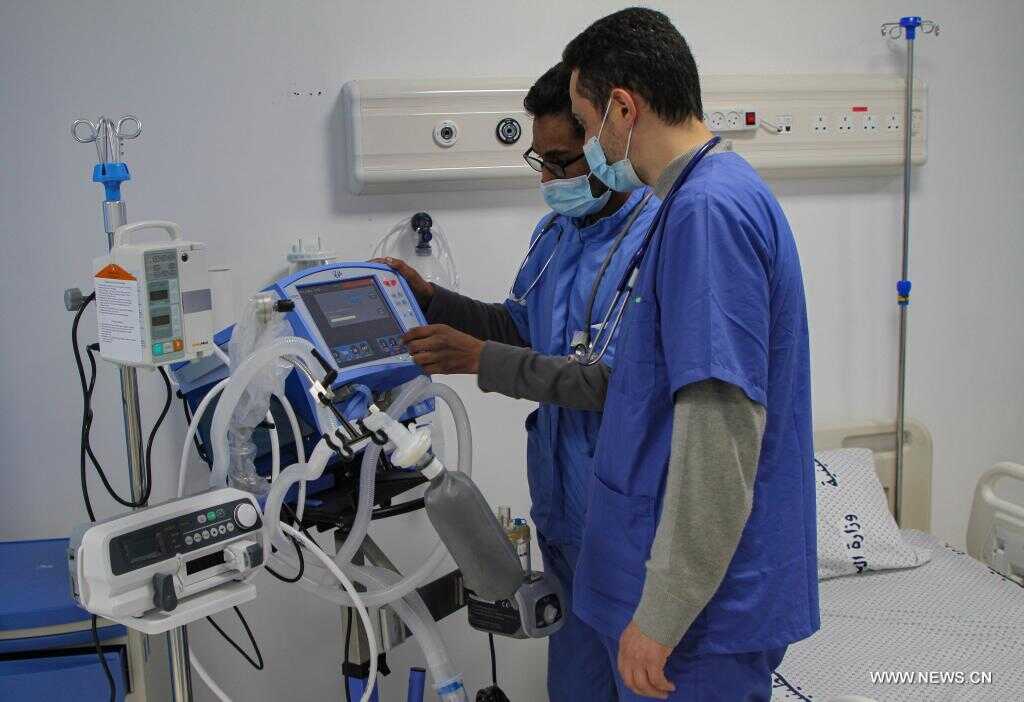
This is quickly generating a humanitarian disaster of a proportion commensurate with the Strip’s population of more than two million, with specific consequences ranging from hospitals lacking the supplies and electric power needed to treat the wounded to families running short of food.


On top of all this, Israel, through a pre-invasion warning leaflet, has told the more than one million residents of Gaza City and the rest of the northern half of the Strip to head south. Given the lack of food, water, and housing wherever those people could go, such a movement, as U.N. Secretary General Antonio Guterres has stated, ranges between the “extremely dangerous” and the “impossible.” Evacuation does not even buy safety, as indicated by lethal Israeli attacks on convoys that were using what Israel had designated as a “safe route.”


The scale of physical human suffering in the Gaza Strip already exceeds what Hamas inflicted on Israel last week. And Israel is just getting started as the Israeli aerial assault is likely to transition to a ground offensive.

Given the extensive and careful planning that clearly went into the recent Hamas attack, it can be assumed that Hamas’s planning did not end there. The group surely anticipated a strong Israeli reprisal, has done all it can to prepare for that reprisal, and has calculated that when the whole episode is over it will have served Hamas’s interests more than Israel’s. Drawing Israel into an extremely difficult urban warfare campaign on Hamas’s own turf may have been one of the group’s objectives.


The hostages Hamas seized in southern Israel (as many as 150) vastly complicates any Israeli military operation. Hamas claims that Israeli airstrikes already have killed 13 of the hostages — an unconfirmed but plausible claim given the destruction from the airstrikes. The remaining hostages will be in grave danger from a ground assault, regardless of whether Hamas positions them to function as human shields.


Animosity across the region and much of the rest of the world will be substantial and will work against Israeli interests and Israeli security. Arab governments will be less inclined than before to expand relations with Israel.

In the occupied West Bank — where even before October 7, anger over Israeli policies and actions made the chance of a new popular uprising or intifada significant — heightened anger over more Israeli killing of Palestinian brethren in Gaza increases that chance. There already are signs of the current violence in Gaza spilling over into the West Bank, with at least 46 Palestinians killed and 700 injured in clashes with Israeli security forces and settlers since the Hamas attack.


In Gaza itself, an expansion of Israeli-inflicted bloodshed among the Palestinian residents will feed expanded anger against Israel among the remaining residents, with all the potential for new violence that such anger always has entailed. Destruction of Hamas’s military capability, even if that could be completely achieved, does not remove the problem. Hamas was never the whole story of violent Palestinian reaction to Israeli policies. Much of the recent rocket fire from Gaza has been carried out by the Palestine Islamic Jihad, a smaller and more radical Gaza-based group. The anger and the violence will find other channels — perhaps through groups and cells not yet formed — even if neither Hamas nor the PIJ were still functional.


The Israeli objective in a new ground invasion of Gaza may go beyond “mowing the lawn,” to use the Israelis’ term for their periodic surges in military attacks against Palestinians, and extend to destroying the ability of Hamas to function any more as Gaza’s de facto government. But even if that objective is achieved, then a big unanswered question is, who does govern the Gaza Strip? The Palestinian Authority is widely discredited among Palestinians and seems unable to rise above its residual role as a security auxiliary to the Israeli occupation of the West Bank. Direct Israeli rule of Gaza would be a prescription for even more resentment over occupation and more potential for violent Israeli-Palestinian clashes.


U.S. policy on the crisis shows signs of having been swept up in some of the same emotions and rage as most Israelis have. In this respect, the policy is tracking with a broader mood that the Hamas attack has generated in the American body politic, in which the safest public posture is expression of unflinching support for Israel. It is even more hazardous to one’s political health than it usually is to say anything that places the crisis within the context of longstanding Israeli policies toward the Palestinians. Related to this, the Biden policy of essentially going all in with Israel likely has domestic political calculations behind it.


The administration’s pronouncements have often reduced the crisis to an easy-to-emote-over tale of good versus evil, which ignores likely motivations for what was a carefully calculated attack undertaken in response to Israeli policies and actions.

Continuing this theme, administration officials have likened what Hamas did to the Islamic State or ISIS. The brutal tactics that Hamas used during its incursion into southern Israel can indeed be compared to some notorious actions by ISIS, but beyond that the comparison is meaningless. ISIS is not part of any longstanding situation comparable to the Israeli-Palestinian conflict and Israeli occupation of Palestinian territory. ISIS is an international terrorist group whose ideology and ambitions know no international boundaries.


Hamas is a nationalist group seeking political power in a Palestinian state and has no interest in international terrorism beyond that theater. ISIS has never spoken about observing an open-ended truce to live peacefully next to a state that is currently its adversary. Hamas has. ISIS has never competed in, much less won, a free and fair election. Hamas has. Why and how the tactics and objectives of Hamas have evolved into what it displayed this month have to do with peaceful avenues of competition being closed. To reduce the entire conflict into a matter of one set of outrageous tactics is to miss all the other dimensions of that conflict.


Meanwhile, Saudi Arabia has been calling for de-escalation. Russia and China have called for an immediate cease-fire, and Russia is proposing a U.N. Security Council resolution to that effect.

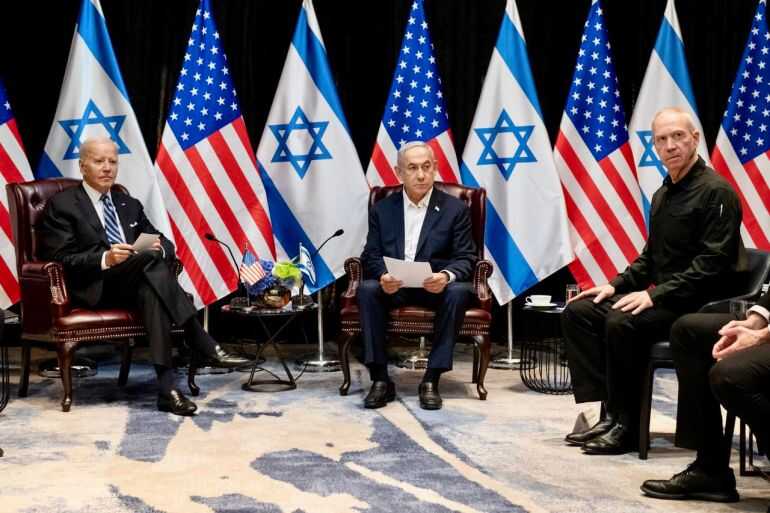
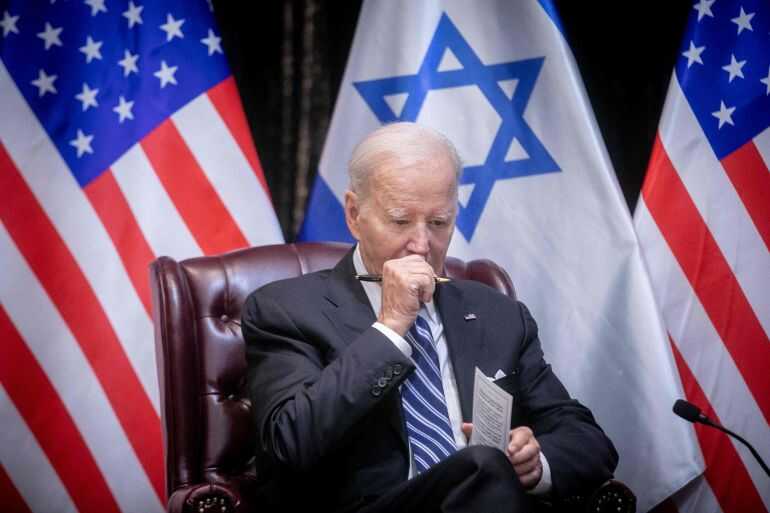
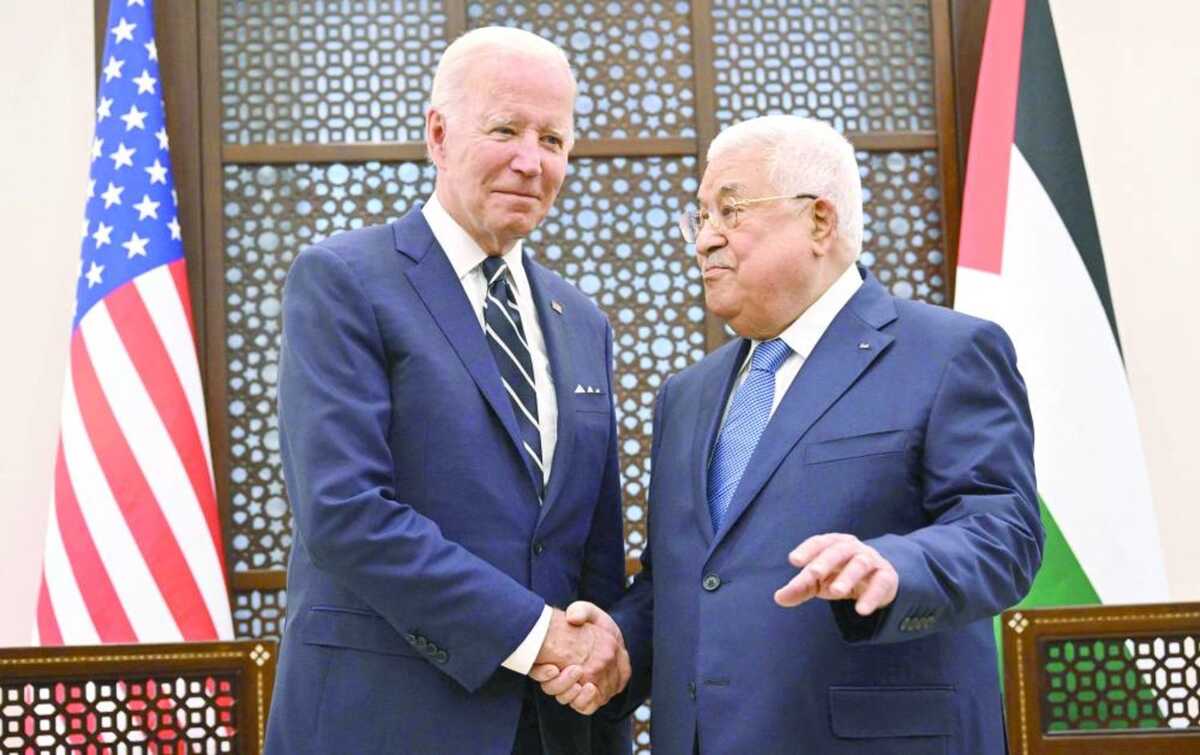
The Biden administration is moving in the opposite direction. Secretary of State Antony Blinken on social media endorsed Turkish efforts to secure a cease-fire, but later deleted the post. While President Biden said on Sunday that Israeli occupation of Gaza would be a “big mistake,” current administration policy is to otherwise endorse the escalation of the violence that Israel currently is conducting in the Gaza Strip.


The administration should think carefully about how U.S. interests differ from Israeli interests and objectives. Israel violently exacting revenge in this case is not a U.S. interest. Given that the foremost responsibility of a government is ensuring the safety and security of its own citizens, one of the important U.S. interests at stake concerns how some of those citizens may have become hostages in the Gaza Strip and will be greatly endangered by escalated Israeli military attacks.


In addition to Americans among the hostages Hamas seized, an estimated 500 to 600 other U.S. citizens — mostly Palestinian Americans — are in the Gaza Strip. They are hostages, too — trapped there after the Israeli shutdown of all movement in and out of the territory, and in serious danger of becoming casualties of Israeli air or ground operations. One of those Americans, a woman whose home is Salt Lake City and currently is stuck in Gaza with her family, said, “I feel like I’ve been abandoned by my country. We’re American citizens and we’re not being treated as American citizens.”


Another U.S. interest is preventing the current warfare to spread regionally. The more that the fighting involving Israelis and Gazans escalates, the greater is the danger of such spread, even though other actors in the region are not seeking a wider war. Those in the U.S. who habitually try to stir up conflict with Iran are using the current crisis to do more stirring. This is despite the fact that no evidence has emerged of any direct Iranian role in the Hamas attack — as attested to most convincingly by official Israeli spokespeople, given that the Israeli government usually is eager to implicate Iran in anything condemnable. Press reports citing sources within the U.S. government indicate that Iranian government officials were surprised by Hamas’s action.


The Biden administration nonetheless has foolishly picked this moment to draw Iran into the Gaza crisis in a way by reneging at least temporarily on its commitment, under a recent prisoner swap deal that freed five imprisoned Americans, to permit some frozen Iranian assets to be used for humanitarian purposes inside Iran. Accusations by opponents of the administration that this money had some connection, however indirect, with Hamas military operations are patently false, given that none of the money involved had yet been expensed. The administration’s move will further damage U.S. credibility regarding a willingness to make good on commitments, thereby making it more difficult for the U.S. to reach beneficial agreements with any other government, not just Iran.


The administration evidently wanted to make a critical statement about the longstanding and well-known supply relationship between Iran and Hamas. If a patron that has supplied arms or money to a client is to be punished — to the extent even of previous agreements being reneged upon — this raises a question about yet another U.S. interest at stake in the current crisis: avoiding opprobrium and repercussions stemming from some other state’s actions.

If Iran is to be condemned for any actions by Hamas, even actions Iran did not instigate or control, then what is the attitude to be taken toward the United States regarding destructive and anger-inducing actions in Gaza by its client Israel, the recipient of voluminous U.S. financial, military, and diplomatic support?


The world won’t likely remember gentle admonitions from President Biden about observing the rule of law. It will instead focus on the U.S. effectively giving a green light for — and materially assisting — an assault that not only flouts the laws of war but brings death and suffering to thousands of innocent persons.


There will be hostile reactions to all this, including from violent extremist groups. Revenge is an urge that is not unique to Israelis. Those who are quick to make comparisons with ISIS should reflect on the fact that probably the most consistent theme in the propaganda, interrogations, and claims of terrorists — including al-Qaida — who have attacked U.S. interests has been U.S. support for Israel and its treatment of the Palestinians.


Author: Paul R. Pillar is Non-resident Senior Fellow at the Center for Security Studies of Georgetown University 


Source: Responsible Statecraft


PALESTINE

Wed 18 Oct 2023 10:59 pm - Jerusalem Time

Yedioth Ahronoth: America conducts war on Gaza according to interests to counter Russia and Iran

Strategic analyst Yossi Yehoshua mentioned - in an article published yesterday by the Israeli newspaper Yedioth Ahronoth - that the arrival of the US aircraft carrier Gerald Ford and the statements of US President Joe Biden and his Secretary of State Anthony Blinken prove the amount of US support for Israel, but it will not come without return.


The writer explained that the Americans are conducting the war on Gaza according to their strategic interests in the region, adding that Biden’s visit to Tel Aviv could put controls on Israel’s movements as part of a broader war on the Iranian axis, which includes - in his opinion - Russia.


This comes at a time when Israeli army officers are demanding entry into Gaza, claiming that it is illogical that there is a time gap between the operation of the Palestinian resistance movement (Hamas) on October 7th and the response to it. The writer added that the recent American moves aim to deter Iran and Hezbollah. The Lebanese government announced the opening of another front in the north, stressing that the US President insists on the safety of the “kidnapped” US citizens, to the point of planning a separate deal in addition to asking Israel to make a humanitarian gesture in Gaza without compensation.


The writer believed that Biden is not concerned with effectively eliminating the Hezbollah threat to the northern regions of Israel, as much as he is concerned with avoiding a “humanitarian catastrophe and violation of international law” in Gaza.


The Israeli writer added that the White House is concerned with the interests of the United States first, then the Israeli soldiers.


He stressed that Israel's attachment to America will increase after Biden's visit to Tel Aviv, especially if the visit leads to a regional summit that would restrict their movement in the war, indicating that it is not known how events will develop after Israeli Prime Minister Benjamin Netanyahu's conversation with Russian President Vladimir Putin, which showed Quiet situation so far.


Source: Israeli press

PALESTINE

Wed 18 Oct 2023 9:01 pm - Jerusalem Time

Gaza Hospitals: We will not abandon our patients and wounded, no matter the circumstances

Directors and representatives of government and private hospitals in the Gaza Strip affirmed their commitment to fulfilling their health and humanitarian mission towards our people despite all the threats and warnings they receive, stressing, “We will not abandon our patients and wounded, no matter the circumstances.”


They pointed out during a press conference they held today, Wednesday, regarding the Israeli occupation’s threats to them to evacuate the hospitals, that “what happened with the Ahli Baptist Hospital is a massacre and a premeditated crime, and we warn the world that the occupier will continue with his threats if there is no one to restrain him.”


They added: "After demolishing homes on top of their residents and targeting the displaced to the south, ambulances, mosques and churches, the occupation today dares, with all brutality and in an unprecedented manner in the world, to target hospitals."


They pointed out that all hospitals in the Gaza Strip had received threatening messages from the Israeli occupation requiring evacuation, stressing that this order, in addition to being in violation of all international norms and laws, is operationally impossible to implement.


They explained that deliberately sending threatening messages repeatedly to health facilities means that the Israeli occupation is thirsty to shed more blood and inflict more massacres and victims.


They stressed that the hospitals of the Gaza Strip are no longer a place only for the sick, but rather have become a place of refuge for innocent and defenseless displaced civilians who are stranded and cannot find a safe place in the entire Gaza Strip.

PALESTINE

Wed 18 Oct 2023 8:55 pm - Jerusalem Time

Palestinian leadership takes decisions to confront the Israeli aggression

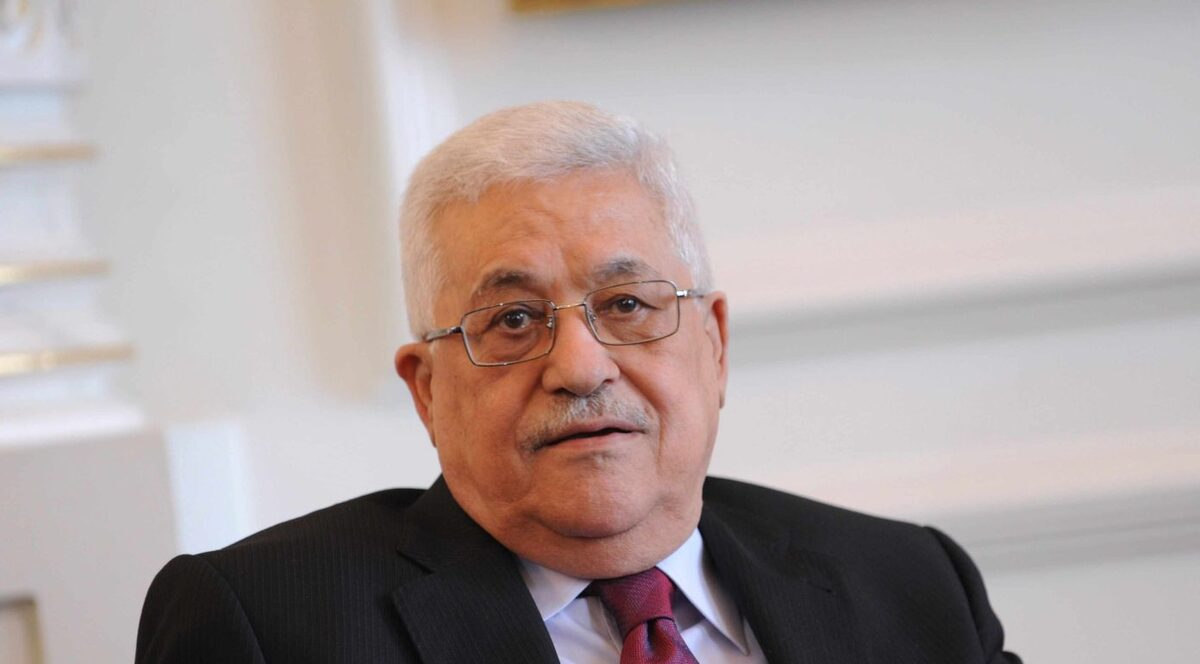
As part of its ongoing meetings, the Palestinian leadership held a meeting at the presidential headquarters this Wednesday evening, headed by the President of the State of Palestine, Mahmoud Abbas, to discuss the latest developments in the ongoing Israeli aggression and its crimes against our people in the Gaza Strip.


The attacks on our people in the West Bank, including East Jerusalem, continue.


The Palestinian leadership unanimously decided to adopt the following decisions:

▪ The leadership’s emphasis on adherence to all decisions taken on 7/3/2023 regarding the relationship with the occupying state, including the continued cessation of security coordination completely.


▪ The leadership affirms the legitimate right of our people to defend themselves, and that the mission of the Palestinian state institutions is to protect the Palestinian people, and everyone must bear their responsibilities while emphasizing commitment to international legitimacy and international law.


▪ Follow up on the cases brought, continue filing cases before international courts, and legally prosecute the occupation government at the international level for war crimes and crimes it has committed for which it bears full responsibility, in violation of international law and international humanitarian law.


▪ Emphasizing that our Palestinian people in Gaza are not alone, and we must stand with all our capabilities to protect our people in the Gaza Strip from the crimes of the occupation, and work with all concerned parties to lift the siege and provide medical and food relief materials, water and electricity.


▪ Emphasis on preventing the displacement of Palestinians from the Gaza Strip, and considering it a red line that we will not allow to be crossed, just as the displacement of Palestinians from their homes in Jerusalem or the West Bank should not be allowed.


▪ Emphasis on protecting our people in the West Bank and Jerusalem from invasions by the occupation forces, settler terrorism, and attacks on Christian and Islamic sanctities.


▪ Emphasis on continuing political and diplomatic action on the broadest scale and at the highest levels in order to stop the aggression, lift the siege on the Gaza Strip, bring in relief materials, prevent displacement, and pursue a political solution that ends the occupation through an international peace conference based on international legitimacy resolutions.


▪ Emphasis on providing international protection for our Palestinian people by implementing Resolution 2334, heading to the Security Council and moving with all parties and international forums.


▪ Preserving the unity of the Palestinian ranks, rejecting strife and being drawn into chaos, preserving the gains of our people and public and private property, and not diverting the compass from the desired goal.


▪ Adhering to national constants and the Palestine Liberation Organization as the sole legitimate representative of the Palestinian people, adhering to international legitimacy and continuing to work towards the State of Palestine gaining full membership in the United Nations and obtaining more international recognition, and embodying the sovereignty of the State of Palestine on the ground in accordance with Resolution 19/67.


▪ Emphasizing that security and peace will not be achieved unless the Palestinian people obtain their legitimate rights, ending the Israeli occupation of the land of the State of Palestine with East Jerusalem as its capital, and resolving the refugee issue in accordance with United Nations Resolution 194.


▪ The Palestinian leadership decided to keep its meetings in session permanently.

PALESTINE

Wed 18 Oct 2023 8:46 pm - Jerusalem Time

Israel approves restricted aid entry to Gaza at request of Biden... and an American veto against “humanitarian truce”

The office of Occupation Prime Minister Benjamin Netanyahu announced, on Wednesday, October 18, 2023, that it would allow restricted entry of humanitarian materials through Egypt into Gaza, at a time when America used its veto in the UN Security Council against a resolution calling for a humanitarian truce.


The Palestinian Ministry of Health announced that the death toll had risen to about 3,478 martyrs and more than 13,000 injured in the Gaza Strip since October 7.


Meanwhile, Netanyahu’s office said in a written statement: “At the request of President Biden, Israel will not thwart the provision of humanitarian aid from Egypt, as long as this aid contains food, water and medicine for the civilian population located in the southern Gaza Strip, or who are moving there, and so on.” As long as these supplies do not reach Hamas’ hands.”


Netanyahu's office indicated that "Israel will not allow any humanitarian aid to be provided through its territory to the Gaza Strip, unless our abductees are returned," and added: "Israel is demanding that Red Cross visits be arranged for our abductees, and it is working to mobilize broad international support for this demand."


Netanyahu's office announced that he had initiated these steps "in light of the widespread and vital American support for the Israeli war efforts, and based on President Biden's request to provide basic humanitarian aid."


Security Council

In this context, the United States used its veto in the UN Security Council against a resolution calling for a humanitarian truce in the conflict between Israel and the Palestinian Islamic Resistance Movement (Hamas) to allow aid to enter the Gaza Strip.


The vote was postponed twice over the past two days on the text drafted by Brazil, in light of the United States’ attempt to mediate the entry of aid into Gaza. 12 members voted in favor of the draft resolution today, while Russia and Britain abstained from voting.


Meanwhile, the Secretary-General of the United Nations, António Guterres, called for an immediate ceasefire on humanitarian grounds to allow the release of the hostages and the arrival of aid into Gaza.


The draft resolution also urges Israel, without naming it, to cancel its order for civilians and UN staff in Gaza to move to the southern Palestinian enclave, and denounces “the terrorist attacks launched by Hamas.”


Last week, Israel ordered about 1.1 million people in Gaza, or about half the population, to move south, as it prepares for a ground attack in response to the worst Hamas attack on civilians in Israel’s history, which dates back 75 years.


Israel imposed a comprehensive siege on the Gaza Strip and is targeting it with intense bombing. It vowed to eliminate Hamas after the armed Islamist group killed 1,400 people and took hostages in an attack on Israel on October 7.


The draft United Nations resolution condemned all acts of violence and hostilities against civilians, and all acts of terrorism, and called for the immediate and unconditional release of all hostages.


At dawn on October 7, Hamas and other Palestinian factions in Gaza launched Operation “Al-Aqsa Flood,” in response to “the continuing attacks by Israeli forces and settlers against the Palestinian people, their property, and their sanctities, especially Al-Aqsa Mosque in occupied East Jerusalem.”


During the operation, Hamas and gunmen from other Palestinian factions took “dozens of Israelis, including soldiers and officers,” during a large-scale infiltration of settlements around the Gaza Strip, according to what the movement announced at the time.


Source: arbipost

PALESTINE

Wed 18 Oct 2023 8:34 pm - Jerusalem Time

The attack will not be from Lebanon.. Qaani’s visit to Syria and Iraq reveals details of possible Iranian interference against Israel

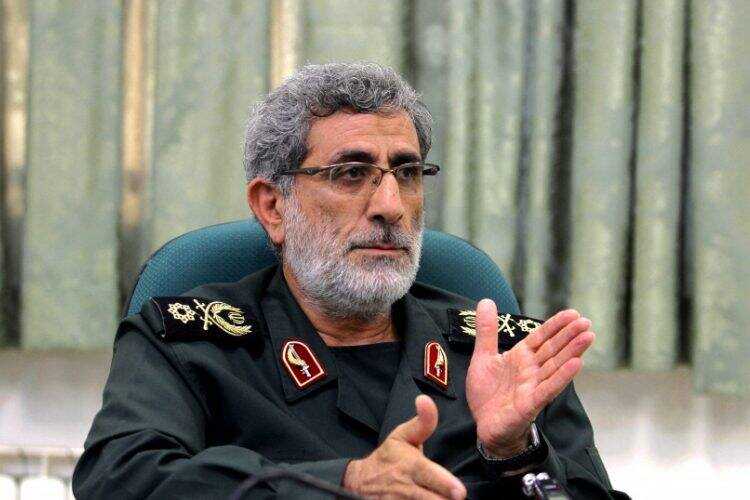
As Arab Post learned from Iranian and Iraqi sources that the commander of the Quds Force of the Iranian Revolutionary Guard, General Ismail Qaani, was on an unannounced secret visit to Syria on October 15, and the visit lasted two days.


According to Arab Post, the sources said the goal of Ismail Qaani’s visit to Damascus was to raise the state of maximum alert for Iran’s allies in Syria, and to establish a joint operations room for Iran’s allies in both Syria and Iraq to monitor the current situation and coordinate the deployment of forces.


Iranian Foreign Minister Amir Abdollahian responded to a journalist's question about whether Iran would enter the war in Gaza, saying: "All possibilities are possible, and I confirm that no party can remain indifferent to the situation in Gaza."


Details of Qaani’s visit to Syria

An Iranian military expert close to the Iranian Revolutionary Guard, specifically the Quds Force, revealed to Arab Post that Qaani visited Syria two days after Hamas’ attack on Israel, and then returned to Tehran to prepare Khamenei’s report.


The same source added that Qaani returned to Syria again on October 15, 2023 and established an operations room to tighten coordination between the allies. This room would make decisions in difficult or dangerous times, because it is primarily under the management of officers from the Revolutionary Guard.


Arab Post source indicated that Qaani's second visit was aimed at ensuring the readiness of the allies in Syria in the event that the situation developed and Israel launched a ground invasion into Gaza. Qaani himself also supervised a number of training exercises for the Fatemiyoun and Zainabiyoun brigades, which were placed on maximum alert.


According to Iranian military sources who spoke to “Arabi Post” earlier, fighters from the “Fatemiyoun and Zainabiyoun” brigades are still present in Syria, since they were established by General Qassem Soleimani to fight alongside Assad’s forces.


Qaani's trip to Baghdad

The trip of Quds Force Commander Ismail Qaani was not limited to Syria only, but he traveled to Baghdad to meet with the leaders of the Iraqi Shiite armed factions allied with Iran, according to what a leader in the Iran-backed Shiite Sayyid al-Shuhada faction revealed.


Arab Post reported  that the spokesman said that Qaani arrived in Baghdad on October 16, late at night, and we were waiting for him. He informed us of the latest developments regarding the intervention of the resistance axis in the Gaza war, how to coordinate between groups within the axis, and many logistical matters.


Arab Post  added that the source added to “Arabi Post”: “At the beginning of the war, we asked Qaani to be patient, especially with a number of Popular Mobilization Forces factions announcing their intention to target American targets in the region, but in his last visit he was seriously talking about the possibility of all factions of the Axis of Resistance participating during the next few weeks.” .


Arab Post  continued that according to the source from the Sayyid al-Shuhada Brigades in Iraq, the latest plans for possible intervention by the Shiite and pro-Iranian factions in Iraq in the war on Gaza are still largely unprepared yet.


He told "Arabi Post": "We have some plans and their alternatives. The Iranians also informed us during Qaani's visit of their possible plans, but they said that there are alternative plans that will be discussed in Qaani's next visit to Iraq."


It is worth noting that Iran and its allies in Syria, Lebanon, Iraq, Yemen, and Palestine call themselves the “Axis of Resistance,” and Tehran has worked in the past decade to greatly strengthen the network of its allies from the Axis of Resistance.


The escalation will be on the Syrian front

For his part, an Iranian intelligence official close to the Revolutionary Guards and the senior leadership told “Arabi Post” that “in the event of escalation, it will be from the Syrian side and not from Lebanon, in order to protect Hezbollah.”


The spokesman added, "Escalation on the part of Hezbollah will drag all of Lebanon into war, and this is what neither Hezbollah nor Iran wants, because Tehran wants to preserve Hezbollah's military infrastructure for as long as possible."


The source adds, saying: “Hezbollah is the strongest and most important member of the axis of resistance, and sacrificing it will cost us a lot. At the same time, this does not mean that Hezbollah is a key player in any escalation with Israel at the present time, but the beginning of the escalation will not be on its part, only on its part.” Keeping Israel's northern front busy now."


A source close to the Quds Force confirmed the intelligence official’s statement, telling Arab Post, “Iran does not want to risk Hezbollah now, even though Hezbollah’s current military capabilities will be very effective in inflicting heavy losses on the Israelis.”


The spokesman added that Iran's senior leadership is very concerned about the losses that Hezbollah will suffer, especially since in recent years it has acquired strong military and intelligence capabilities, in addition to the improvement of its economic situation and its military spending.


From where...from Syria?

Sources revealed to "Arabi Post" that Ismail Qaani, during his recent visit to Damascus, told Bashar al-Assad directly and seriously about the desire of Iran and the rest of the factions of the axis of resistance to equip the Syrian front. Because it will be the beginning of escalation against Israel if this happens.


A high-ranking Iranian official close to decision-making circles in Tehran said: “We know that Assad has no serious intention of entering the Gaza war, and he told Qaani that the situation in Syria is difficult at all levels, and he cannot tolerate entering into a new war, but at the same time he does not "He could refuse a request from his allies."

According to an Arab Post source, the Iranian plan to start escalation against Israel will begin specifically from the Golan Heights with a limited ground operation at first, and preparations for this plan have already begun a few hours after General Ismail Qaani left Damascus.

According to an Iranian military commander now in Syria, “Iranian forces and Hezbollah forces have been redeployed and stationed near the occupied Syrian Golan Heights,” adding: “We are now a few meters away from the Israeli forces.”

The matter did not stop at the redeployment of Iranian and allied forces in Syria, but according to the military commander, Iran was able to introduce many weapons and drones into Syria in the past few days.


An Arab Post source said, "Everything is ready and waiting for a decisive decision. We have missiles, drones, jamming devices, and fighters to attack Israel."


Did Russia agree?

In 2018, Israel and Russia signed the Security Belt Agreement in the Golan Heights. To ensure that Iranian forces do not target the Israeli occupation forces, Russia guaranteed to Israel the removal of all Iranian factions and factions opposing Bashar al-Assad from the Golan Heights.


Therefore, the redeployment of Iranian and Hezbollah forces in this region of the Golan Heights primarily requires Russia’s approval. Has Moscow agreed to this matter?


An Iranian diplomat close to decision-making circles in Tehran answers this question, telling Arab Post: “Russia agreed to the redeployment, but has not yet agreed to start from the Golan Heights in the event of an escalation with Israel, but there are many calls and conversations between us and the Russians.” To resolve this point.


It is noteworthy that Russia did not describe Hamas's recent attack on the Israeli occupation as a terrorist act, and this is noteworthy, because during the second Palestinian intifada in 2014, Putin stated that "Israel faces terrorism, and that there should be no negotiations with terrorists."


Putin had linked the second Palestinian Intifada to the military campaign launched by Russia in the Second Chechen War, saying: “The militants in Chechnya want to send fighters to Palestine.”


This time, Russian President Vladimir Putin commented on the Islamic resistance’s attack on the Israeli occupation as an unprecedented attack in history.


Iranian political analyst close to the Iranian government, Ali Najafi, said, “Russia’s positions changed after the Russian-Ukrainian war, and Moscow’s political priorities in the region became close to Tehran, so it is not strange that Russia avoided describing Hamas as a terrorist after its conflict with the West.”


What about Iran's allies in Iraq and Yemen?

In the wake of the attack by the military wing of Hamas on the Israeli occupation, many statements were issued by the leaders of the Iraqi Shiite armed factions allied with Iran.


Abdul-Malik al-Houthi, the leader of the Ansar Allah group, known as the Houthis in Yemen, which is supported by Iran, threatened Israel and the United States with launching attacks on American interests if Washington provided support to Tel Aviv in its war against the Gaza Strip.


In this regard, a leader in an Iraqi Shiite armed faction told “Arabi Post”: “Iraqi factions will have a major role if the war on Gaza intensifies. We are in the process of redeploying and stationing fighters along the Iraqi-Syrian border.”


He added, "Our role in Iraq is to target American targets on Iraqi soil, and it will be no less important than the participation of the rest of the factions of the axis of resistance in Syria and Lebanon."


According to the same source, the resistance factions in Iraq have their own plan that has been discussed with the Iranian side, in the event of issuing orders to clash and intervene in the ongoing war between Israel and Hamas.


The source said: “We are on high alert and have our own military plans, which will be coordinated with Hezbollah, the Iranians, and the resistance factions in Syria and Yemen at the appropriate time.”


As for the Houthi group in Yemen, the Iranian source close to the Revolutionary Guards told Arab Post: “In the talks between the resistance factions, the Houthis announced that they are ready to target everyone who supports Israel in the current war.”


According to the same source, it is expected that officials from the Houthi group will travel to Iraq during the next few weeks to discuss ways of cooperation between them and the Iraqi factions in the event that the “axis of resistance”, led by Iran in the region, enters the line of confrontation.


Source: arabipost


ARAB AND WORLD

Wed 18 Oct 2023 8:22 pm - Jerusalem Time

Biden Reiterates his old saying: If there was no Israel, we would work to establish it

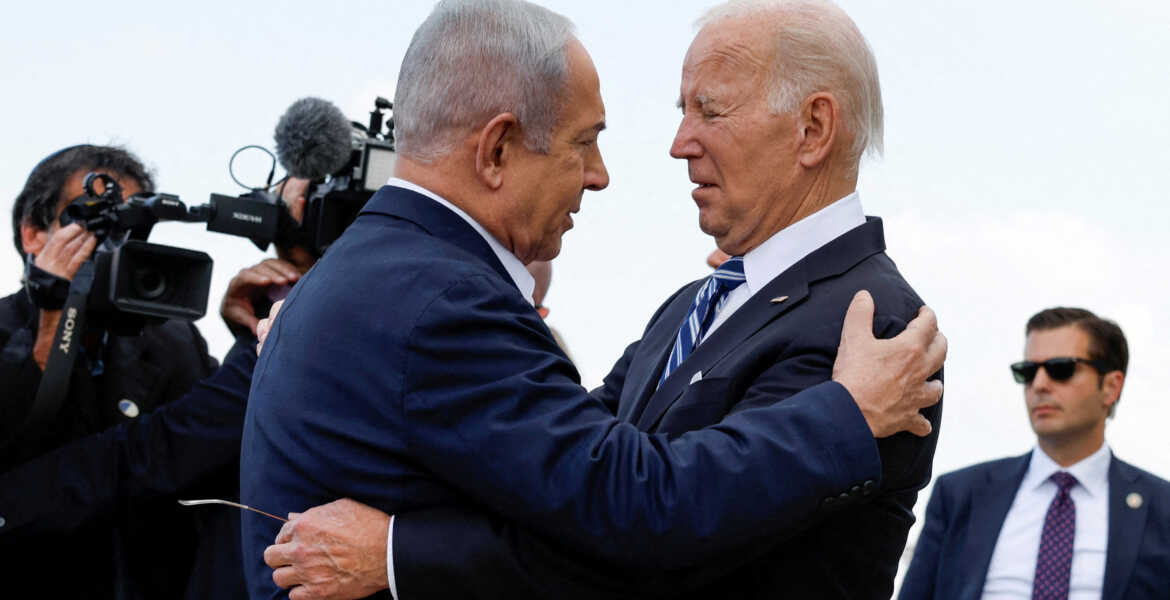
US President Joe Biden said - today, Wednesday - during his "solidarity" visit to Tel Aviv that Israel must return to a safe place for Jews, he Reiterated his old saying: If there was no Israel, we would work to establish it


Biden added that the operation of the Palestinian resistance movement (Hamas) left a deep wound on the Israelis, likening the "Al-Aqsa Flood" operation to being 15 times greater than the attacks of September 11, 2001.


Biden addressed the Israelis, saying that there were those who wanted to break their will, but he “did not succeed,” expressing his solidarity with their “pain” as a result of Hamas holding about 250 prisoners.

In his speech, the American President stressed the priority of the issue of releasing prisoners.


Biden pointed out the need to work on a two-state solution and integrate Israel into its surroundings, stressing that the United States stands by Israel during what he described as the dark days.


During his visit, which came after the Baptist Hospital massacre, the US President warned other countries against attacking Israel, while adopting the Israeli narrative that holds the Palestinian resistance responsible for the bombing of the hospital, citing data presented to him by the US Department of Defense.


Biden also stated that he will ask Congress to provide unprecedented supplies to Tel Aviv this week to support Iron Dome and the State of Israel in general.


Biden read his speech at a hotel in Tel Aviv, amid intense security measures, with snipers stationed on the rooftops of nearby houses.


The US President considers Israel's presence in the Middle East to protect their interests in the region, as he affirmed in more than one speech the United States' full and unconditional support for Tel Aviv.

PALESTINE

Wed 18 Oct 2023 8:04 pm - Jerusalem Time

Putin's five goals in Middle East as the conflict between Israel and Hamas intensifies

Russian President Vladimir Putin, mired in a conflict with Ukraine from which he sees no way out, finds in the confrontation between the Hamas movement and Israel an unexpected, but risky, way to move the geopolitical lines in the region, according to a report prepared by Agence France-Presse.


Here is an overview of the Russian President's five major goals, some of which were no doubt discussed in his talks today (Wednesday) with his Chinese counterpart, Xi Jinping, on the sidelines of the New Silk Roads Forum in Beijing:


Removing Ukraine from the spotlight

600 days after the start of the war in Ukraine that is likely to continue for a long time, the crisis in the Middle East allows the international community to divert attention from the Ukrainian crisis.

Deputy Director of the French-Russian Observatory, Igor Delanoue, says, “The Hamas attack contributes, due to its consequences, to depleting general Western interest in Ukraine.”


Alexander Gabuev, from the Carnegie Center, explains that “this conflict is a blessing for Russia because it diverts a lot of attention from the United States and the West,” stressing that the American administration intends to devote a lot of time to the current crisis in the Middle East, at least until the presidential elections. In November 2024.


This perspective complicates Vladimir Putin's game, as a Republican victory would serve his interests because some of them seek to reconsider American aid to Kiev. The Israeli issue is also very sensitive among the American right.


Avoid clutter

The Middle East is a region of great importance to Russia, and some voices in the West have even expressed doubts that the Kremlin played a role in the attack launched by Hamas on Israel on October 7.


But there is no concrete evidence to confirm this hypothesis. “I have not seen any evidence of direct Russian support for Hamas and this attack - in terms of planning, weapons and execution,” says Hannah Knott, an analyst at the Center for Strategic and International Studies (CSIS), a think tank in Washington. “Let us be clear: Russian assistance was not necessary.”


Tatiana Stanovaya, founder of the specialized website RPolitik, believes, for her part, that “a severe escalation, which could even lead to an open conflict between Iran and Israel, could harm the established Russian presence in the Middle East and the current status of its campaign in Syria.”


It stresses that Russian military bases in Syria allow “to highlight Moscow’s influence in Africa and the Middle East.”


Improving Iran's situation

The rapprochement between Tehran and Moscow has become one of the keys to Russian diplomacy, especially with the extensive use of Iranian drones in Ukraine. Tehran is a major supporter of the Hamas movement, similar to Hezbollah in Lebanon. Here too, Moscow appears to be pulling the strings of the game. “Russia’s war in Ukraine has strengthened military relations with Iran,” says Nigel Gould-Davies of the International Institute for Strategic Studies (IISS). Hamas officials have visited Moscow at least three times since Russia invaded Ukraine.


He added: “The question has always been how far this cooperation can reach without causing Israel to rethink its relations with Moscow.” Moscow also fears that any harsh retaliation against Iran would weaken one of its few close allies.


Arranging the situation in Israel

At the same time, Moscow must be careful to arrange Israel's situation, especially since personal relations are good between Vladimir Putin and Israeli Prime Minister Benjamin Netanyahu.


Since the beginning of the war in Ukraine, Israeli military factories have not delivered any weapons to Kiev's forces.

Dmitry Minnik, of the French Institute of International Relations, says: “The Kremlin has so far succeeded in keeping Israel out of the war in Ukraine, and would like this Western country not to be an additional supporter of Ukraine.”

However, the Russian President refrained from describing the Hamas attacks on October 7 as “terrorist,” as the West did.

This position “indicates the change in his political priorities” and the fact that he is now addressing pro-Palestinian public opinion in the Middle East and Southern Hemisphere, according to Hannah Knott, of the Center for Strategic and International Studies.


Weakening the West

The primary goal of Russian diplomacy is to weaken the Western world order, a project shared in particular by its Chinese, Iranian, and North Korean allies.


The Kremlin head also directly blamed Washington for the crisis in the Middle East.

In this regard, Tatiana Stanovaya believes that the situation in the region “contributes to spreading anti-Western rhetoric by accusing it of causing global instability and reopening historical conflicts.”


Igor Delanoe points out that “Israeli retaliation against Gaza is characterized by a torrent of fire, which will undoubtedly highlight what may be considered double standards in the Western reaction to the use of force.”


Dmitry Minnik, from the French Institute of International Relations, says: “What unites part of the countries of the South and Russia is not so much the exchange of positive values, but rather resentment, even hatred, and often an irrational perception of the West,” adding: “This relationship with the West has sources.” Several constitute inexhaustible fertile ground for Moscow.


Source: Al Sharq Al Awsat


PALESTINE

Wed 18 Oct 2023 7:48 pm - Jerusalem Time

Israel closes the entrances to Bezaria, northwest of Nablus

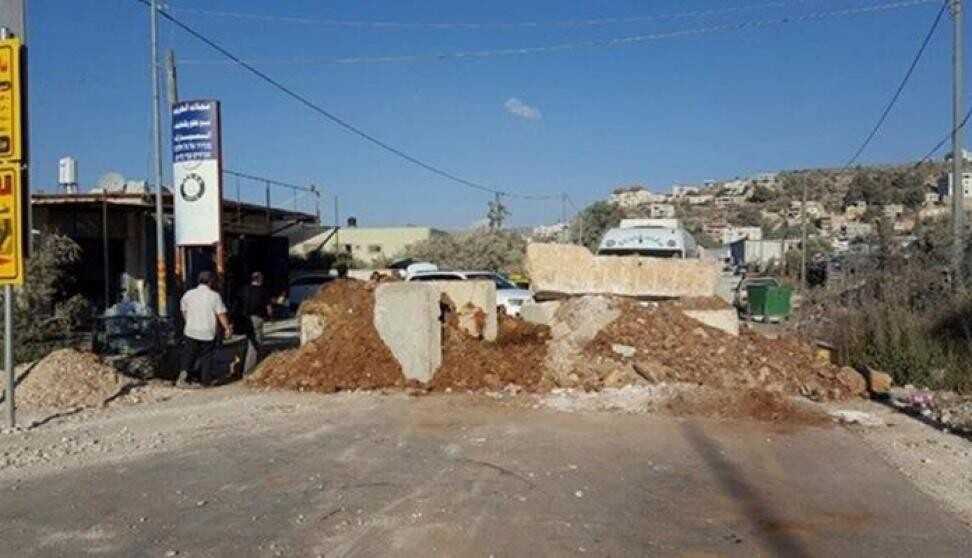
On Wednesday evening, the Israeli occupation forces closed the main entrance to the village of Bzearia, northwest of Nablus, with dirt berms.


Eyewitnesses said that the occupation forces, accompanied by a military bulldozer, stormed the village and closed the eastern entrance with dirt barriers, which obstructed the movement of citizens in the village, and the movement of citizens between the cities of Jenin and Tulkarm.


This evening, the entrance to the village witnessed an attack by colonists on citizens’ vehicles, which resulted in a woman being hit in the head with a stone, and the windows of a number of vehicles being shattered.

OPINIONS

Wed 18 Oct 2023 7:45 pm - Jerusalem Time

An Operation that crosses all ideologies

Translation for "Al-Quds" dot com

Translation for "Al-Quds" dot com

Opinion Writer

By Dr. Amro El Shobaki


The Palestinian issue was not just the issue of a people struggling to regain their land and build their independent state. Rather, from the first day of Israel’s establishment, it opened the door to an intellectual debate about the nature of this conflict and ways to solve it. The Arabs knew a division between moderates and extremists, supporters of a peaceful solution and armed conflict, and an ideological disagreement about Tools for managing this conflict and the position on the existence of Israel.


The Hamas operation on October 7 succeeded in restoring a large part of the Arab divisions over the Palestinian issue, and expressed some of the ideological differences about the path of settlement and peaceful solutions. It was not just a military operation that caused this unprecedented number of victims. The Israelis were also characterized by mastery, professionalism, and strategic deception, in which “Hamas” succeeded in deceiving everyone when it refrained from participating in the recent confrontations between “Jihad” and Israel, as many Western reports and research papers came out that talked about “Hamas’ neutrality,” including one of the papers “ Carnegie Center for Peace” under the title “Hamas from Resistance to Neutralization,” following its non-participation in the armed confrontations that took place last May, and that the matter had nothing to do with neutrality or only preoccupation with managing the affairs of the Gaza Strip, but rather was a process of deception. A complete strategy that made observers in the West and Israel believe that Hamas was on its way to becoming an “administration” and not a resistance movement.


Hence, the Hamas operation, despite the violence of the Israeli reaction and its harsh repercussions on the Palestinian people, nevertheless entered the path of elaborate and professional operations that were absent from many of the practices of the forces of resistance and extremism, which were often characterized by randomness, flashy slogans, and a preoccupation with outbidding the forces of moderation. Without offering a real alternative.


The truth is that any look at previous confrontations between armed resistance factions and Israel will discover a huge difference between the Palestinian victims and their Israeli counterparts. The 2008 clashes killed 13 Israelis compared to 1,400 Palestinians, and the 2014 summer confrontations lasted 50 days and were led by the Hamas movement, in which 73 Israelis were killed compared to more than 2,000 Palestinians. And the armed confrontations between the “Jihad” movement and Israel in 2019 and 2022, and then last May also witnessed a big difference between the Palestinian and Israeli victims.


It is certain that the position on all of these operations represented one of the main aspects of disagreement between the movement of moderation and peace settlement, and the forces of opposition and armed resistance, especially since Israel seemed not to be concerned about the option of armed resistance due to its limited impact, because if one Israeli was killed, it would be met with the death of 100 Palestinians.


It is certain that the October 7th operation was different from all previous armed confrontations that dealt a sudden and unprecedented blow to the Israeli side, and its professionalism and accuracy neutralized the main criticism directed at the armed resistance factions and the Arab resistance movement since the defeat of 1967, that they are movements concerned with ideological slogans and banners. It is far from being professional and capable of effective deterrence and resistance.


It is true that the killing of 1,300 Israelis was met with an earth-shattering Hebrew response, the price of which was paid by civilians in the Gaza Strip, and that Israel’s strategy is now based on dismantling Hamas’ military power and targeting its military and political leaders alike through a ground invasion.


However, this extremely violent and oppressive response only vaguely raised the usual “ideological” question in the Arab world, especially Egypt, about the feasibility of armed resistance operations and the returns from them, which had been raised forcefully in previous times.


This transformation is due to two things: The first, as we previously pointed out, is the strength and professionalism of the Palestinian process, and everyone discovered after 20 years of Israeli settlement policies that it emptied the Arab moderation project of its content after it destroyed the Oslo Accords and the two-state solution and completely weakened the Palestinian Authority. As for the reason? 

The second is due to the blatant American and Western bias towards Israel politically and in the media (the media performance of a number of major Western newspapers has improved in recent days after witnessing the Gaza massacres), which made the Arab division between moderates and opponents decline significantly, because the principled position of the Arab Moderation Movement is to refuse to harm any civilian and its disagreement with the forces of resistance and armed resistance do not call for the killing of civilians, but consider targeting them as a response to the crimes of the occupation. 

Both trends discovered that the leaders of major democratic countries distinguish between Palestinian and Israeli civilians on national, religious, and cultural grounds, a position that was shocking to Arab public opinion with its various political orientations and ideological differences. .


The blatant Western and American bias towards Israel and considering that there are victims to be mourned for and others who are worthless, everyone questioned the greater values related to justice, international legitimacy and equality between peoples, and led to a decline in ideological differences in the Arab world regarding the position on the path of settlement and the disagreement between supporters of normalization and its opponents and between options for extremism. And moderation.


What is happening in Gaza, despite its tragedies, has put the Arab world, perhaps since the 1973 war, before major questions related to identity and how the world views them, their issues and their priorities, not only with regard to the Palestinian issue but also to the rest of the issues, and these are questions closer to the “existential” questions that have been covered in a way. It greatly affects the ideological divisions between moderates and extremists, and between supporters of peace and supporters of war, which is a remarkable shift whose repercussions will be significant.


Source: Al Sharq Al Awsat


PALESTINE

Wed 18 Oct 2023 7:29 pm - Jerusalem Time

Israel marginalizes prisoner negotiations and insists on liberating them by force

At a time when Turkish Foreign Minister Hakan Fidan announced, from Beirut, that his country was holding talks for the purpose of mediating the release of Israeli and foreign prisoners from Hamas captivity in the Gaza Strip, and that the countries of the world to which the foreign prisoners belong had blessed this step and assigned him to negotiate on their behalf, The Israeli government continued to marginalize these negotiations and insist on liberating the prisoners by force.


The new Israeli official in charge of this file, Brigadier General Gal Hirsch, said that the government is making great efforts on the issue, but he did not provide any details and did not express any intention to enter into negotiations. He said, "Hamas must release them unconditionally."


Israel initially rejected any talk of mediation to conclude an exchange deal. It rejected a proposal for a preliminary deal, according to which children, the elderly, women, and sick Israeli and foreign prisoners would be released, in exchange for sick, women, and children Palestinian prisoners in Israeli prisons as well. But the American administration, along with strong support for Israel, requested a change in the Israeli approach and placed the issue of prisoners at the top of the scale of attention. It sent a specialized delegation to address this file, including Stephen Gillan, Deputy Presidential Envoy for Prisoners and Missing Persons Affairs, and a group of American experts on the subject.


In a meeting with Hersh and his crew, Gilan said that the United States stands by the security of Israel and the return of its prisoners, and that the United States has a specialized staff that works permanently to follow up on the affairs of prisoners and missing persons, and that it also has a number of figures who participated in negotiations to release prisoners in several places in the world. He has gained rich experience in this field, and he personally and all his team put their energies into serving the State of Israel to help release the hostages.


An American team remained in Tel Aviv to follow up on the issue and prevent it from being marginalized. With the publication of information about the prisoners and the revelation that at least a fifth of them were foreign citizens: French, British, Germans, Chinese, Thais, South Africans and others, their countries began to exert pressure to change the Israeli approach and demand that Benjamin Netanyahu’s government be careful in its bombing so that none of the prisoners would be harmed. In Israel, too, many voices have been raised demanding that the government change its approach and abandon its stubborn position of not concluding exchange deals. Two Hebrew newspapers called on the government to put the release of Israeli and foreign prisoners at the top of its attention, even if the price is the release of all Palestinian prisoners and the closure of prisons.


Hence, the Turkish proposal was encouraging to those who support this position and demand a deal to release them. On Tuesday evening, it was published in Israel that “a support ship from Turkey docked in Haifa port carrying 4,500 tons of vegetables, 80 percent of which were tomatoes, requested by Israel after its agricultural sector was damaged by the war in Gaza.” This rapid assistance was considered a goodwill gesture from Ankara to facilitate dialogue on the necessity of concluding a deal. Sources in Tel Aviv said that Turkey maintains an open line of communication with the Hamas leadership and received a green light from this leadership to conduct negotiations. It confirmed that the statements made by Abu Ubaida, spokesman for the military arm of Hamas, about the status and numbers of prisoners, and the publication of the tape in which the Israeli prisoner of French origin, Maya Shem, appeared, is part of the response of the Hamas leadership to Turkey.


The Al-Qassam Brigades, the military wing of the Hamas movement, had published a tape on Monday, in which Shim appeared receiving medical care after suffering an injury to her right hand. She said that she is 21 years old and that she is still in Gaza. The prisoner praised the treatment of the “Al-Qassam” officers, explaining that “she was injured in the hand and underwent a 3-hour surgery, and they took care of her and provided her with the required medicine, care and medication.” She asked to return to her family “as quickly as possible,” saying: “Please get us out of here.”


The Israeli army responded to this tape with a statement published on the “X” platform in which it said that its representatives were making “contacts with the family,” considering that “Hamas is trying, by publishing the video, to show itself as a humanitarian organization.” He stressed that he "is working with all intelligence and operational means to return the kidnapped people."


In Paris, the publication of the tape sparked widespread reactions. The Elysee Palace said that President Emmanuel Macron “denounces the kidnapping of innocent people and calls for their immediate liberation” and that he is “committed to releasing the citizens of his country,” amid expectations that he will visit Tel Aviv to “stand in solidarity with it against (Hamas) terrorism and seek to release the prisoners and provide food aid to the people of Gaza and address their suffering.” Great humanity.


Sources in Tel Aviv said that Western countries disagree with Israel and show a willingness to negotiate the release of the hostages, and when they reach an agreement through their own efforts, they will seek to persuade Israel and perhaps pressure it until it accepts it and releases prisoners to help free the rest of the prisoners.


It is noteworthy that Israel estimates the number of prisoners at two hundred people, while Abu Ubaida announced that their number is between 200 and 250 prisoners or more. Hamas holds prisoners in underground detention centers in various places and claimed that 9 of them were killed due to Israeli bombing.


Source: Al Sharq Al Awsat

ARAB AND WORLD

Wed 18 Oct 2023 7:27 pm - Jerusalem Time

China condemns Israeli attack on the Baptist Hospital in Gaza

On Wednesday, China condemned the Israeli attack that targeted the Baptist Hospital in Gaza, which resulted in the death and injury of hundreds of Palestinians, expressing its shock.


A Chinese Foreign Ministry spokesman said: “We mourn the victims and express our sincere sympathy to the injured.”


He added: "China calls for an immediate ceasefire, a cessation of hostilities, and every effort to be made to protect civilians and avoid a worse humanitarian catastrophe."


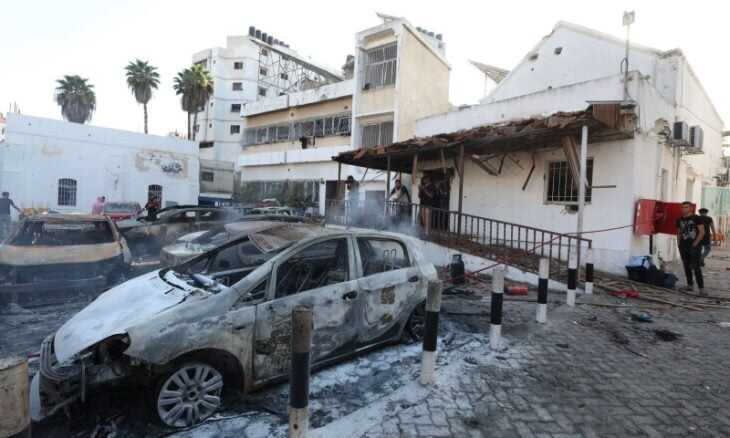
On Tuesday evening, the Israeli occupation forces committed a new massacre that resulted in the martyrdom and injury of hundreds of our people in the Gaza Strip, after bombing the Arab National Hospital (Al-Baptist) in the Al-Zaytoun neighborhood in Gaza City.

PALESTINE

Wed 18 Oct 2023 7:14 pm - Jerusalem Time

Great tension in Palestinian-American relationship due to Washington's position on war

  1. Conviction in Ramallah, Amman, and Cairo that Israel will revive the plan of displacement to Sinai and Jordan
  2. The relationship between the American administration and the Palestinian Authority is marred by great tension these days, against the backdrop of unlimited American support for Israel in its war on the Gaza Strip.

  3. Palestinian sources told Asharq Al-Awsat that the main disagreement with the United States today is related to America’s position in support of the continuation of the war on the Gaza Strip “until the end that Israel wants.”

  4. According to the sources, the American administration does not want to stop the war, but rather “lift the cover on Hamas, Palestinian and Arab, and neutralize the other fronts,” which is the main reason for the worsening dispute.

  5. The sources confirmed that the cancellation of the quadripartite summit, which was supposed to bring together US President Joe Biden with Jordanian King Abdul II, Egyptian President Abdel Fattah El-Sisi, and Palestinian President Mahmoud Abbas, in Amman, on Wednesday, came after the Arab presidents realized that it would not lead to any progress in terms of Stopping the war, and that this was not acceptable after the Baptist Hospital massacre, in which Israel killed about 500 Palestinians who fled with their families to the hospital.


Source: Asharq Al-Awsat

ARAB AND WORLD

Wed 18 Oct 2023 6:38 pm - Jerusalem Time

Israel calls on its citizens to leave Türkiye and evacuate some of its embassies

Today, Wednesday, Israel asked its citizens to leave Turkey as soon as possible after angry demonstrations in front of the Israeli embassy in Ankara following the Baptist Hospital massacre yesterday. It also evacuated the employees of its embassies in Morocco and Egypt.


The Israeli Consulate in Ankara raised the security alert for Israelis in Turkey to the highest level.


While the Israeli National Security Council justified the request to leave with “increasing terrorist threats against Israelis abroad,” warning Israelis against traveling to Turkey.


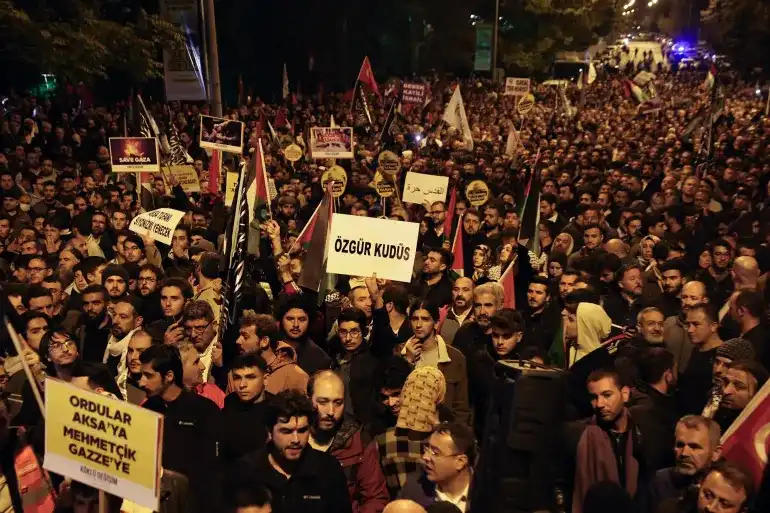
Demonstrations took place in about 12 Turkish cities yesterday, Tuesday, especially in front of the Israeli embassy in Ankara, denouncing Israel's bombing of the Baptist Hospital, which resulted in the death of at least 500 Palestinians, most of whom were women and children who took refuge in the hospital because they believed it was safe.


Evacuation of embassies

The Israeli newspaper Yedioth Ahronoth reported that the Israeli Ministry of Foreign Affairs evacuated the employees of its embassies in Cairo and Rabat, after demonstrations condemning the bombing of Baptist Hospital.


Thousands of Egyptians demonstrated today in a number of governorates, including Minya in the south, Dakahlia, and Menoufia in the Nile Delta, denouncing the ongoing Israeli aggression against Gaza since October 7, in the wake of Operation “Al-Aqsa Flood” launched by the Palestinian resistance.


For its part, Morocco denounced - in a statement by its Foreign Ministry - the Israeli bombing of the Baptist Hospital in the Gaza Strip, and thousands demonstrated in Rabat last Sunday in support of the besieged Gaza Strip and to denounce normalization with the Israeli occupation.

ARAB AND WORLD

Wed 18 Oct 2023 6:33 pm - Jerusalem Time

The Baptist Hospital massacre... Lebanon warns of a fire consuming the region, and Turkey declares mourning

Today, Wednesday, Arab and international reactions to the Israeli bombing of the Baptist Hospital in Gaza City, which resulted in the death of about 500 Palestinians and the injury of hundreds of others, continued. In contrast, US President Joe Biden adopted the Israeli story that claims that the hospital was hit as a result of a “missile launch failure” by the Palestinian resistance. Yesterday evening, Tuesday, several countries and international organizations held Tel Aviv responsible for the massacre, while others called for an investigation to determine the party responsible for what happened.


The following is a new series of Arab and international positions that followed the positions that were recorded hours after the massacre: Lebanon Lebanese Foreign Minister Abdullah Bouhabib said, on the sidelines of the ministerial meeting of the Organization of Islamic Cooperation in the Saudi city of Jeddah, that the continuation of the aggression against Gaza may ignite a fire that will consume the entire region. TurkeyA Turkish official announced that his country will declare national mourning for 3 days after the bombing of the Baptist Hospital in Gaza.Iran Iranian President Ibrahim Raisi said - today, Wednesday - that the crimes committed in Gaza and Palestine will be met with revenge from the peoples and the Islamic nation. Spain Spain condemned the Israeli attack on the Baptist Hospital in Gaza It described it as a "massacre." Italy Italian Deputy Prime Minister and Foreign Minister Antonio Tajani said he felt pain over the killing of hundreds in the Baptist Hospital in Gaza, stressing the need to protect civilians in all circumstances. Norway Norwegian Foreign Minister Espen Barth Ede expressed his deep concern about Israel's targeting of a hospital Crowded with displaced people in Gaza, he said that hospitals are protected under international humanitarian law and attacks against them are illegal, calling for the protection of civilians and health institutions.


Finland

Finnish President Sauli Niinistö described the bombing of the Baptist Hospital as “terrifying,” calling for respect for international humanitarian law in all circumstances and opening an investigation into the violations.


China

Today, Wednesday, China strongly condemned the Israeli attack on the Baptist Hospital in Gaza, and said that it was shocked by that. Afghanistan: The spokesman for the Afghan interim government, Zabihullah Mujahid, said that Israel is committing a war crime in Gaza, stressing that those who support these Israeli practices or remain silent about them They are considered partners in this injustice.


Brazil

Brazilian President Lula da Silva said - today, Wednesday - that the raid on the Baptist Hospital in Gaza was an “unjustifiable tragedy,” and renewed his call for international humanitarian intervention and a ceasefire in the region. Cuban President Miguel Díaz-Canel strongly condemned the targeting of the Baptist Hospital, and said: His country condemns in the strongest terms the Israeli bomb attack on this hospital.


Canada

Canadian Prime Minister Justin Trudeau said that news of the attack on Baptist Hospital in Gaza was "horrific and completely unacceptable," adding that "it is unacceptable to bomb a hospital."


Australia

Australian Prime Minister Anthony Albanese condemned the targeting of Baptist Hospital in Gaza, and described the scenes coming from there as very sad, saying that the lives of civilians are important, whether they are Israelis or Palestinians.


Source: Al Jazeera + agencies

PALESTINE

Wed 18 Oct 2023 5:54 pm - Jerusalem Time

Israeli artillery bombards villages in southern Lebanon

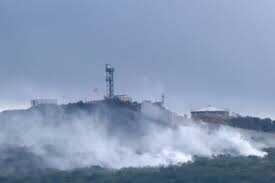
Today, Wednesday, Israeli occupation artillery bombed the outskirts of Shebaa Farms, Kfar Shuba, Halta, and Al Khraiba in southern Lebanon, and the bombing targeted farms in Kfar Shuba.


The Lebanese border is also witnessing intense flights of Israeli reconnaissance planes and helicopters in the airspace of the villages of Mays al-Jabal, Hula, Markaba, and Al-Adiseh in southern Lebanon.

PALESTINE

Wed 18 Oct 2023 5:50 pm - Jerusalem Time

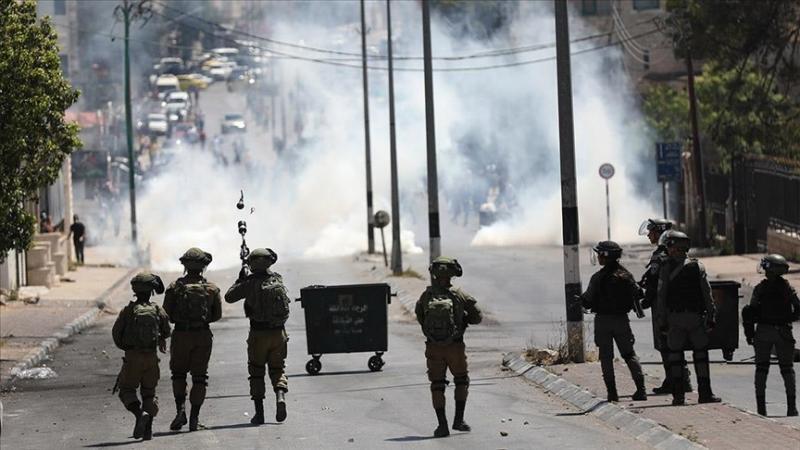
Updated: Clashes with Israeli army in the West Bank

Two citizens were injured by Israeli occupation bullets, and a woman was hit with a stone in the head, this evening, Wednesday, during confrontations that broke out with the Israeli occupation forces in the West Bank.


In Bethlehem, a young man was injured by live bullets in the village of Dar Salah, east of the city.


According to local sources, the confrontations were concentrated in the Wadi al-Hummus area, located between the villages of Dar Salah, east of Bethlehem, and Sur Baher, Jerusalem, where the occupation forces fired bullets, poison gas bombs, and sound bombs, which led to the injury of a young man with a live bullet in the abdomen. He was transferred to one of the centers. Medical.


In Nablus, a citizen was injured by live bullets during clashes that broke out at the Huwwara military checkpoint, south of Nablus.


Palestinian Red Crescent sources reported that a young man was injured by live bullets in the foot and was taken to the hospital to receive treatment.


Meanwhile, a 48-year-old woman was injured by a stone in the head as a result of settlers attacking citizens’ vehicles near the town of Burqa, north of Nablus. She was transferred to Rafidia Governmental Hospital to receive treatment.


Local sources explained that settlers closed the entrance to the eastern village of Bazaria, on the road between Jenin and Nablus, and opened fire on citizens' vehicles and smashed their windows.


ARAB AND WORLD

Wed 18 Oct 2023 5:28 pm - Jerusalem Time

Lebanon's' Hezbollah targets Israeli soldiers in southern Lebanon

The Lebanese Hezbollah published clips of what it said was an operation targeting soldiers in the Israeli occupation army at the Ramya site in southern Lebanon.


According to what was stated in the video clip, the Ramya site includes “a border company command within the Zarit Battalion sector of the Western Brigade in the Galilee Division,” and contains many technical surveillance devices and communications media, and the site is occupied by a vehicle company from the 605th Engineering Forces, reinforced by a platoon of armored vehicles. 


A correspondent reported Al Jazeera reported earlier that light weapons fire had occurred in the vicinity of the town of Zarit near the Israeli-Lebanese border, while Israeli bombing targeted the vicinity of the towns of Alma al-Shaab and Ramiya in southern Lebanon. For its part, the Israeli army said that some of its positions on the Lebanese border were subject to fire, adding that His forces respond to the sources of fire.


Source: Al Jazeera

PALESTINE

Wed 18 Oct 2023 5:23 pm - Jerusalem Time

Demonstrations in Arab and Islamic capitals denouncing the bombing of Baptist Hospital

Demonstrations and protest events continued in several Arab and Islamic cities denouncing the Israeli aggression on Gaza and the Baptist Hospital massacre, which was committed by the Israeli occupation forces and left more than 500 martyrs.


  • Tunisia
    Several demonstrations were launched in Tunisian cities denouncing the Israeli massacre, and the National Salvation Front and the Tunisian General Labor Union called for protests in the Tunisian capital. The demonstrators raised slogans demanding an end to the Israeli attack on the Gaza Strip, and stressing solidarity with the Palestinian people.


A number of Tunis residents also went out in a demonstration in front of the French embassy to express their protest against the massacres committed by the Israeli occupation.


  • Sultanate of Oman
    Dozens of Omanis participated in a protest in front of the US Embassy in Muscat, denouncing the Israeli massacres against the Palestinian people. The demonstrators raised slogans in solidarity with the Palestinian resistance and rejected normalization with the occupation.


  • Iraq
    Iraqi institutions witnessed several protests denouncing the bombing that targeted the National Baptist Hospital in Gaza.


At the University of Baghdad, thousands of students and professors organized a protest in which they declared their solidarity with the Palestinians, during which they demanded an end to the Israeli attacks.

Yesterday, Tuesday, Prime Minister Muhammad Shiaa Al-Sudani directed employees and members of all state departments, facilities and formations, and students of universities and schools throughout Iraq, to perform a stand of solidarity and mourning in their workplaces in loyalty and reverence for the innocent souls of the Palestinian people who were martyred in the attack on the Baptist Hospital in Gaza.


  • Iran
    Iranians demonstrated this Wednesday morning in the cities of Mashhad, Tehran, Diyar Kariman and Arak, in solidarity with the people of Gaza and to denounce the Baptist Hospital massacre in which hundreds were martyred.


  • Jordan
    Jordanian pages published a live broadcast of dozens of students at Al-Hussein Bin Talal University in Jordan, in a demonstration of solidarity with the people of Gaza and the massacres they are being subjected to.

  • Lebanon
    Demonstrations took place in Palestinian refugee camps and cities in Lebanon, in solidarity with Palestine, and hundreds of people from Nabatieh, southern Lebanon, gathered in a solidarity stand called for by Hezbollah in solidarity with Gaza and in denunciation of the massacres against children.

Lebanese media platforms published scenes of a protest by health teams in the Ain al-Hilweh Palestinian refugee camp.


  • Morocco

In Morocco, lawyers stood in Casablanca in protest against the crimes of the occupation against the Palestinian people.


  • Idlib
    Dozens of Atma residents in the Idlib countryside, northern Syria, went out in a demonstration, raising Palestinian flags, in solidarity with Gaza and the crimes it is being subjected to by the occupation army.

  • Egypt
    Dozens of students from Minya University in Upper Egypt, Mansoura University and Fayoum University organized a massive demonstration on Wednesday in support of the Palestinian cause, rejecting the Israeli aggression on Gaza, and denouncing the bombing of the Baptist Hospital, which left hundreds of martyrs.

A number of lawyers also organized a protest in the city of Alexandria, Egypt, to denounce the massacre.


  • Türkiye
    Thousands of Turkish citizens demonstrated in front of the Israeli Consulate in Istanbul, denouncing the massacre at the National Baptist Hospital in Gaza. The demonstrators chanted slogans against the Israeli occupation, describing the massacre as a war crime against the people of Gaza. The city of Istanbul also witnessed demonstrations in both parts of the city, in addition to other demonstrations in the capital, Ankara, and the cities of Van, Kayseri, and Diyarbakir.

ARAB AND WORLD

Wed 18 Oct 2023 4:45 pm - Jerusalem Time

Arab Americans denounce US administration’s rhetoric encouraging their targeting

In a call with Andrew Miller, Deputy Assistant Secretary of State for Israeli-Palestinian Affairs, on Monday, leaders of the Palestinian, Arab and Islamic community criticized the administration of US President Joe Biden “for being insensitive and even reckless in its rhetoric after the Hamas attack on Israel last week,” which puts the community in the circle of being targeted by Before racist extremists, according to what was published by the American newspaper Politico on Wednesday.


“The discussion was a frank expression of concerns about the conduct of President (Biden) and his team. It came at a particularly sensitive time: in the wake of the fatal stabbing of a 6-year-old Palestinian-American child in the Chicago area, which authorities described as “It is a hate crime,” according to Politico.


The newspaper said that in a call on Monday, (which was first reported by Politico), Zaha Hassan, a human rights lawyer, addressed what she believed was the Biden administration’s problematic language, noting that: “At a press conference last week, a State Department spokesperson declined to say specifically Directed that Israel should stop cutting off medicine, water and humanitarian aid to the Palestinians, although he said he expected Israel to abide by international law.


“He gave the impression that it was okay to do this to Palestinians because they are Palestinians,” she said in the call. "This is inhumane, and it opens the door for people to think that some things are okay because they must be bad people. They must be terrorists."


Also on the call, Warren David, president of Arab America, told Andrew Miller, deputy assistant secretary of state for Israeli-Palestinian affairs, that his members were “angry — outraged — to say the least about the rhetoric coming out of the Arabs.” The last few days” of the Biden administration.


David warned against the “demonization of Palestinians in Gaza and Arabs in general,” which “has already led to an escalation of hatred” against them. Miller asked what the State Department and President Joe Biden intend to do to “undo their negative rhetoric” in light of the killing of Wadih Fayoum.


“We feel that significant damage has been done in terms of the image of Arabs in the United States,” David said on the call. “In some ways, this is worse than what happened on September 11.”


In response, Miller stressed that "the Biden administration's intent was certainly not to stir up anti-Arab sentiment" and welcomed further discussions "to make sure we're not inadvertently contributing to a problem." He also said that "the Palestinian people are not responsible for the actions of Hamas" and that the administration takes the safety of minorities "very seriously."


The call starkly highlighted how fearful Arab Americans and Muslims across the country are of becoming victims of a 9/11-style backlash following the Hamas rampage. It also highlighted the growing frustration they felt with the administration's stance, even as the president's tone evolved.


These frustrations, as well as the uneasiness expressed in the call, may become more important as the conflict in Israel escalates. As Biden prepared to travel to Israel this week, an explosion in a hospital in Gaza killed hundreds of people and heightened international alarm about civilian casualties. Israel and Hamas made conflicting accusations of responsibility for the explosion


With its continuous bombing of Gaza, Israel has killed more than 3,500 Palestinians (as of Wednesday morning) since the start of the war it launched against the besieged Strip, while the death toll in Israel rose to 1,400, according to the Israeli authorities.


“We cannot lose sight of the fact that the vast majority of Palestinians had nothing to do with the horrific attacks by Hamas and Hamas, and that they are suffering as a result as well,” Biden said in a statement.


He made similar comments at a Human Rights Campaign dinner this weekend, denouncing the “humanitarian crisis in Gaza.” After the killing of the Fayoumi child, Biden said he was "shocked and disgusted" by the news. He added: "This horrific act of hate has no place in America."


But some Arab American and Muslim leaders, as well as their allies, dismissed Biden's latest comments as too little, too late. They said in interviews that they were horrified by recent statements by foreign policy hawks such as Senator Lindsey Graham (R-South Carolina), who described the war between Israel and Hamas as a "religious war." But they said they were also troubled by statements often made by Biden officials and other Democrats who align with them.


Many expressed disappointment in comments made last week by White House press secretary Karine Jean-Pierre, who called progressive lawmakers' call for a ceasefire "disgraceful," "wrong" and "abhorrent." They were particularly frustrated given that two of the top liberal politicians calling for a ceasefire are Reps. Rashida Tlaib (D-Mich.) and Ilhan Omar (D-Minn.). The two members, the first Muslim women elected to Congress, were among a group of progressive lawmakers of color who received a security briefing from Capitol Police amid escalating threats.


White House officials said Biden stood firm against Islamophobia and anti-Semitism throughout his presidency. They noted that he has repeatedly stated that Hamas does not represent the Palestinian people, ordered his top national security officials to meet with Muslim leaders last week, and called on law enforcement officials to identify any potential domestic threats that may arise in relation to Israel. - Hamas war.


James Zogby, president of the Arab American Institute and a member of the Democratic National Committee, told Politico that he was “deeply concerned” by the recent rhetoric of Biden and his aides.


“There was no language of sympathy for the Palestinians in the initial statements. He added that there was no call for a ceasefire or restraint.


In turn, Khalil Jahshan, executive director of the Arab Center in Washington, D.C., who participated in the call on Monday, said that in previous discussions with Biden officials last week, Arab American and Muslim leaders raised “the issue of domestic violence here and the need to combat domestic violence.” Let the president open his mouth and say that this is not a war against his fellow Americans.”

PALESTINE

Wed 18 Oct 2023 4:36 pm - Jerusalem Time

UNRWA: Gaza is witnessing an unprecedented catastrophe and the world has lost its humanity

Philippe Lazzarini, Commissioner-General of the United Nations Relief and Works Agency for Palestine Refugees in the Near East (UNRWA), stressed on Wednesday that Gaza is witnessing an “unprecedented catastrophe,” and said that “the world seems to have lost its humanity.”


Lazzarini indicated in a statement carried by the Arab World News Agency that an UNRWA school housing 4,000 displaced people was bombed yesterday, killing at least 6 people and wounding dozens. He added that “horrific images” are still coming from Al-Maamdani Hospital in Gaza.


He pointed out that thousands of civilians were killed during the past 12 days. Including women and children.


Last night, an Israeli bombing on Al-Maamdani Hospital in Gaza, which was crowded with wounded and displaced people, caused the death of hundreds of Palestinians.


Palestinian television said that 500 people were killed in the Israeli bombing that targeted the hospital, which is one of the oldest hospitals in the Gaza Strip. The Palestinian Information Center said that another 600 people were injured in the bombing.


The Ministry of Health in Gaza announced that more than 3,200 people had been killed and 11,000 injured. Most of them are children and women, since the start of the war on the Gaza Strip.

PALESTINE

Wed 18 Oct 2023 4:32 pm - Jerusalem Time

Updated: Confrontations with Israeli army in Nablus and West Jerusalem

Confrontations broke out between citizens and Israeli occupation forces on Wednesday evening in Nablus and Jerusalem.


In Nablus, the occupation forces fired live bullets, rubber-coated metal bullets, and poison gas bombs at citizens in the village of Osrin, south of Nablus, and on the outskirts of the village of Deir Sharaf to the west.


In northwest Jerusalem, clashes broke out between young men and the occupation forces in the town of Beit Daqu, north of Beit Daqu, and no injuries or arrests were reported.

PALESTINE

Wed 18 Oct 2023 4:22 pm - Jerusalem Time

Updated: Two Palestinian teens killed by Israeli army west of Ramallah

Two Palestinian teens were killed by live bullets today, Wednesday, after the Israeli occupation forces targeted them at the entrance to the village of Shuqba, west of Ramallah.


According to local sources, the occupation soldiers targeted the two teenagers, Qais Taim Shalash (17 years old) and Khalil Muhammad Khalil (15 years old) at the entrance to the village with live bullets, resulting in their death.

PALESTINE

Wed 18 Oct 2023 4:01 pm - Jerusalem Time

Updated: Attacks by Israeli settlers and Israeli forces in the West Bank

Today, Wednesday, Israeli settlers and occupation forces attacked Palestinian citizens while they were picking olives in the West Bank.


In Nablus, a group of settlers opened fire on a group of citizens while they were picking olives in the village of Burqa, northwest of the city.


Settlers also bulldozed areas of land in the village of Tal, west of Nablus, and uprooted its olive trees.


Meanwhile, a group of settlers attacked Palestinian vehicles on the Tal-Madama road, west of Nablus.


In Salfit, the Israeli occupation forces stormed the “Umm Hanoun” area in the town of Kafr al-Dik, west of the city, and forced the residents to leave their lands and prevented them from picking olives.


PALESTINE

Wed 18 Oct 2023 3:37 pm - Jerusalem Time

UNRWA in the Gaza Strip: Food supplies enough for half a day

The media advisor to the United Nations Relief and Works Agency for Palestine Refugees (UNRWA) in Gaza, Adnan Abu Hasna, said that the agency’s food supplies are only enough for half a day, and that what Gaza is currently being exposed to has never been exposed to in all previous wars with the Israeli occupation.


Abu Hasna added: In previous wars, Israel was coordinating with UNRWA, reopening the crossings to bring in relief aid, and opening humanitarian corridors, but this complete closure has not happened since 1967.


The UNRWA media advisor confirmed that fuel in Gaza is about to run out, the health sector is collapsing, and all of Gaza is now drinking polluted water. The population in the Gaza Strip drinks directly from wells, its salinity level is 9 times the global average, and all desalination plants are stopped, in addition to the fact that sewage flows directly into the Gaza underground reservoir and its services are stopped, and after all of that, there has been a siege on the Gaza Strip for 16 years.


In an attempt to alleviate the catastrophic situation in the Gaza Strip, Adnan said that the Secretary-General of the United Nations, Antonio Guterres, made contacts with regional countries, the US administration, and the European Union, and the Commissioner-General of UNRWA, Philippe Lazzarini, visited Cairo and met with Egyptian officials in order to coordinate the entry of humanitarian aid into Gaza. . But in practice and on the ground, the crossings are still closed.

PALESTINE

Wed 18 Oct 2023 3:33 pm - Jerusalem Time

It witnessed the largest Israeli massacre in the history of Gaza.. Learn about Baptist Hospital

The occupation forces committed a horrific massacre, the largest in decades in the history of the Palestinian conflict, when they bombed those fleeing from death in the courtyard of the Baptist Hospital in Gaza, which led to the death of 500 Palestinians, the majority of whom were children, and the injury of hundreds of others.


The Arab National Hospital (Baptist) is a local institution that provides health care to residents of different areas of the Gaza Strip. It belongs to the Anglican Episcopal Church in Jerusalem, and is considered one of the oldest hospitals in Gaza.


“Al-Mamadani” is located in one of the residential squares in the Al-Zaytoun neighborhood in the Gaza Strip, surrounded by the Church of St. Porphyrius, the Al-Shamaa Mosque, and the cemetery of Sheikh Shaaban, according to a report on “Al-Jazeera Net.”


“Al-Baptist” is one of the oldest hospitals in Gaza City. It was founded at the end of the 19th century AD by the missionary mission of England. It was managed by Reverend “Elliot” and was succeeded by Dr. Bailey, then Dr. Stirling. It was the only hospital in the region between Jaffa and Port Said, and provides its services to approximately 200 people. A thousand people.


In World War I, “Al-Maamdani” was destroyed, stolen, and looted. Then it was rebuilt and called “Arab National Hospital” in 1919. It remained under the management of Dr. Stirling until 1928, then its management was transferred to Dr. Alfred until 1948.


At that time, the Evangelical missionary mission affiliated with England decided to close the hospital with the end of the British mandate over Palestine, but the Baptist mission took care of the hospital, so they took it and transferred its management to it, and Gaza at that time belonged to Egypt.


A dispute occurred over the ownership of this hospital in the 1940s and 1950s, following the Egyptian administration’s abolition of the Civil Endowment Law in Gaza, which exposed the hospital’s property and lands to an ownership dispute.


It continued to provide its services despite the Israeli occupation of the area, and its officials also continued to develop it, building a second floor, which included an office for two doctors, a laboratory, and three rooms allocated for various therapeutic purposes. The laboratory also included services for training local students and accrediting them as laboratory technicians. The hospital established the first physical therapy unit in the sector.


In 1976, UNRWA cut off aid to Al-Maamdani and stopped its support for the hospital’s nursing school, so its work declined and the number of its employees was reduced. At the beginning of 1977, the hospital had only 3 doctors and 28 nurses, and the number of patients it received began to decrease. By the end of the seventies, its ownership returned to the Episcopal Diocese of Jerusalem.


At that time, the name of the “Ahli Arab Hospital” was changed and it was funded by the United Palestinian Society of America, and it continued to provide its services and receive patients and injuries during the various wars, starting with the first Palestinian Intifada (December 1987) and ending with the “Al-Aqsa Flood” war in October. 2023.


The hospital has developed significantly and its departments have multiplied, becoming an integrated health institution containing different departments, namely:


– Emergency Department, which operates around the clock.


- Department of Surgery.


– Department of Orthopedic Surgery.


– Operations Department.


- maternity section.


– Pharmacy Department.


- Department of Physical Therapy.


– Burns Department.


- Laboratory Department.


– Department of Radiology and Mammography.


– The outpatient department provides its services seven days a week except Sunday.


The Anglican Church condemns the massacre

The Anglican Episcopal Church in occupied Jerusalem condemned the massacre carried out by occupation aircraft at the Baptist Hospital in Gaza.


The church said in a statement issued by it that, coinciding with the day of fasting and prayer for peace, which was declared by the patriarchs and heads of churches in Jerusalem, the Arab National Hospital in Gaza, which is affiliated with the Anglican Episcopal Church, was brutally attacked, according to the Palestinian News Agency (Wafa).


She added, “Hospitals are considered safe havens, according to the principles of international humanitarian law, but this attack exceeded those sacred boundaries.”


He continued: “We responded to the call of the Archbishop of Canterbury, Justin Welby, who called for the protection of medical facilities and the cancellation of evacuation orders. “It is unfortunate that Gaza is still deprived of safe havens.”


The Anglican Episcopal Church said, “The destruction we witnessed, along with the desecrated targeting of the church, strikes at the core of human morality,” stressing that the Israeli attack “deserves international condemnation and punishment.”


The Church issued an urgent appeal to the international community “to fulfill its obligations to protect civilians and ensure that such horrific, inhumane acts are not repeated.”


The Church expressed its grief over the loss of countless lives who lived in its facilities, declaring a day of mourning in all its churches and institutions, and appealed to “friends, partners and individuals of good will to stand in solidarity, denouncing the heinous attack on our dedicated staff and vulnerable patients.”


PALESTINE

Wed 18 Oct 2023 3:20 pm - Jerusalem Time

Israel launches a campaign against domestic critics of its war on Gaza

Since the attack launched by the Islamic Resistance Movement (Hamas) on October 7, the world's attention has been entirely focused on the escalating attack launched by the Israeli army on the Gaza Strip, without anyone paying attention to the growing political persecution inside Israel against the Palestinians and some Jews who oppose the destruction of Gaza. And its siege.


With this introduction, the Israeli magazine "972" began - a joint investigation between Ghosn Bsharat, Oren Ziv, and Baker Zoabi - in which they shed light on what is happening inside Israel, amid the world's preoccupation with the events in Gaza, including suspension of studies, expulsion from jobs, and nightly arrests, due to posts on social media.


The magazine reviewed - as an example of the growing climate of repression in Israel since the start of the war - a letter addressed to an Israeli Jewish faculty member at Central Israel College reprimanding him for changing his profile picture on Facebook with the comment that “the Gaza ghetto will be liberated,” concluding that “in view of the danger Your posts have resulted in you being suspended pending a disciplinary investigation that will be conducted with you in the coming days.”


Increasing climate of repression

The magazine pointed out that the day before Monday, the Attorney General’s Office asked the heads of higher education institutions - who contacted it following cases of students who published words praising terrorism - to send the details to the Israeli police so that their case could be investigated at the criminal level outside the disciplinary level with which the educational institution deals. .


But the increasing persecution in recent days has not been limited to academic institutions, as the Civil Society Coalition for Emergencies in the Arab Community reported that at least 30 Palestinian citizens of Israel have been fired from their jobs, due to social media posts seen as supporting an attack. Hamas, and the Israeli police revealed that about 170 Palestinians had been arrested or submitted for interrogation, at a time when the Attorney General’s Office said that it had “zero tolerance” for those who express “support for the enemy,” and for those who wish to harm Israeli soldiers “as they fight the deadly enemy.” .


Director of the Justice Center, Hassan Jabareen, said that his center “has received reports of illegal arrests carried out often brutally and late at night without justification, all based on posts on social media,” which reflects “a worrying trend of deliberate persecution and banning of expression.” Project,” and indeed the center has received reports of people being summoned for police investigation or interrogated simply for “liking” posts on social media.


Help the enemy

In another strange case seen last week, Amer Al-Huzayel, the candidate for the position of mayor of the Bedouin city of Rahat, was arrested on suspicion of “aiding the enemy during wartime” on the basis of a brief political analysis he wrote and shared on Facebook, in which he presented his interpretation of the possibilities of Israel reoccupying the Gaza Strip. Police representative Muhammad Mohamed said. Ibrahim Al-Huzail “published several posts, including one that we believe helps the enemy.”


In the same context, the famous Palestinian singer Dalal Abu Amna - who has more than a million followers - was arrested because of a post in which she wrote, “There is no victor but God,” when she was filing a complaint at the Nazareth Police Station against right-wing activists who sent her several threatening messages, so he called her. One of her children told her that there were police officers knocking on the door and asking to see her. After the call, the officers returned to the police station and arrested her.


This campaign against freedom of expression extends beyond the level of the state and academic institutions to the broader society, as the magazine says, as Israel Frey, the left-wing Jewish journalist and outspoken critic of Israeli policy, was subjected to a campaign of intimidation in his home carried out by the extreme right, and demonstrators fired flares at his apartment and chased him as he fled, and he stated that The police officers who took him for interrogation spat on him, physically assaulted him, and accused him of “supporting Hamas,” which the police denied.


PALESTINE

Wed 18 Oct 2023 2:52 pm - Jerusalem Time

Marches and demos in West Bank denouncing the crimes of Israel

Today, Wednesday, thousands of citizens participated in vigils, demonstrations and marches denouncing the crimes of the Israeli occupation and its continuing aggression against the Gaza Strip, in the West Bank and the camps in Lebanon.


In Bethlehem, a large crowd of citizens and health personnel in the city participated in a protest denouncing the crimes of the Israeli occupation and its continued aggression against the Gaza Strip since the seventh of this month.


The participants gathered, in response to the invitation of the Factional Coordination Committee, federations, unions, institutions, events and churches in the Bethlehem Governorate, on the court of the Church of the Nativity, raising Palestinian flags and banners on which expressions were written condemning the crimes being committed, the most recent of which was the Baptist Hospital massacre.


Father Mitri Al-Raheb said in a speech he delivered on behalf of the churches of Bethlehem: We stand today in front of the Church of the Nativity united and denouncing a crime that shames humanity if there is some humanity left in the world that does not do anything in the face of the crimes being committed in the Gaza Strip, the latest of which is the Baptist Hospital massacre.


He added that the pain of the crime hurt us all as one indivisible people. Gaza is Bethlehem and Bethlehem is Gaza. We are one people, and our message to the occupier is that we will remain steadfast on this land and the occupation war machine will not be able to uproot us from a land that witnessed the birth of Jesus Christ.


The monk called on the world and the international community to intervene to stop the crimes in Gaza, and to open safe humanitarian corridors to supply our brothers with medicine, food, and water, stressing that our people want freedom, independence, justice, and human dignity, sending a message to the world to hear Christ’s message, which is, “I have come so that you may have a better life.”


For his part, the coordinator of the factional coordination committee in Bethlehem Governorate, Muhammad al-Jaafari, said, “We came today and in front of the Church of the Nativity to deliver a message to the world that the attacks and crimes against the Baptist Church and the hospital are a bloody massacre committed in front of the world, which did not move. Where are your consciences?”


Al-Jaafari warned against the fifth column, which is exploiting the situation to stir up chaos and strife, which would harm the social fabric to achieve agendas outside the national ranks. Therefore, we absolutely reject harming the security establishment, and the compass must remain directed to the struggle towards the brutal occupier.


The Mayor of Bethlehem, Hanna Hanania, stressed that what is happening in Gaza is an attempt at human genocide, and the world must stand up to its responsibilities to do justice to our people by achieving independence and establishing their Palestinian state with Holy Jerusalem as its capital.


In Ramallah, thousands of citizens demonstrated in the city, denouncing the massacres committed by the Israeli occupation army, for the twelfth day in a row, against our people in the Gaza Strip.


In response to factional and popular calls, thousands took part in the demonstration that took place in the streets of Ramallah, where the Palestinian flag was raised, banners denouncing the crimes of the occupation and demanding their immediate cessation, chanted slogans denouncing the occupation’s plan to displace the people of the Gaza Strip, and affirming our right to freedom, independence and national unity.


In Tulkarm, crowds took part in an angry march denouncing the Israeli occupation massacre, at Al-Baptist Hospital.


The participants raised Palestinian flags, chanted national takbirs and chants of anger at the crimes of the occupation in the Gaza Strip, and demanded urgent action from all countries of the world to support our people and end their suffering.


The march was preceded by a massive stand in the middle of Gamal Abdel Nasser Square, at the invitation of the National Action factions, during which speeches were given that emphasized the necessity of supporting our people in the steadfast Gaza Strip, and condemned the occupation’s massacres against our people, especially children, women and the sick.


It stressed that national unity to confront the occupation and strengthen the steadfastness of our people on their land is the only guarantee for achieving victory and freedom.


OPINIONS

Wed 18 Oct 2023 2:48 pm - Jerusalem Time

WHAT WE SEE, AND WHAT WE DON’T

Gershon Baskin

Gershon Baskin

Opinion Writer

Last night one of my closest Palestinian friends who live in Sheikh Jarah in East Jerusalem called me crying “did you see what they did, they bombed a hospital in Gaza – so many dead children”. It was already late evening, I was zapping between the talking heads on Israel’s three main channels – and nada, no report, no pictures, no denial yet of any wrong doing.  Then there were news flashes and some windows of pictures from foreign news services.  Then the spinners got spinning and the Israeli channels produced all of the denials – no, it can’t be Israel. Then they started screening videos of rockets being fired from Gaza with one appearing to fall on the hospital – according to their claim. The experts sat around the studio and came to the conclusion that it wasn’t Israel, it was Islamic Jihad. Many rockets from Gaza fall in Gaza. I got sick and tired of these television stations jumping to baseless conclusions and joking about Jihad and Hamas killing their own people while a genuine human tragedy was taking place just over the border.


I opened up some Palestinian and Arab news channels and saw the pictures from the other side. Heart wrenching scenes of carnage – there is no other way to describe it. Then came the scenes of the massive demonstrations of anger and pain from Ramallah, Amman, Istanbul and throughout the Arab and Islamic world. There will for sure be massive demonstrations all around Europe today and in Asia against Israel. There is no way that any human being can be neutral in viewing the human tragedy in Gaza. Just as I expected no human being to be neutral to the horrific terror attack on Israel on October 7, we cannot be obtuse to the catastrophe unfolding in Gaza. 


Before going to bed last night, I posted on my social media: The hit on the hospital in Gaza is a criminal act of war. Whoever did it, Israel as claimed by Palestinians, or Jihad as claimed by Israel, should admit their guilt. If it was intentional it is even more horrific.


This is a turning point in the war. The narrative has been set and no evidence brought by Israel will convince the Palestinian people, the Arab world, and much of the West that Israel did not do it. I have no way of knowing who did it. I have not seen Hamas or Jihad rockets with the fire power of the size of the explosion at the hospital that we saw on our TV screens. All of the talking heads on Israeli television refused to admit that Israeli precise bombings, the last world in the technology of death, can at times miss their target. What they did not say, is that sometimes they do, sometimes pilots make errors, sometimes the technology does not work and sometimes they are even given wrong targets to hit. 


What was totally absent in the reporting in Israel was compassion. We demanded compassion from Palestinian citizens of Israel when Israel was brutally attacked and more than 1300 innocent victims were killed. We wanted to hear the compassion of the world. I know that Israel is traumatized by what happened on October 7, but have we lost our humanity as a result? The Palestinian people are our neighbors and will always be our neighbors.


My heart bleeds for all of the innocent victims of this conflict and this war. While I cannot see a scenario of this war ending with Hamas still in control of Gaza and posing an ongoing threat to Israel, I cannot tolerate the thought of how many more innocent victims will be in the path of removing Hamas. War is ugly, they say. War is much more than ugly. This must be the last war that we fight over this land. It is time that we begin to sanctify the people who live here and not the stones and symbols of our separate identities.