OPINIONS

Wed 25 Oct 2023 5:07 pm - Jerusalem Time

Benjamin Netanyahu's last battle

Haaretz- Sami Peretz

Haaretz- Sami Peretz

Opinion Writer

A security negligence of this magnitude requires immediate lessons to be drawn, but for some reason, what is currently required is to postpone the investigations into the “Gaza envelope” disaster until another day. This is a mistake. It is possible to wait for a formal investigation committee and the resignation of high-level officials at the end of the fighting, but drawing preliminary lessons is necessary to prevent additional disasters in the future.

The army and Shin Bet will examine intelligence failures in assessments and in analyzing the facts. The public has no way of knowing who was aware of this there, who was not aware, and how the decision was made to allocate 30 battalions to the West Bank, compared to only 4 battalions to the Gaza Strip. There are speculations regarding the composition of the current extremist coalition, but even if they are unfounded, this does not exempt the security establishment from providing answers regarding the reason for the reduction of forces in the Gaza Division, and the fragility of the first line of defense. Lessons must now be learned regarding defensive doctrine, because the reality on the northern front changed radically overnight, as well as in the West Bank, and this could happen in other sectors.

On the political level, drawing lessons is no less important. During the last years of Benjamin Netanyahu's rule, the country witnessed a serious political crisis that weakened its institutions, including the security establishment. At the root of the problem is Netanyahu, the criminal defendant, who is waging a struggle for survival, dragging with him his supporters, his party, and his partners on the right and in the Haredi parties. He is the one who turned everyone who did not stand to his right into an enemy: the judicial system, the police, a section of the media, the leaders of the security services, and opponents of the judicial coup. In parallel, he improved the position of the sycophants around him - petty, bad and weak people, to whom he entrusted extremely important functions. They had one mission: to defend it, even if the price was the destruction of state institutions.

They succeeded in their mission, the institutions were destroyed. The commanders of the army and Shin Bet bear great responsibility for the negligence, but any investigative committee cannot ignore the atmosphere in which the Chief of Staff, the commanders of the Air Force, and the head of the Shin Bet worked in the past year. The warnings they issued about the seriousness of the situation, and the danger that the enemy would exploit the internal rift in Israel to attack, fell on deaf ears. Netanyahu even refused to receive the Chief of Staff before the law abolishing the reasonableness argument was passed in the Knesset.

The direct lesson is that a criminal defendant should not be prime minister, as Netanyahu previously warned in the case of Ehud Olmert, when he said: “There is a fear that he will make fateful decisions, based on his personal interest and political survival, and not based on the national interest.” Even in these moments, Netanyahu is preoccupied with his political survival, and it does not seem that he intends to resign, or take responsibility for the disaster. The least that is required of him is to abandon politics, public relations, and his personal survival, and devote all his energy to managing the dangerous security crisis. He cannot postpone investigations and clarifications until another day, and at the same time, collect materials before establishing the investigation committee, and ask his supporters to attack senior military officials.

There is a way to manage this battle professionally, without resigning: announcing that he will resign at the end of this battle. It is reasonable to assume that this was the decision reached by senior officials in the army and Shin Bet, who deep down understand their responsibility for the disaster. It is difficult to imagine a scenario in which Netanyahu survives this disaster and remains prime minister. Even before the massacre in the Gaza Envelope, his and his government's popularity had declined due to the damage of judicial reform. After more than 1,300 dead and about 220 kidnapped, this seems more clear. The question remains: How will this happen? When will his partners in his party and in the coalition realize that he has turned from an asset into a burden?
ARAB AND WORLD

Wed 25 Oct 2023 4:56 pm - Jerusalem Time

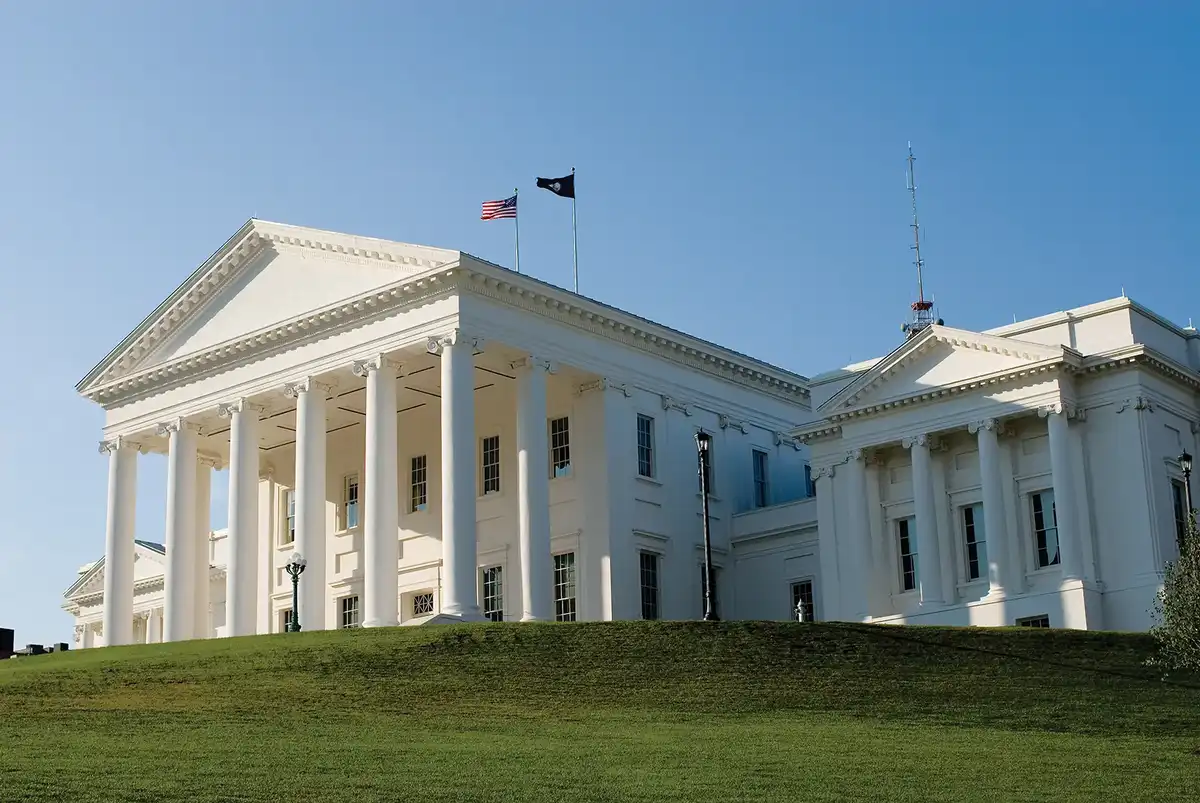
The American city of Richmond accuses Israel of practicing ethnic cleansing against the Palestinians

The Richmond City Council in California voted in favor of a resolution accusing Israel of practicing ethnic cleansing and considering it a state that practices apartheid against the Palestinian people.


The resolution was adopted by a majority of five votes in favor and one vote against, and was titled: “Richmond City Council affirms support and solidarity with the Palestinian people.”


The population of this city is more than a quarter of a million citizens. Before voting, the positions of the citizens were listened to, most of whom expressed their support for the Palestinian people and their legitimate rights.


The resolution affirmed that “the city of Richmond stands in solidarity with the Palestinian people in Gaza, who are currently facing a campaign of ethnic cleansing and collective punishment from the State of Israel.”


He stressed that collective punishment is considered a war crime under international law, and refers to a form of punishment imposed on persons or a group of persons in response to a crime committed by one of them or a member of the group. The resolution said: The State of Israel practices collective punishment against the Palestinian people in Gaza, and this collective punishment of the Palestinian people includes cutting off all access to electricity, drinking water, food, and humanitarian aid.


The resolution referred to reports issued by the United Nations, which stated that nearly two million people in Gaza would not soon find drinking water and medical care.


The resolution considered that Israel is now engaged in a campaign of ethnic cleansing by explicitly demanding that two million Palestinians in the Gaza Strip leave Gaza immediately or risk being bombed in their homes by the Israeli army. The Gaza Strip is one of the most densely populated places on Earth, and groups have indicated that Human Rights Watch has repeatedly described it as “the largest open-air prison in the world”, due to the ongoing intolerable living conditions imposed by the State of Israel, including a complete air, land and sea blockade, cordoning off its borders with concrete walls and barbed wire fences, and the strict prohibition imposed on Palestinians. To leave and enter the region freely, and since this siege on Gaza has caused an unemployment rate of up to 42%, while 84% of the population depends on humanitarian aid, 41% of Palestinians have little food, and 60% of Palestinian children suffer from anemia. Gazans cannot rely on more than 2-4 hours of continuous electrical power per day, and that before this current water shortage, only 1% of Gaza’s population had access to safe drinking water, leaving Gazans - half of whom are children - vulnerable.


Increased risk of waterborne diseases, infections and dehydration, as Israel has not allowed many common cancer diagnostic and treatment tools, including positron emission tomography and radiotherapy, to enter Gaza since 2007. It was also decided that the city of Richmond pledges to combat anti-Semitism and ethnic nationalism at all costs. forms, and finally, they resolved that the City of Richmond defends the dignity and safety of the residents of every community, regardless of the crimes that may be committed by its leadership, and that peaceful diplomacy is the only way to achieve this safety and dignity.

OPINIONS

Wed 25 Oct 2023 4:34 pm - Jerusalem Time

Exchanging kidnapped and captives with prisoners: an immediate, humane, realistic, and painful plan

Yedioth Ahronoth - Ron Ben Yishai

Yedioth Ahronoth - Ron Ben Yishai

Opinion Writer

The state of uncertainty and suffering experienced by the families of kidnapped citizens and captured soldiers in Gaza, to a large extent, imposes restrictions on the hands of the Israeli army, and prevents Israel from doing what is required to fundamentally change the reality in the Gaza Strip. The issue disturbs us emotionally here in Israel, and it disturbs enlightened citizens and leaders around the world. At the same time, it is understood that there are dozens of Israeli children, women and elderly people, some of whom are citizens of other countries who have been kidnapped, stuck as if they were a thorn in the throat of the killers. As long as they are detained in Gaza, Hamas or Islamic Jihad will not be able to mobilize almost the only effective pressure that remains available to them: American public opinion in particular, and international opinion in general.

In addition to the above, Hamas or Islamic Jihad will not be able to use their prisoners and bodies to achieve the primary goal of the October 7 massacre, without making a settlement with Israel. This primary goal is to liberate Palestinian security prisoners and detainees from prisons in Israel. Here, it is clear that the two main parties in this war, namely Israel and Hamas, now have a great interest in ending the issue of the kidnapped and hostages, in a humane manner, and without shedding more blood. This common and horrific interest must be exploited, and can be exploited, through an exchange deal achieved through Qatari and Egyptian mediation, under pressure from the United States and its allies behind the scenes.

In general, the talk here is about an event in which Hamas, Islamic Jihad, and other armed organizations and groups in Gaza release all the prisoners and hostages in their control, including the bodies. In return, and at the same time and place, Israel transfers a number to be determined, a very large number, unfortunately, of Palestinian prisoners. In return, Hamas will also receive broad humanitarian support, including food, water, medicine, health equipment, field hospitals, tents, clothing and personal equipment suitable for winter. The aid will come through Egypt, and the aid is likely to also include a limited amount of fuel, which will be supplied to hospitals in several batches.


Additional principles according to which an exchange transaction must be conducted:

It must be made clear to the mediators that this deal must be implemented before the IDF enters a major ground exercise in the Strip. It must be made clear to the mediators, and to both Hamas and Islamic Jihad, that the Israeli army will carry out the ground invasion in any case, and then Israel will greatly tighten the conditions for its approval of the deal, if it agrees to it at all.

The exchange should include the bodies of soldiers Hadar Goldin and Shaul Oren, who were killed in Operation Protective Edge in 2014.

Israel releases hundreds of security prisoners, according to a nominal list provided by Hamas. Israel will not compromise on the identity of the liberated prisoners, although it is clear that the list will include “killers” with a lot of blood on their hands. However, Israel will not give up its demand that every Palestinian prisoner freed in this deal be transferred to the Gaza Strip, and not be allowed to leave the Strip.

In order to implement the deal, a humanitarian ceasefire will be declared under the supervision of the United Nations, and will last between 12 and 24 hours.

In order to ensure transparency for both parties, and to prevent deception, fraud and interference by foreign parties, the exchange will be carried out in the open area located on the border between the Gaza Strip and Israel. Carrying out the exchange, via Egypt or another third country, may lead to delays and misunderstandings that could disrupt this sensitive procedure. The groups of liberators from both sides are accompanied by Red Cross personnel.

This plan can be implemented quickly, as it does not require long negotiations, protects the vital interests of the kidnapped and their families, does not constitute a handcuff to the Israeli army, and allows both Hamas and Islamic Jihad to claim that they did not kneel and did not feel insulted. It is not possible, and of course not desirable, to list all the reasons for supporting the exchange deal proposed here and those for rejecting it. But this balanced scheme creates strong incentives for both sides, so its success is possible.


PALESTINE

Wed 25 Oct 2023 4:29 pm - Jerusalem Time

Israel arrests 11 Palestinians from West Bank and Jerusalem

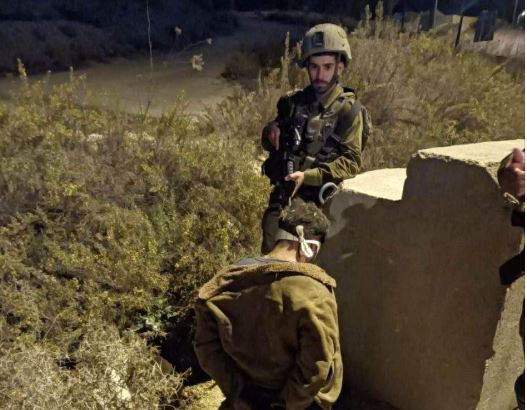
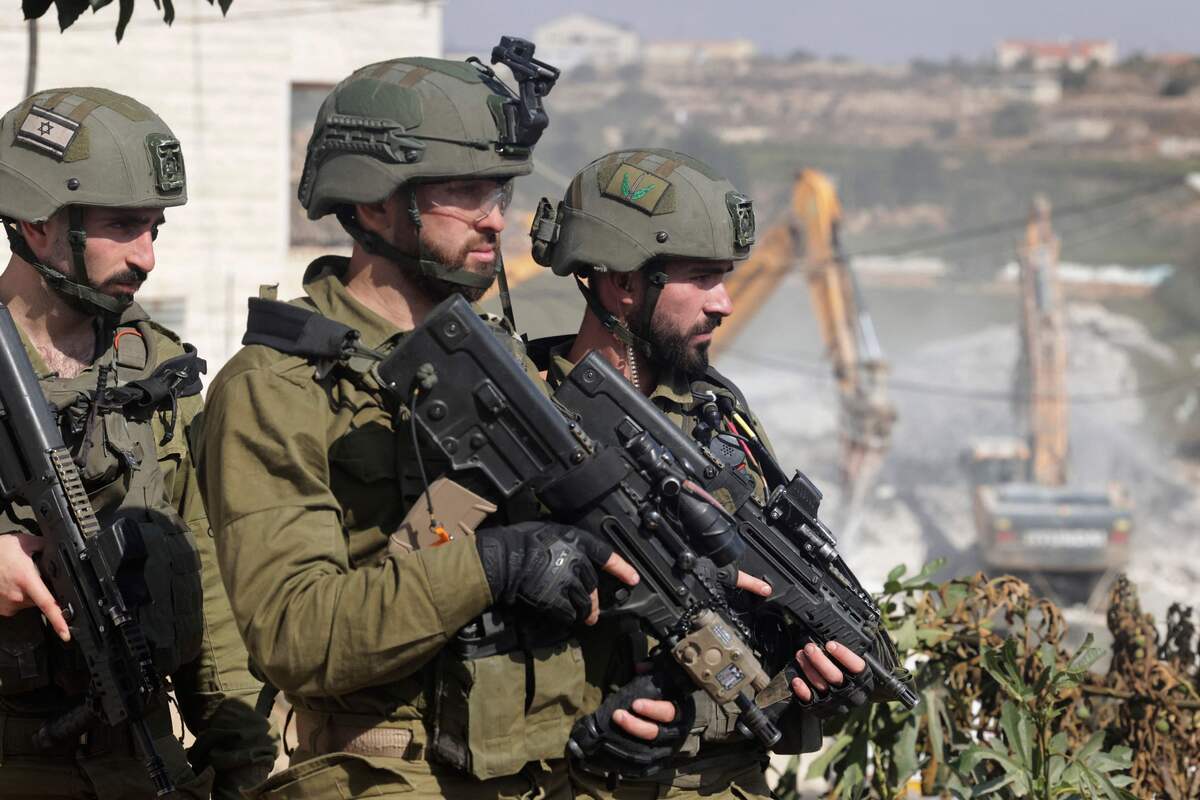
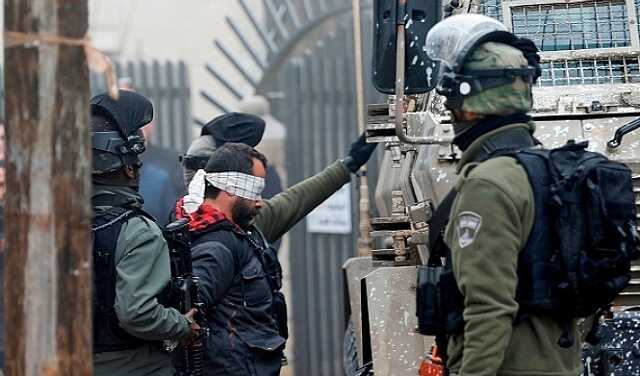
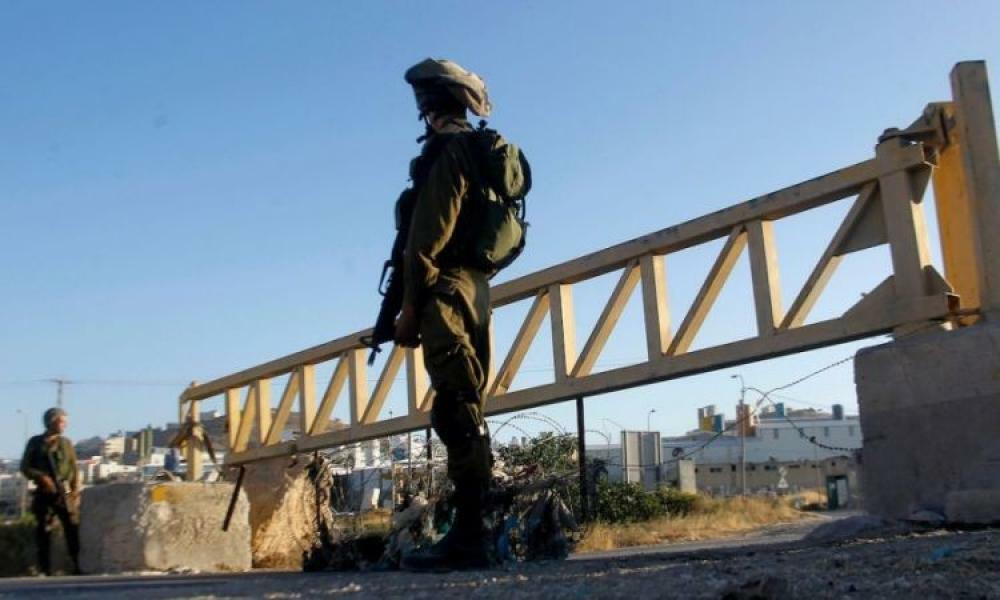
Today, Wednesday, Israeli occupation forces arrested 8 citizens at the Atara military checkpoint, located on citizens’ lands, north of Ramallah.


Local sources reported that the occupation forces arrested eight citizens, “whose identity is not yet known,” as they passed through the Atara military checkpoint, indicating that the soldiers stationed at the checkpoint were checking the citizens’ identities and searching their vehicles.


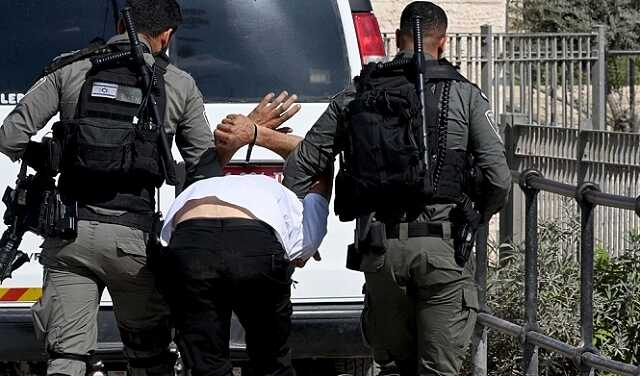
In Jerusalem, the Israeli occupation forces arrested three Jerusalemites, while clashes broke out in the Shuafat refugee camp, north of occupied Jerusalem.


Local sources said that the occupation forces closed the military checkpoint established at the entrance to the camp, which connects it to the occupied city of Jerusalem, while dozens of soldiers stormed the camp’s courtyards, fired rubber-coated metal bullets, poison gas bombs, and incendiary bombs at the citizens, and beat up a number of them.


In this context, the Israeli occupation forces stormed the Al-Saadiya neighborhood in the Old City of occupied Jerusalem, and arrested both: Hamed and Hamza Al-Rajabi, after raiding their house.


The occupation forces also stormed the town of Al-Issawiya, north of occupied Jerusalem, and arrested former prisoner Walid Alyan after raiding his home.

ARAB AND WORLD

Wed 25 Oct 2023 4:21 pm - Jerusalem Time

The White House says Israel will continue to kill "innocent civilians" in Gaza

John Kirby, spokesman for the White House National Security Council, said on Tuesday that Israel would continue to harm “innocent civilians” in its attack on Gaza.


When asked if the United States believed the Israeli bombing was a disproportionate response to Hamas' attack on southern Israel on October 7, Kirby said, "It's war. It's fighting. It's bloody, it's ugly, it's going to be messy, and innocent civilians will be hurt in the future."


"I wish I could tell you something different and I wish it wouldn't happen, but it will happen. And that doesn't make it right and it doesn't make it undeniable," Kirby added.


He also reiterated US opposition to a ceasefire in Gaza, claiming that it would only benefit Hamas. Both Kirby and Secretary of State Antony Blinken said the United States is open to the idea of a “humanitarian truce” to allow more aid into Gaza.


Kirby insisted that the United States would continue to urge Israel to reduce civilian casualties, but Israel doubled its bombing of the Gaza Strip, while Israeli Prime Minister Benjamin Netanyahu admitted on Tuesday that the air strikes launched the previous day were the most difficult to occur.


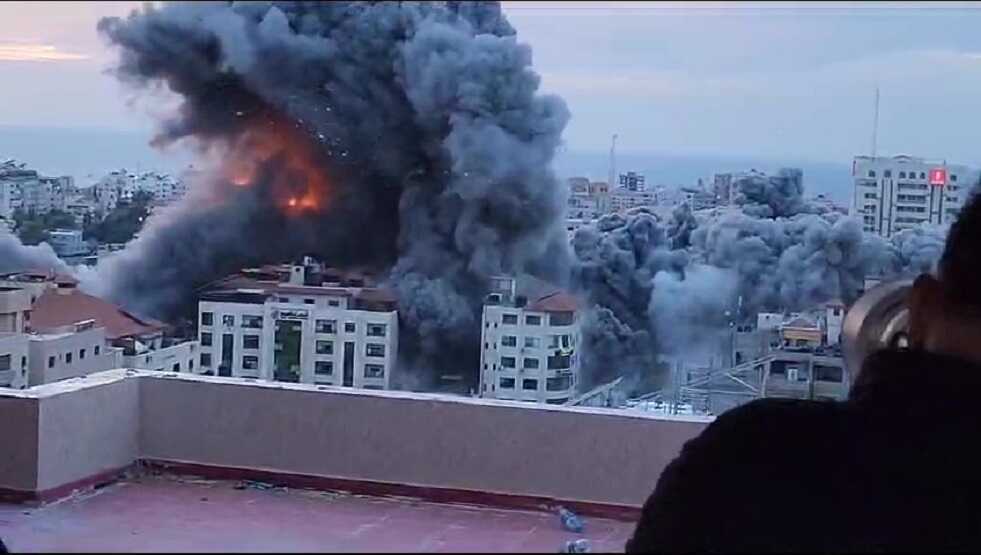
Although Kirby depicted civilian casualties as a fact of modern warfare, Israeli bombing was particularly brutal, with Israeli attacks leveling entire neighborhoods to the ground. According to the Gaza Ministry of Health, after 18 days of bombing, at least 6,000 Palestinians were killed in Gaza, including 2,360 children (according to UNICEF).


Kirby questioned the casualty numbers issued by the Ministry of Health in Gaza due to Hamas' control of the ministry.


However, experts estimate that the number of victims will be more than that because hundreds of them are still under the rubble, and this is consistent with Israeli statements, as Israel boasted about the size of the Israeli bombing unit, as the Israeli authorities stated that in only the first six days of its attack, Israeli forces shot down 6,000 bombs on Gaza, one of the most densely populated places on Earth. By comparison, the United States dropped 7,423 bombs on Afghanistan in 2019, the most since the United States began keeping a tally in 2006.


On the 18th day of the war on Gaza, Israeli aircraft continued to bomb civilians relentlessly, and the Palestinian Ministry of Health in the Gaza Strip documented during the past hours 47 massacres that left 704 martyrs, which raises the total toll within two weeks to about 6,000 martyrs, most of them children and women, in addition to More than 15 thousand infected.

ARAB AND WORLD

Wed 25 Oct 2023 3:23 pm - Jerusalem Time

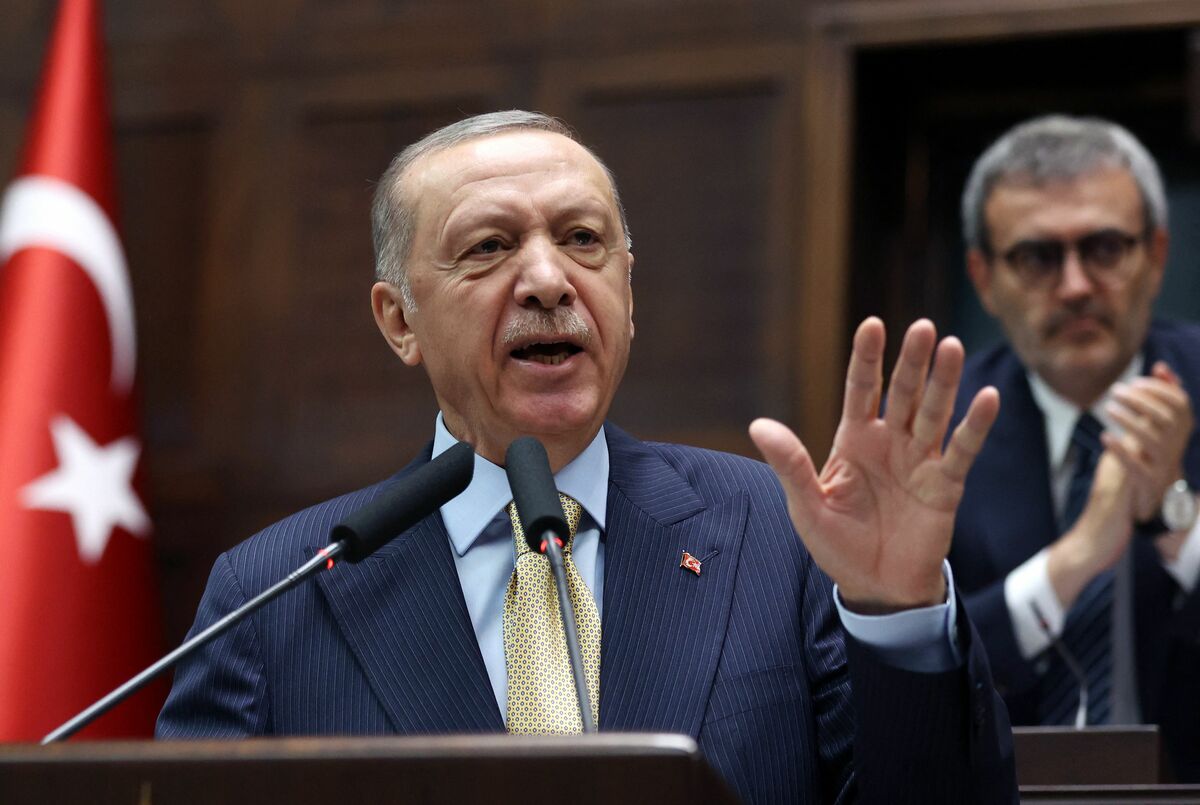
Erdogan cancels his plans to visit Israel: Says Hamas is not terrorist

Turkish President Recep Tayyip Erdogan announced today, Wednesday, the cancellation of all his plans to visit Israel due to its brutal attacks against the Palestinian people in Gaza, stressing at the same time that the Hamas movement is not terrorist, and warning that Turkey will use all political and military means if necessary to stop the aggression against... Gaza.


Erdogan said, in a speech before his party’s parliamentary bloc: “We had a project to go to Israel and I canceled it. Israel kills children, and we will not allow them to be killed because we have our share of humanity,” noting that “the Israeli attacks on Gaza are a sign of killing, and we will do so.” Whatever it takes is for Gaza, and we will never give up our position.”


Erdogan considered that Israel is carrying out one of the most brutal attacks in history against the Palestinian people in Gaza, as half of the dead are children, and the other half are their mothers and the elders of their families, and this alone is enough to show the horror of Israel, considering that making excuses for launching attacks is the West’s legacy of its bloody history. .


Erdogan stressed that Hamas is not a terrorist organization, saying, “I appeal to Israel from here, and I tell it that you can be an organization, because the West owes you a lot, but Turkey does not owe you anything. The West considers Hamas a terrorist organization. Hamas is not a terrorist organization; "It is a group of mujahideen trying to protect and liberate their lands."


The Turkish President escalated his words against Israeli Prime Minister Benjamin Netanyahu, saying, "I shook the hand of this man called Netanyahu once in my life (past United Nations meetings). Of course we had good intentions and they misused them."


Erdogan stressed the need to declare a ceasefire immediately, saying, "As long as innocent people continue to die in Gaza, sending any ship to the region will not lead to peace, and Israel must respond to our call for peace."


He continued: "We will continue, as a state and a nation, to call for the truth and use all diplomatic and military means if necessary. Both parties must remove their hands from the trigger. A ceasefire must be declared, our call for peace must be answered, the hostages must be released quickly, and the Rafah border gate must remain open in "At all times, settler terrorism must also end."


He stressed that Turkey will never stop bearing responsibility, stressing that it is ready to be one of the guarantors of the Palestinian side with its political and military presence, considering that the issue of the guarantor is the most effective way to provide a realistic solution, recommending holding a conference for Palestinian-Israeli peace.


Calling on countries to put pressure on the Netanyahu government to bring Israel back to its senses, the Turkish president stressed that "peace in the region depends on the establishment of an independent Palestinian state recognized by the whole world. Otherwise, it is not possible to predict where extremism will lead us."


He added, "I repeat my call: the United Nations must reform itself," considering that "the structure that hands over world security to the interests of the five countries has no sustainability," deploring the state of impotence that the United Nations has reached.


ARAB AND WORLD

Wed 25 Oct 2023 3:07 pm - Jerusalem Time

The Jordanian King to Macron: Stopping the war on Gaza is a necessity

The Jordanian King, King Abdullah II, stressed during his meeting with French President Emmanuel Macron, today, Wednesday, that stopping the war on Gaza is an absolute necessity, and the world must move immediately in this direction.


The Jordanian King and the French President discussed possible efforts internationally to work to end the cycle of violence, reach a political horizon to end the Palestinian-Israeli conflict, ensure security, and achieve a just and comprehensive peace based on the two-state solution.


In the meeting, which took place in Al-Husseiniya Palace, he warned against the continuation of the war on the Gaza Strip, which might lead to an explosion in the situation in the region.


The Jordanian King called on the international community to take immediate action to pressure Israel to stop the war, protect civilians, and break the siege on the Gaza Strip.


He renewed the warning of the seriousness of the deteriorating humanitarian situation in the Gaza Strip, stressing the importance of ensuring the arrival of humanitarian aid.


He also affirmed his rejection of any attempts to displace or cause displacement within the Gaza Strip.


He stressed the importance of France's role in supporting efforts to work towards a political horizon to achieve peace based on the two-state solution.


The French President left the Kingdom on Wednesday.


PALESTINE

Wed 25 Oct 2023 3:01 pm - Jerusalem Time

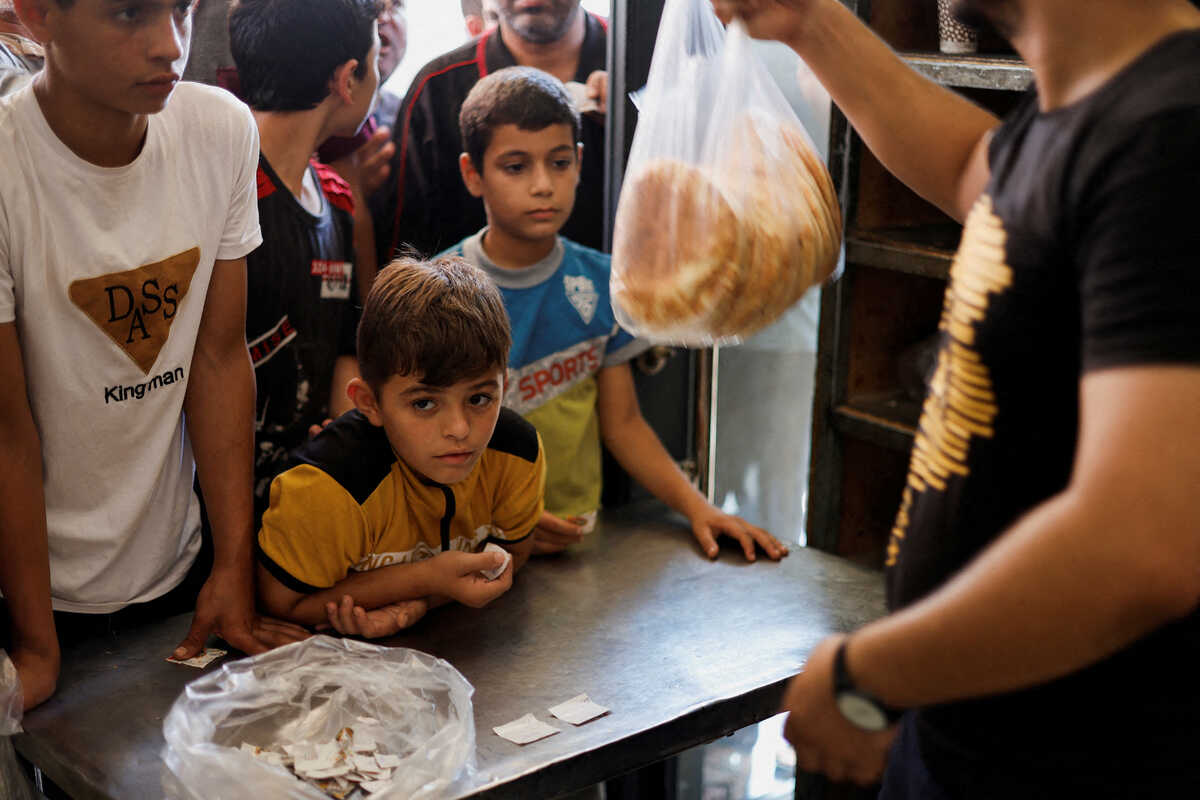
Bread crisis in the Gaza Strip...and food stocks are about to run out

As the sun begins to rise every day, Palestinian Ahmed Nassar from the city of Deir al-Balah in the central Gaza Strip rushes with five of his brothers on foot to reach their nearest bakery and line up in a long line to get a little bread for their displaced family.


After long hours of waiting, often punctuated by quarrels between citizens for fear of taking the other’s turn, Nassar (33 years old), a father of four children, complains that he can barely buy 4 kilograms of bread, and sometimes he may return to his house crowded with displaced people. “Zero” Hands without anything.


Nassar told Xinhua news agency after his turn to get bread approached, "The worst thing than waiting in such a queue is hearing the sound of successive explosions that result from targeting civilian homes, especially when they are close to the bakery that we are standing in front of."


He added, "Israel does not differentiate between civilian and military, and if it wants to target someone, it will not care whether he is among us or not. It will inevitably target us all."


He continued, "I do not want to die and leave my children to suffer after me. I am the only breadwinner for them in this tragic life that often puts us through difficult and deadly tests."


Nassar's family of six usually consumes four kilograms of bread daily, but due to the difficult circumstances they are going through, his wife decided to provide one meal for her children and a little bread once instead of three times.


His wife says, "We are displaced and do not live in our own house. Everything has changed and all the time we live under the sounds of bombing and explosions. I do not have a kitchen to cook nor even the tools needed for that. We are truly dying slowly."


The situation is not much different for forty-year-old Nidal Al-Ashqar, who used to stand in long bread lines for more than ten days after his displacement from Gaza City to Rafah in the southern Gaza Strip to escape Israeli raids.


Al-Ashqar, a father of six children, told Xinhua, "I was tired of waiting for a long time without getting enough for my children, so my wife decided to make bread at home."


However, Al-Ashqar does not have a sufficient amount of cooking gas, which prompted his wife, Wafa, to use wood to light a fire to cook food and prepare bread for her “homeless” family, as she put it.


The couple expressed their fears that the house they currently live in might be targeted by Israeli warplanes, especially with smoke rising from the fires.


Wafa says, "Mostly, I feel like an Israeli fighter plane might attack our house because of the smoke rising from the firewood."


She went on to say, "We are living in an unprecedented conflict, and Israel does not separate civilians from militants," noting that, "Even if we survive the Israeli attacks, I will not have enough money to buy more flour if we run out."


In addition to the Nassar and Al-Ashqar families, there are more than 2.3 million Palestinians suffering from the consequences of the severe Israeli siege that was imposed weeks ago on the coastal enclave as collective punishment for the local population, who have already been suffering from poverty, destitution, and food shortages for more than 17 years.


Israel has been waging a large-scale war on the Gaza Strip for 19 consecutive days, after the Islamic Resistance Movement (Hamas) carried out a military attack on the Israeli towns adjacent to the Strip.


According to UN and Palestinian officials, the tightening of the Israeli siege and the military war led to a significant scarcity of goods as the third week of the war approached its end, without any indications of reaching a truce agreement.


This prompted Shadi Salha, a lawyer from the city of Rafah, to express his fears about the repercussions of the current reality, saying, “It seems that Israel is following a new policy of killing us in Gaza by committing mass massacres with its warplanes, or killing us en masse by imposing famine on us.”


He added, "They (the Israelis) are targeting bakeries spread throughout the Gaza Strip... Can you give us a logical justification for that?", stressing the need to protect civilians from the "Israeli madness" that targets everything Palestinian in Gaza.


In addition to providing food and basic needs, Salha wants to "provide safe areas with international guarantees that prevent the occupation from targeting these areas, in light of its deliberate targeting of civilian gatherings."


After intense and complex negotiations, Israel allowed the entry of about 40 trucks in successive batches loaded with humanitarian aid, including medicines and food, into the Gaza Strip without bringing fuel.


The Executive Director of the World Food Program, Cindy McCain, stressed that “there is an urgent need for food because the conditions inside Gaza are truly catastrophic (...) This aid is important for the people of Gaza, but we must also provide continuous and safe access for humanitarian workers and civilians inside Gaza so that we can Delivering this food to people in need.


The head of the government office run by the Hamas movement, Salama Marouf, said, “There are goods that have completely run out of markets and distribution and sales points, in addition to the presence of other goods remaining in very scarce quantities, which would put the sector in a state of stagnation,” warning that “food security "The population is in danger."


Marouf added, "What was allowed to enter Gaza through the Rafah crossing did not include basic food needs or even the fuel needed to operate electrical generators in hospitals, as the existing fuel is close to running out, which threatens to put hospitals out of service and threaten the lives of patients."


According to Marouf, about 1.4 million people were displaced from their homes (most of which were destroyed) to avoid the “barbaric attacks launched by Israel on the civilian population.”


For its part, the United Nations Relief and Works Agency for Palestine Refugees (UNRWA) announced that about 406,000 displaced people reside in 91 facilities affiliated with the international organization in the central regions, Khan Yunis, and Rafah, while the agency’s shelters are designed to host between 1,500 and 2,000 displaced people in each shelter.


Acting Director of the UNRWA Information Office, Enas Hamdan, told Xinhua, "The situation in the Gaza Strip is extremely catastrophic in light of the ongoing Israeli raids, in addition to the lack of electricity and the availability of water only in very small quantities."


She added, "We are doing everything we can to provide the displaced people with supplies inside the agency's schools and headquarters."


However, the United Nations organization faces popular and official criticism from government agencies in Gaza, Palestinian factions, and even human rights organizations, against the backdrop of failure to provide for the needs of displaced people in various regions of the Strip.

PALESTINE

Wed 25 Oct 2023 1:03 pm - Jerusalem Time

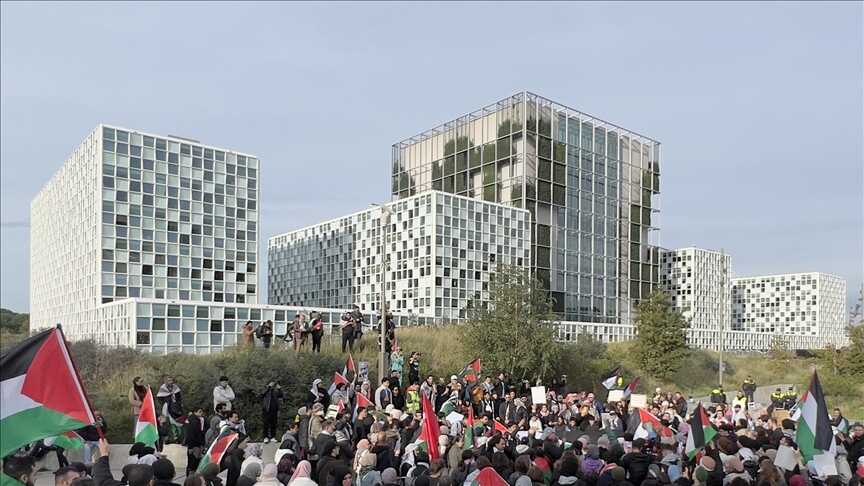
International Criminal Court’s response to Palestine, Ukraine raises impartiality, political influence concerns: Experts

ICC acted rapidly over war crimes claims in Ukraine but seems ‘very slow’ when it comes to Palestine, says Ben Saul, an international law expert set to take over as UN special rapporteur next month


- Court needs to show same urgency to reassure the world that it is impartial, Saul tells Anadolu

- Lack of urgency about Palestine compared to Ukraine shows ‘inequality loaded with political influences,’ says Dewan Khalil, senior lawyer at UK firm part of previous ICC cases involving Israel.


The devastating human cost of Israel’s relentless assault on the Gaza Strip continues to mount by the hour.

More than 5,000 Palestinian men, women and children have been killed in Israeli bombardment, which has targeted all areas of the besieged Palestinian enclave.

Its aerial attacks have hit densely populated residential areas, hospitals and other civilian sites, also claiming the lives of dozens of humanitarian and health workers and journalists.

Israel has cut off basic supplies, such as water, electricity and humanitarian aid, to more than 2.2 million people in the Gaza Strip, while also ordering what some experts call the forced displacement of over 1.1 million with its evacuation warning for northern Gaza.

For Israel, all of this was a response to the Oct. 7 attack by Hamas and its subsequent rocket attacks on Israeli areas, which have now claimed more than 1,400 lives.

But many around the world have questioned the excessive and disproportionate force used by Israel, giving rise to multiple warnings of war crimes and crimes against humanity, from legal experts and even officials like Francesca Albanese, UN special rapporteur for the occupied Palestinian territories.

One of the areas of focus has been the role – or the apparent lack of it – of institutions like the UN’s International Court of Justice (ICJ), or the independent International Criminal Court (ICC), which, by its own definition, has the specific mandate of acting on “the gravest crimes of concern to the international community: genocide, war crimes, crimes against humanity and the crime of aggression.”

On Monday, the ICJ announced it will hold public hearings on the request for an advisory opinion on the “legal consequences arising from the policies and practices of Israel in the occupied Palestinian territory, including East Jerusalem.”

However, the hearings will begin on Feb. 19 next year.

As for the ICC, several experts have been calling on it to take immediate action over the growing escalation in Gaza.

“While the ICC responded rapidly to allegations of war crimes in Ukraine since last year, it seems to be very slow in addressing crimes in Palestine since it began its investigation in 2015,” said Ben Saul, who was recently appointed as the next UN special rapporteur on promotion and protection of human rights and fundamental freedoms while countering terrorism.

Saul, currently the Challis Chair of International Law at the University of Sydney in Australia, will take over the post this November.

He said the ICC needs to show “the same urgency and mobilization of resources, to reassure the world that it is impartial and that its legitimacy is not undermined by the geopolitical forces.”

“All states should cooperate with the court where they have information about crimes,” he told Anadolu.

He pointed out that there have been several violations by both Hamas and Israeli forces in the current escalation.

For Israel, he said the “total siege of Gaza is a violation of international law, and could constitute the war crime of starvation.”

“Israel has an obligation to allow and facilitate rapid and unimpeded humanitarian relief, including food and medicine. Israel’s warnings to civilians about impending attacks must be effective, and its order to evacuate over 1 million people in northern Gaza, under siege conditions was not sufficient,” he said.

“More information is needed about Israel’s targeting decisions and intelligence, but it is possible that some of the thousands of Israeli bombings in Gaza may have involved excessive civilian casualties or indiscriminate attacks.”

For Hamas, Saul said the “mass killings of Israeli civilians could constitute the international crime of genocide if specifically intended to destroy part of the Israeli and/or Jewish people as such.”

“They could also constitute various crimes against humanity,” he said.

ICC response shows ‘inequality loaded with political influences’

The ICC has confirmed its jurisdiction over war crimes in Palestine for all parties, according to Khalil Dewan, head of legal investigations at UK-based law firm Stoke White, which has been part of previous cases at the ICC involving Israel.

“The ICC are accepting evidence bundles of war crimes, and recently announced that the prosecutor holds jurisdiction via Palestine,” he told Anadolu.

“The court’s jurisdiction of war crimes includes Jerusalem, West Bank and Gaza for all parties to the conflict.”

He said many law firms are gathering evidence “including current hostilities – targeting civilians, protected infrastructure and collective punishment.”

“Israel’s pending ground force actions will be carefully examined and submitted to the ICC,” he said.

Dewan pointed out that Israel will “reject the ICC’s jurisdiction,” but added that “it has already been claimed by the (ICC) prosecutor.

“In any case, the ICC’s lack of urgency and approach to war crimes in Palestine, compared to the response to Ukraine demonstrates inequality loaded with political influences,” he asserted.

Dewan said that international law remains an “indeterminate legal system,” and that “some states deploy the strategy of ‘lawfare’ to win military objectives, including politics and media narratives.”

He said Palestinians have “exhausted all international legal and political avenues in seeking justice.”

“The calls at the Organization of Islamic Cooperation to form a separate regional mechanism for peace and safeguarding security of Palestine would be a welcomed initiative,” he said.

“If UN resolutions are not upheld on Palestine, then it’s vital to seek decolonial approaches to international law, and weed out lawfare designed to silence and subjugate non-Western states.”

‘ICC can issue arrest warrants’

Ahmet Necip Arslan, an Istanbul-based attorney, echoed the same views, saying that the ICC’s mechanisms are “very slow.”

“Often the decisions made, in any stage, can be under the heavy influence of governments and politics,” he told Anadolu.

Arslan pointed out that the ICC “can issue arrest warrants,” stressing that “this can be an effective method to stop an armed conflict.”

He said reports coming out of Gaza “indicate that Israel is employing prohibited weapons like white phosphorus and targeting places of worship and cultural properties, both considered war crimes.”

Israel, he continued, has been depriving civilians of essentials such as food, water, humanitarian aid, antibiotics and medical supplies, adding that these could be violations of international law that could be “potential war crimes.”

Anadolu Agency


Source: Anadolu

PALESTINE

Wed 25 Oct 2023 12:57 pm - Jerusalem Time

Attacks by Israeli forces and settlers on Palestinians in the West Bank

Today, Wednesday, the Israeli occupation and settlers continue their attacks on citizens and their property in the West Bank.


In Hebron, the occupation forces seized land from the town of Surif, northwest of the city.


According to local sources, the Israeli occupation forces were notified, via a military order, of seizing and seizing more than two dunums of town land in the Khallet Salama area near the Al-Jabaa military checkpoint, for military purposes, and it belongs to the Al-Hur family.


The occupation forces also raided the Khallet al-Kalata area adjacent to the “Karmi Tzur” settlement, south of Beit Ummar, and bulldozed lands with an area of about one thousand square metres, and uprooted more than 25 forest trees, owned by a citizen.


In the same context, a settler, accompanied by the occupation army, fired live bullets at the citizens, bulldozing land with an area of about 6,000 square metres, and uprooting 55 forest trees and almond trees, owned by the citizen Hafez Al-Harini, near the village of Al-Tuwanah, south of Hebron.


In Nablus, the occupation forces assaulted a young man by beating him near the entrance to the village of Aqraba, south of the city.


According to the Palestinian Red Crescent Society, its crews transported a young man to the hospital after the occupation forces beat him near the town of Aqraba.


Meanwhile, settlers, protected by the Israeli occupation forces, opened fire on farmers in the town of Qarawat Bani Hassan, northwest of Salfit.


PALESTINE

Wed 25 Oct 2023 12:51 pm - Jerusalem Time

Prisoners' Commission: Israel began carrying out a systematic assassination against prisoners

The Prisoners' Affairs Authority and the Prisoners' Club confirmed today, Wednesday, that the Israeli occupation has begun carrying out a systematic assassination operation against prisoners and detainees.


This came after the martyrdom of detainees Omar Daraghmeh and Arafat Hamdan within 24 hours.


In a joint statement, the Authority and the Club referred to a report issued by the Occupation Prisons Administration, which showed that the detained martyr, Omar Daraghmeh, was suffering from internal bleeding at the moment of his martyrdom. “This confirms once again that he was subjected to a premeditated assassination.”


The authority and the club referred in a joint statement to a report issued by the occupation prisons administration, which showed that the detained martyr, Omar Daraghmeh, was suffering from internal bleeding at the moment of his martyrdom. “This confirms once again that he was subjected to a premeditated assassination,” according to the statement.


The statement added: “The reference to this report issued by the Prisons Administration is not out of our need for proof of this assassination, but rather to confirm that the occupation’s narrative is merely lies to disavow the crime, as it has always done and will always do.”


Omar Daraghmeh was martyred two weeks after his arrest, and hours before his martyrdom was announced, a court session was held for him, and his lawyer said that he asked him about his health and assured him that he was in good health. As for the young man, Arafat Hamdan, he rose only two days after his arrest.


It is noteworthy that the occupation army arrested 1,350 Palestinians from the West Bank since Operation Al-Aqsa Flood on October 7, until this morning, Wednesday, October 25.


The head of the Prisoners’ Authority, Qaddoura Fares, confirmed that male and female prisoners are exposed to a state of starvation and thirst, and are prevented from obtaining medicine, specifically the medicines taken by prisoners with chronic diseases, which puts their lives in danger, not to mention cutting off water and electricity for them.


Qaddoura Fares reported that physical attacks against prisoners were repeated. The occupation authorities even used sticks, axes and shovels to beat the prisoners. Many of the prisoners had their limbs, hands and legs broken, indicating that some of the prisoners were not recognized by their colleagues’ faces due to the tumors that resulted from the brutal attacks.


The occupation prison administration also implements retaliatory measures in all prisons, including cutting off electricity, reducing the shower period for all prisoners, increasing the number of prisoners per room, withdrawing all electrical items, and repeating the counting process several times a day. This is in addition to the repressive forces’ raids into prisons and violent attacks during... that.

ARAB AND WORLD

Wed 25 Oct 2023 12:39 pm - Jerusalem Time

Israel Accuses Iran of Plotting Hamas Attack Plan

For the first time since the conflict in Gaza began earlier this month, Israel has officially accused Iran of being directly responsible for the attack by Hamas, which triggered the outbreak of the war. Tel Aviv is claiming that Tehran was involved in both training and planning. The Israeli government has launched an international campaign against both Hamas and Iran, considering them responsible for the Oct. 7 attack, which they believe was part of a plan for a “regional war that threatens global peace.” 

The Israeli Foreign Ministry gathered 100 foreign media correspondents for a meeting on Monday, during which it presented a video showing acts of cruelty and staged scenes involving bodies during the Hamas attack on Israeli towns near Gaza. Spokespersons at the meeting stated that Iran trained Hamas operatives and devised the attack plan for them as part of a “broad regional battle” against Israel, involving all of its militias across the Middle East, from Yemen to Iraq, as well as from Lebanon and Syria. Veteran Israeli diplomat Itamar Rabinovich regards the current Gaza conflict as the “first Iran-Israel war.”


Rabinovich, who previously served as the Director-General of the Ministry of Foreign Affairs and as Israel’s ambassador to Washington, and who chaired the Israeli delegation for negotiations with Syria, affirmed that the conflict being witnessed since Oct. 7 is a war between Israel and Hamas in Gaza.“ 

However, this war is taking place within a broader context primarily shaped by Iranian efforts to challenge Israel on multiple fronts,” noted Rabinovich. He explained that “currently, there is an ongoing war of attrition between Hezbollah, an Iranian proxy, and Israel, and at any given moment, Iran and the leadership of Hezbollah could determine the shift towards a full-scale war.” 


Source: Al Sharq Al Awsat


PALESTINE

Wed 25 Oct 2023 11:49 am - Jerusalem Time

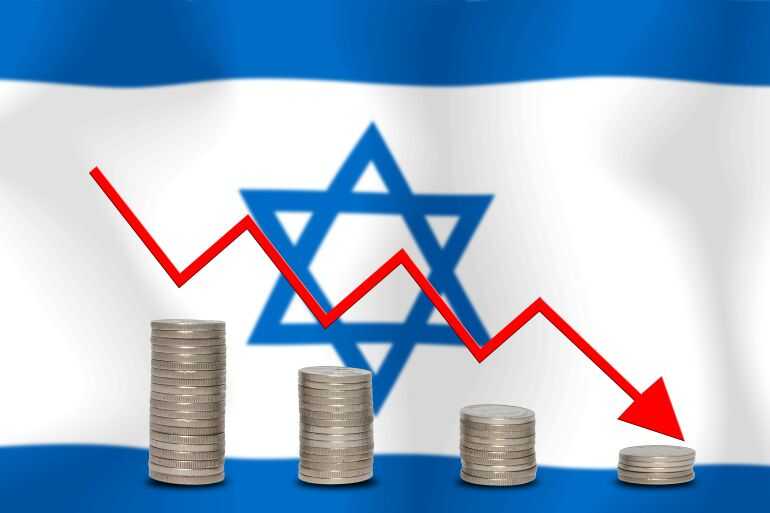
The war on Gaza pushes Israeli economy into unknown

A depleted workforce, constant sirens warning of the threat of missiles, and a feeling of shock due to the unexpected attack - all contribute to the size of the cost to the Israeli economy as a result of the war with the Islamic Resistance Movement (Hamas) and is expected to be different from anything else the economy has been exposed to since Contracts.


The cranes that dot the Tel Aviv skyline stopped several days ago after the city closed construction sites. An industry report stated that these sites were reopened this week under stricter guidelines to ensure safety, but the cessation of activity in this sector alone is costing the economy an estimated 150 million shekels (about 37 million dollars) per day.


“This is not a blow to contractors or industrialists alone,” said Raul Sarojo, president of the Association of Builders of Israel. “It is a blow to every family in Israel.”


Israel was shaken on October 7 when the Palestinian resistance launched Operation “Al-Aqsa Flood,” and since that date Israel has responded by carrying out continuous raids on the Gaza Strip and mobilizing its forces in preparation for a ground attack.


Israel's roughly $500 billion economy - the most developed in the Middle East thanks to its inherent strengths in technology and tourism - was healthy for most of 2023. Growth was on track to reach 3% this year as unemployment fell.


But with a ground war in Gaza likely imminent and the war potentially turning into a regional conflict, Israelis are holed up and spending less on everything but food, while rating agencies have already warned that they may lower their assessment of Israel's creditworthiness.


A huge gap in the workforce

Hundreds of thousands of army reservists have been called up, causing a huge gap in the workforce and disrupting supply chains from seaports to retail stores, while retailers are furloughing employees, amid the decline in the value of the shekel.


The conflict also halted the movement of thousands of Palestinian workers from Gaza to Israel and reduced their flow from the occupied West Bank.


The escalators and walkways of Jerusalem's main shopping mall were empty during the first two weeks of the war, although customers slowly returned.


“There is a significant decrease in traffic,” said Nathaniel Shraga, manager of Columbia Sportswear. He added that some of his employees were called up for military service. Others feel very afraid to come to work.


Hotels are now half full of Israelis evacuated from the border areas, and the rest of the rooms are mostly empty.


Work is still continuing in factories, even those close to Gaza, but there is always a problem related to the insufficient number of truck drivers who carry out regular deliveries.


Credit card purchases fell 12% last week compared to the same period a year ago, with sharp declines in almost all sectors except for a significant rise in retail shopping.


The high-tech industry, which has boomed during the Covid pandemic, is facing difficulties. This industry usually represents 18% of Israel's GDP and half of total exports.


“Productivity drops dramatically because it's hard to focus on daily work when you have existential concerns,” said Barak Klein, CFO at fintech company Thetaray.


12 of the company's 80 employees residing in Israel were recruited into the reserve forces. Others - with children - remained at home, while the constant fear of missile launches remained.


Thettarai has set up a daycare center for employees who need to take their children with them, and has relied on its overseas offices to shoulder part of the workload.


Al-Aqsa flood losses to Israel's economy in numbers

An estimated 10 to 15 percent of the high-tech workforce has been called up to serve in the reserve forces, said Dror Ben, CEO of the state-funded Israel Innovation Authority.


“We are in contact with hundreds of technology companies, especially early-stage projects,” he added, explaining that many of them are in the middle of their financing cycle and are running out of money.


In order to provide assistance, the Innovation Authority established a fund worth 100 million shekels (about 25 million dollars) to help 100 technology startups weather the storm.


The Ministry of Economy established an operations room in times of war and issued an appeal for assistance. Its database has so far matched at least 8,550 people to distressed companies.


When a major supermarket chain's logistics center came under severe pressure, 38 people were sent in to fill the night shift.


Psychological crisis

The government promised "not to set limits" on spending on financing the war and compensating affected families and businesses, which means a larger budget deficit and more debt.


Past conflicts may not be a correct guide to the course of the economy. GDP fell by as much as 0.5% in the 34-day war with Lebanon's Hezbollah in 2006 as exports fell and manufacturing slowed, but the recovery that followed was rapid.


Officials say what is happening today is different.

Leo Lederman, chief economic advisor to Bank Hapoalim - one of the largest banks in Israel - said that there is a "psychological crisis" among the Israeli public and that its negative effects have already begun.


He added, "People will reduce consumer spending due to the uncertainty and atmosphere" prevailing.


Since consumer spending represents more than half of economic activity, the damage to the economy could be significant.


A senior official at the Israeli Ministry of Finance told Reuters, "Israel was able to recover significantly from all the recent hostilities... This event seems to be more exciting, although it is too early to confirm that."


On Monday, the Central Bank of Israel reduced its economic growth estimates for 2023 to 2.3%, down from 3%, and to 2.8%, down from 3% in 2024, assuming the war in Gaza is contained.


Bank Governor Amir Yaron - who currently opposes lowering interest rates - expects a recovery. He said, "We knew how to recover from difficult periods in the past and (we knew how to) return to prosperity quickly... I have no doubt that it will happen this time as well."


ARAB AND WORLD

Wed 25 Oct 2023 11:45 am - Jerusalem Time

The Monetary Fund: The war will have economic repercussions on Egypt, Lebanon, and Jordan

The Director General of the International Monetary Fund, Kristalina Georgieva, said that the war in Gaza will have economic repercussions on Egypt, Lebanon and Jordan.


She explained, during a session at the “Future Investment Initiative” forum, held in Riyadh, that there are changes in the “Monetary Fund’s” directions after the pandemic, and “our policies will focus on prevention and protection of the international economy.”


She added: “There must be proactive steps for any growth plans, and there must be good use of new financial policies,” noting that the IMF “has begun building a strong financial system to confront crises.”


She said that interest rates will continue for a long time, and that dealing with inflation will be costly next year.

ARAB AND WORLD

Wed 25 Oct 2023 11:44 am - Jerusalem Time

8 Syrian soldiers killed by Israeli bombing on near Daraa

Syria announced today (Wednesday) that eight soldiers were killed and seven others were injured as a result of Israeli bombing that targeted points in the Daraa countryside in the south of the country.


The Syrian News Agency (SANA) quoted a military source as saying, “At approximately 1:45 a.m. today, the Israeli enemy carried out an air attack from the direction of the occupied Syrian Golan, targeting a number of our military points in the Daraa countryside.”


The source added that the bombing "led to the death of eight military martyrs and the wounding of seven others, in addition to some material losses."


On Sunday, Syria warned that continuing Israeli attacks on its territory would “push the region into a broader spiral of violence that will be difficult to contain.”


The Syrian warning came after an attack on Damascus and Aleppo airports, which put them out of service and left one dead, according to Syrian official media.


Sunday's attack was the third attack targeting Aleppo Airport, and the second targeting Damascus Airport this month, amid escalating tension in the region in light of the Israeli aggression on the Gaza Strip since October 7th.


Israel has repeatedly launched attacks on targets in Syria during the years of conflict that has been ongoing in the country since 2011, and the attacks have repeatedly targeted Aleppo and Damascus airports.

PALESTINE

Wed 25 Oct 2023 11:34 am - Jerusalem Time

1,350 Palestinians arrested in West Bank since October 7th


The occupation forces arrested more than 1,350 Palestinians from the West Bank, and this number does not include the detained workers and the Gaza detainees, whose identities and numbers of detainees have not yet been accurately known to the Palestinian authorities and institutions.


Last night and at dawn on Wednesday, the Israeli occupation forces launched an arrest campaign that targeted at least 80 Palestinians from the West Bank, including two women from Jerusalem, with the continued systematic arrests and comprehensive aggression launched by the occupation against the Palestinian people.


The arrests were concentrated in the governorates of Hebron, Bethlehem, and Jerusalem, and the rest of the arrests were distributed across the majority of the governorates of the West Bank.


The Prisoners' Commission and the Prisoners' Club stated that the occupation forces have escalated their arrest campaigns since October 7, the date of the resistance battle, "Al-Aqsa Flood." In an unprecedented way.


The occupation forces arrested more than 1,350 Palestinians from the West Bank, and this toll does not include the detained workers and the Gaza detainees, whose identities and numbers of detainees have not yet been accurately known to the Palestinian authorities and institutions.


The Prisoners' Authority and the Prisoners' Club pointed out that the occupation began carrying out systematic assassination operations against prisoners with premeditation, in light of the martyrdom of two detainees in the occupation prisons, who were arrested after the seventh of this October as part of the widespread arrest campaigns, namely Arafat Hamdan and Omar Daraghmeh. .


Based on the testimonies and accounts received from detainees who were recently released, and in light of the data reaching the institutions that reflect the level of crime, including assaults, death threats, and operations of abuse at several levels, the occupation authorities are carrying out the systematic assassination of prisoners.


It is noteworthy that the number of prisoners in the occupation prisons, according to available data, reached about 6,600 after the escalating arrest campaigns since October 7, including at least 50 female prisoners, and more than 1,600 administrative detainees.


Source: Agencies


PALESTINE

Wed 25 Oct 2023 11:29 am - Jerusalem Time

Thousands of Gazan workers are detained in inhumane conditions... “concern” in the Israeli Ministry of Justice

The occupation authorities "hide" thousands of Gazan workers in detention centers, and concentrate them in the open without water or food for two days, with their hands and feet shackled and blindfolded, before the difficult journey of the post begins. Degrading treatment of the elderly and continuous attacks.


The Israeli occupation authorities arrested thousands of Palestinian workers from the Gaza Strip under inhumane conditions, even though they remained in Israel legally, on the eve of the attack on October 7, and before the start of the war launched by the occupation against the besieged Gaza Strip.


On Tuesday evening, Haaretz newspaper reported that the Gazan workers are being detained in detention centers at Israeli army bases in the occupied West Bank, under extremely difficult conditions and in violation of international humanitarian law, noting that they were working in Israel under a legal permit.


In the testimony of one of the detainees who were released, it was stated that the occupation authorities kept the workers in the open without food for two days, with their hands tied and their eyes blindfolded. Thousands of workers were later transferred to “cage-like facilities” and detained them in large numbers and with a high density, even though none of them were Suspected of any charge.


"Haaretz" said that the Israeli Ministry of Justice is "concerned" about the "inappropriate" detention conditions for the Gazan workers, and describes their situation as "extremely difficult," in conjunction with the petitions submitted by human rights organizations, earlier this week, to the Israeli Supreme Court, demanding "the extradition of... Names of detainees and informing their families of their whereabouts.”


The numbers revealed by Israeli media regarding the number of detainees vary, and range between 3,000 and 1,500 detainees.


The report stated that the government's deputy attorney general, Gail Lemon, contacted the Ministry of Security last week and "alerted it of the workers' conditions." Haaretz quoted informed sources as saying that Lemon called “a senior political-security official and asked him to deal with this issue,” while the Ministry of Security held deliberations on “the conditions of the workers’ imprisonment.”


Officials in the Ministry of Justice consider that responsibility in this file lies with officials in the Ministry of Security and the Israeli Army, and that the Ministry of Justice and the Public Prosecution are “awaiting the directives and decisions” of the Ministry of Security to “deal with this case,” while “Haaretz” quoted a senior security official that The occupation intends to "keep the workers in detention until they can be returned to Gaza."


The sane workers do not have access to their phones, none of them were allowed to meet with a lawyer, and the Red Cross was not allowed to visit them. The report noted that the occupation authorities worked to "disappear thousands of Gaza Strip residents who were residing here legally."

The report indicated that the fate of many workers is unknown, and explained that in one case of arrest, the occupation authorities arrested a Gazan worker at the Ni’lin checkpoint, when he tried to enter the West Bank; He was taken to a room where at least 100 other workers were detained for three hours, not allowed to use toilets and prevented from drinking water.


The detainees were also subjected to illegal procedures in transferring them from one detention center to another using the Busta buses of the occupation prisons service, noting that among the detainees there were elderly people, who were treated in an inhumane manner and insulted with insults, insults, and physical attacks.


One of the workers who was released said: “The bus passengers were handcuffed and taken to a military base. The soldiers there replaced the handcuffs on their hands with plastic ones, untied the detainees’ legs and covered their eyes. They were detained for two days in the sun, without water or food, and if you asked for something they would tell you 'Shut up you son of a bitch.'


Two days later, the detainees' handcuffs were removed, their blindfolds were removed, and they were transferred to a "cage-like compound or chicken coop with an area of approximately 300 square meters."


Katz calls for the "execution" of captured Qassam fighters


In a related context, the Israeli Minister of Energy, Yisrael Katz, called on Tuesday for the establishment of a special military court to “impose the death penalty” on those involved in the events of October 7. He said in a tweet on the “X” platform: “This evening I contacted Justice Minister Yariv Levin, with the aim of establishing a special military court that applies the law of crimes committed by Nazis and their associates against Hamas,” as he put it.


He added: "Death sentences will be imposed on those involved in the attack on the State of Israel on October 7." The occupation authorities announced that they arrested dozens of Palestinians in Israeli towns surrounding the Gaza Strip on October 7 and in subsequent days during clashes with fighters in the resistance factions.


Source: Arab 48


PALESTINE

Wed 25 Oct 2023 11:19 am - Jerusalem Time

Israel: Depositing a plan to establish 5 settlements in the Negev

The Arab Center for Alternative Planning said, “The Arab community in Israel must be careful not to pass planning decisions during this particular period.”


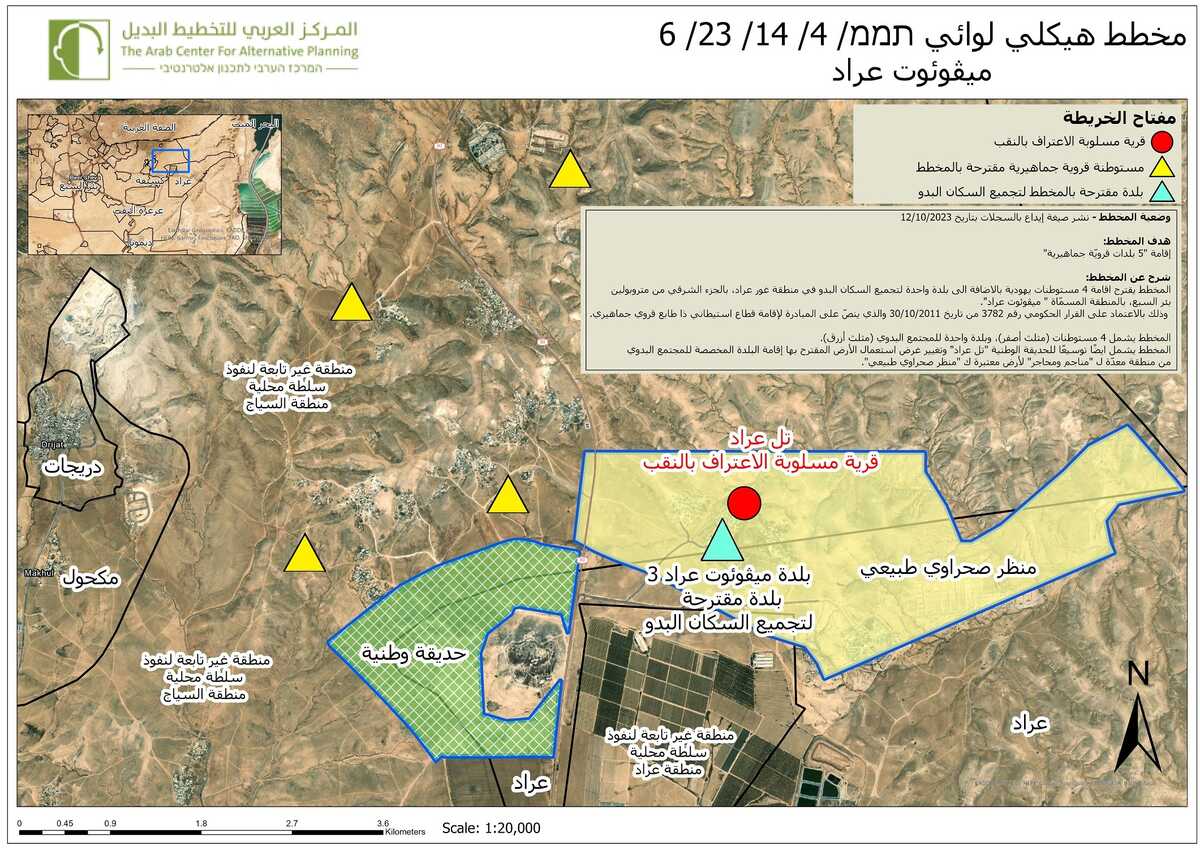
On October 12, 2023, the District Planning and Building Committee published an announcement about the submission of a “Regional Structural Plan (Tamam) for the Southern District - No. 6/23/14/4 named Mevovot Arad,” for objections for a period of 60 days.


The plan proposes establishing 5 new settlements in the Negev region, in the south of the country, one of which will be designated for the Arab Bedouin population in the Negev.


The plan to establish five new settlements in the Negev is a continuation of Government Resolution No. 3782 of October 30, 2011, which stipulates the establishment of a village settlement complex in the Mevovot Arad area.


Accordingly, District Planning and Building Council recommended the establishment of five settlements, one of which would be allocated to gather the Bedouin population from villages deprived of recognition in the region.


On March 27, 2022, the Israeli government approved Government Resolution No. 1325 to establish settlements based on the above Council decision.


This plan (exact 6/23/14/4) comes in the context of the Netanyahu government’s strengthening of the policy of expanding settlement in the Galilee and the Negev, which emerged in the coalition agreement with the “Religious Zionism” party, which pledged to accelerate the establishment of 14 settlements in the Negev.


The Arab Center for Alternative Planning said, “The plan contains several problems, which are:

The settlements proposed in the plan are located on areas on which deprived villages stand. These villages have been in the region for a very long time and are struggling to gain recognition and obtain rights and basic necessities of life.


Instead of recognizing and regulating existing Arab Bedouin villages, the plan proposes grouping the Bedouin population within the proposed settlement of Mevovot Arad 3.


The proposed plan for the Mevovot Arad 3 settlement ignores the existing population and community character of the area, and the existing rural and communal character of the villages.


The plan proposes converting the area surrounding the Mevovot Arad 3 settlement into an area defined as a “desert landscape,” thereby limiting the possibility of its expansion in the future.


The plan proposes that the settlement designated for the Bedouin population accommodate approximately 5,000 citizens, on an area not exceeding 800 dunums. In contrast, it is proposed that the four Jewish rural settlements accommodate approximately 1,800 citizens only, without specifying their area.


In addition, only the detailed map of the Bedouin settlement is subject to the approval of the representative of the “Minister of Security” in the district committee.


The Arab Center for Alternative Planning warns local authorities and Arab community leaders of “planning decisions that may be passed during this period in which the media does not pay much attention to planning issues.”


Source: Arab 48

PALESTINE

Wed 25 Oct 2023 11:16 am - Jerusalem Time

UNICEF: 2,360 children were killed in Israel’s attacks on Gaza

The United Nations Children's Fund (UNICEF) said that 2,360 children were killed in Israeli counterattacks in the Gaza Strip, in response to the October 7 Hamas attacks on southern Israel.


The organization stated, citing reports without naming sources, that 5,364 children were injured, and spoke of “relentless attacks.”


Since the sudden Hamas attacks on October 7, the Israeli army has bombed targets in the Gaza Strip and is preparing a ground invasion of the besieged Strip.


Adele Khader, UNICEF Regional Director for the Middle East and North Africa, said: “The situation in the Gaza Strip is a growing stain on our collective conscience. “The rate of death and injury to children is simply astonishing.”


UNICEF indicated that the Gaza Strip suffers from a severe water shortage, with dire consequences for children, who constitute about 50 percent of the population.


UNICEF urged all parties to agree to a ceasefire, provide humanitarian access, and release all hostages.


PALESTINE

Wed 25 Oct 2023 11:07 am - Jerusalem Time

5 questions about the proposal to revive the “International Coalition” for the Hamas war

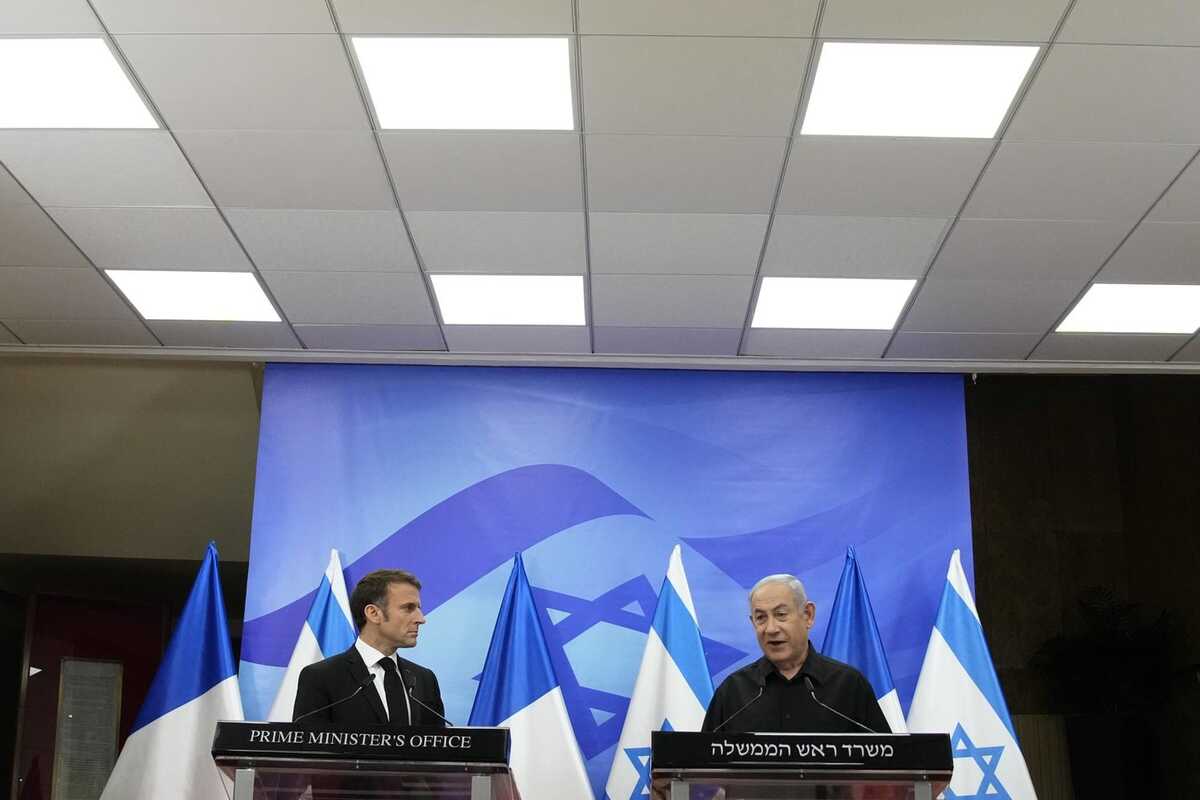
The proposal that French President Emmanuel Macron spoke about, during the joint press conference he held after his meeting with Israeli Prime Minister Benjamin Netanyahu, to expand the scope of work of the international coalition to combat ISIS to include fighting Hamas, raises several questions.


Macron said verbatim: “Israel’s priority, but also the priority of France and all democracies, is to defeat terrorist groups. So, we who have been targeted by these groups want to say something simple: You are not alone. Therefore, France is ready to “work” until the “International Coalition to Combat ISIS,” within which France is active in operations in Syria and Iraq, also fights “Hamas.”


Macron added: “I will offer to our international partners, as I indicated this morning, that we build a regional and international coalition to fight the terrorist groups that threaten us all. I believe that this is in the interest and security of Israel, as well as the interest and security of your neighbors who are threatened by these or similar groups.”


Macron's "surprise".

Political sources in Paris believe that what Macron brought was a “surprise,” and that the Prime Minister, the Minister of Foreign Affairs, or the Minister of Defense had never referred to it in any of their interventions and statements since October 7th. In her lengthy speech before the French Parliament, on Monday afternoon, French Prime Minister Elizabeth Bourne discussed at length her country’s policy and stopped at all the files that Macron brought with him to Israel and which he discussed with Netanyahu, and also with the President of the State of Israel and with the former Minister of Defense and the opposition.


French Prime Minister Elizabeth Bourne in a conversation with the Minister of Parliamentary Affairs in the National Assembly on Tuesday to discuss the war in Gaza (AFP)

But what was most absent was specifically the issue of international force and its push to fight ISIS. Moreover, nothing to this effect emerged from all the contacts that Macron had with the majority of Arab or European leaders or with the American President. Then, the Elysee sources, in their presentation of Macron’s expected visit to Israel, never mentioned the international force and the fight against “Hamas” and France’s role in it.


Clarifying blur

Because Macron’s proposal was vague, the sources accompanying him sought to clarify it, and said after the press conference that the intention was “either to build a new coalition, or (to expand the scope of work of the international coalition to combat ISIS) that currently exists, and its mainstay is the United States of America through its bases in Iraq to include (agitation)". These sources added that this matter “depends on what Israel requests.”


Political sources believe that achieving something like this would be far-fetched for several reasons, the first of which is that “nothing links Hamas to ISIS,” and therefore placing them on the same side is both a political and military mistake. The second reason is that the Arab countries participating in the war on ISIS within the framework of the international coalition will refuse to work alongside the Israeli, American and Western forces in general in the war that will be waged on the Gaza Strip.

The third reason is that adopting a plan like this will marginalize the Palestinian Authority and President Mahmoud Abbas more than he is marginalized, and therefore it will hinder him from playing any political role later, especially since thinking about the so-called “next day” that follows the end of the war, notes a major role for the Palestinian Authority and its restoration. To Gaza after the “elimination” of “Hamas”. Fourth, the French proposal does not take into account what the position of the residents of Gaza will be, nor the position of the Arab street when they see American aircraft participating in the strike on Gaza, and what repercussions this will have. Finally, no one can predict in advance what Hamas's reaction will be and how the file of hostages or kidnapped persons in its possession will develop. Macron has made their release a major goal of his communications.


Improvise the proposal

What indicates the improvisation in the French proposal is that sources accompanying Macron later indicated that what is required is “to be guided by the experience of the international coalition against ISIS, and to consider what can be borrowed from it against Hamas.” Therefore, we are in the process of thinking with our partners and with Israel in this context, and therefore it will be up to our partners and Israel in the first place to express their needs.”


Finally, these sources indicated that the work of the “International Coalition against ISIS” “is not limited to field operations, as it includes training Iraqi forces and exchanging intelligence information...”


The above shows that the French proposal is “immature,” and it is not certain that it may see the light while Israel is preparing to invade Gaza by land. The first reaction from Paris came from Jean-Luc Mélenchon, the former presidential candidate and leader of the hard-left “Rebel France” party, who criticized Macron’s proposal and saw in it a “return to the theory of the war on terrorism” promoted by former US President George W. Bush, which... French diplomacy confronted him at the time.


Ignoring the “humanitarian truce”

What is also striking in the course of Macron’s talks, who held a closed meeting with Netanyahu and then an expanded meeting that included the delegations of both parties, did not refer, either remotely or remotely, to the issue of the “humanitarian truce,” which the Prime Minister and the Elysee’s advisors focused on, and saw in it as a “prelude.” possible” for a cessation of hostilities.


Likewise, in the joint press conference with the Israeli Prime Minister, the French President did not make any reference to the victims of the multi-faceted bombing operations carried out by the Israeli army, which left more than 5,000 Palestinians dead and many times more wounded, in addition to the demolition of entire areas in the Gaza Strip.


One of the Elysee advisors said that it would be difficult for the Israeli army, which is preparing to invade Gaza with the aim of destroying Hamas, to do so while respecting international law, noting that Macron repeated to Netanyahu “the necessity for Israeli democracy to respect a number of standards, including Not to harm civilians who were described as (Hamas) hostages.”


Source: Al-Sharq Al- Awsat


OPINIONS

Wed 25 Oct 2023 10:55 am - Jerusalem Time

I spent two decades as a CNN correspondent. We journalists need to do a better job reporting the truth.

Ramallah - “Al-Quds” dot com

Ramallah - “Al-Quds” dot com

Opinion Writer

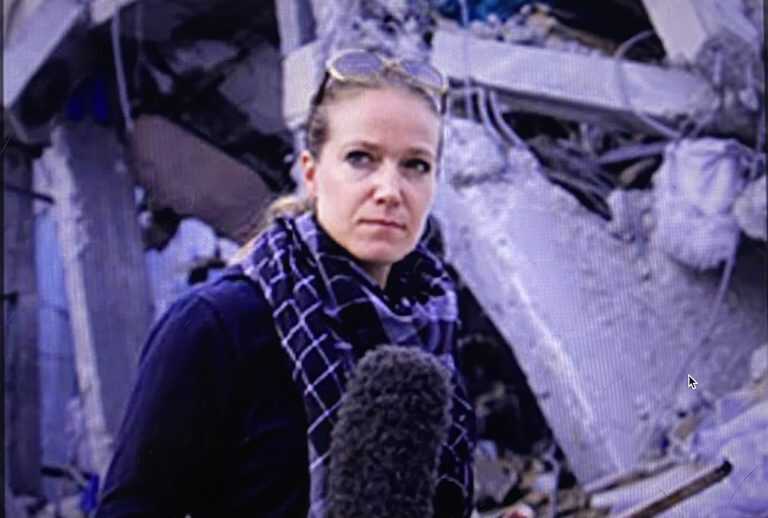
By Arwa Damon

As the often-quoted sentence goes, “The first casualty of war is the truth.”

I would argue that “casualty” is not merely an innocent byproduct of war but deliberately targeted.

As a twenty-year veteran of the journalism industry—two decades spent mainly covering war and violence—I can attest to that and how each “side” is trying to lure and manipulate with their messaging—what some might even call propaganda. I can attest to how each “side” will lie or try to cover up the truth, even when a “side” claims to have a higher moral standing.

I can also attest to just how hard it is to navigate through the many pieces of information hurling themselves in your direction, coming from sources on the ground, eyewitnesses, officials, and social media, which is a beast of its own with its trolls and state-sponsored cyber armies. Add to that journalists’ emotional reaction to the images the world sees and the words heard from survivors.

As the media, we need to realize the role we play in the trajectory of events. Our role can either inflame or educate and explain by building bridges of empathy and understanding.

Arwa Damon in Gaza in 2012 (Courtesy of Arwa Damon)

Looking at the coverage of what is happening between Israel and the Gaza Strip since the October 7 attack by the militant group Hamas, it feels like we’re catapulting ourselves toward this abyss of sheer and utter inhumane madness.

The events take me back to the drums of the Iraq war after the September 11, 2001 terrorist attacks—a runaway train where many Western, especially American media, cheered this effort and the US narrative of “good versus evil.” Oversimplification is so dangerous.

I was in New York City on September 11 and not yet a journalist. My body trembled in fear and confusion as I witnessed the second World Trade Tower come down. I remember how the streets were so eerily deserted at first; the only people out were those looking to donate blood or somehow help. At the time, I thought, “This is how we should treat each other. This is the sort of kindness I want to be a part of.”

But then it all changed.

I remember the hatred and vitriol spewed towards Muslims and people of Middle Eastern and North African descent. It was something that I was spared being a direct target of, despite being an Arab-American of Syrian heritage, simply because I am blond with green eyes.

I also remember watching how, somehow, all Arabs and Muslims got painted with this terrorist brush; watching coverage that lacked nuance and understanding. It was what pushed me to become a journalist.

I remember how Arab rage at the Iraq war was somehow twisted by many in the media as Arab support for al-Qaeda, which could not be further from the truth. How the calls of the few compared to the entire population of the Arab world of “death to America” and “death to Israel”—for the two are magnetically connected in the minds of Arabs—somehow ended up being the loudest voice. The reality was that Arabs did not want an American war in Iraq; not because they supported al-Qaeda; not even because they supported Iraqi dictator Saddam Hussein—for most did not—but because they did not support war. Back then, the Western media played a role. It aided and abetted the United States and its allies in their campaign to villainize and dehumanize Iraqis, Arabs, and Muslims.

Despite being so deeply reminded of the past, this present that we are living in is very different and arguably even more dangerous. Military commanders and even President Joe Biden are warning of the lessons of the past; of the point in time when “victory” will be declared and how there needs to be a plan for “peace.”

I fear that, in that planning, based on everything I am seeing and hearing now from heads of state to people on the street, the intense impact of the emotions generated now is not being planned for at all. Or even more disturbing, it is being planned for: a complete and total meltdown of humanity, which we will all be complicit in bringing around. 

For it is not quite the same as the post-9/11 era. This juncture we are in is potentially more divisive, dangerous, and destructive. There is a much deeper, darker history here with a deeply embedded generational trauma, all of which makes the emotional component of this even more intense. Make no mistake: emotions play such a big part in warfare. There is a reason why there’s an “information war.” It’s because a significant component of military strategy is not just troop movement on the ground nor striking strategic targets but psychological operations. These psychological operations target not just the population against whom war is being waged but all of us.

We need analysts to break down the information war and how it plays and preys on emotions and trauma. I am not talking about military or other analysts who talk about the mechanics of the information war or state that it’s a big aspect of war, but rather psychological analysts who can explain how that impacts our psyche and thinking towards each other. We need to show and analyze the human reaction to hearing words like “human animals,” “rats,” and “children of light versus children of darkness,” and break down how that can dehumanize an entire population and what the risk of that is.

No armed entity can gather support and power without being able to point to pain in the past and say, “Look what has been happening. Look at the pain you suffered. I am the only one who can protect you from your biggest fear.”

No nation can gather support for war within its borders or from its global allies without painting its enemy as “less than.” A life worth less than yours. A life that is not human; not human in the way that you are. A life that doesn’t love like you, laugh like you, hurt like you. This is how we end up, consciously or not, accepting the significant loss of civilian life.

We cannot allow this to happen again. As the media, we cannot let ourselves be a pawn in a dehumanization campaign.

As the media, we need to dive into the emotional aspect of all of this as part of the coverage. Every one of our actions is driven by an emotional reaction—a desire for revenge, anger, hatred, and fear. We need to include emotional analysis, experts who can talk about collective and generational trauma, and the impact that that has had on getting us to this point. It is one thing to analyze events that lead us to a certain point, and it is another, deeper, and necessary thing to talk about how emotions drove the actions that led us to that point.

The polarization that I see is frightening, whether it’s antisemitism on the rise or growing Islamophobia. It is utterly appalling to hear about a six-year-old Palestinian-American child being stabbed to death in a hate crime. It cuts me to listen to an Arab friend tell me about her relative living in the West spat on and told, “You should all be killed.” It is sad to see a Jewish mother post on social media that she is losing followers because she posted about her son’s Bar Mitzvah, a celebration of their faith. It is wrong to hear about some Jewish schools in London closing because of fear.

The Western media needs to give more space to Palestinians, and we all need to really listen and treat their words as if we are hearing them for the first time. There is this very wrong “normalization” of the “plight of the Palestinians”—perhaps because it has been going on for so long—for more than seven decades—and the media “spotlight,” being as limited as it is, kept moving on. Palestinians are right when they question why the outcry and the coverage of their pain is muted. To those networks who do think they are covering “both sides” because they have the one package out of the Gaza Strip and one guest, it’s not enough when the rest of your coverage is leaning so heavily into military operations or, even worse, consists of a lineup of mostly older white men who have not tasted, smelled, nor felt what war feels like on the other end of an American or an Israeli bomb. They are experts who have not lived or experienced, in this scenario, the “Arab” side of it.

On the flip side, non-Western media—especially Arab and Arab-owned media—should not continue to bypass the pain and trauma of the survivors of the Hamas attack and the parents, friends, and family of those taken hostage. I have watched a lot of different networks’ coverage of these events, and while I might have missed it, I did not once see the pain that the Hamas attack caused in Israel reported on. Space needs to be made for Jewish and Israeli voices on such outlets. Not all Israelis support their government’s policies, the illegal settlements, or the oppression or occupation of Palestine. And not all Jews across the world support Zionism or what Israel has done.

We cannot abdicate our fundamental responsibility as the press: to question, confront, and probe all sides; to call out lies and crimes no matter who is committing them. All media outlets need to rise above this notion that, if you cover a person’s pain, you somehow take a “side.” Pain is pain. We must be allowed to see the pain of our “enemy.” For some—and I do believe it is the few; I want to believe it is the few—it will bring them joy and a sense of vengeance to see the pain of the “enemy.” But, for the majority, perhaps, it will make them question and probe why they reacted a certain way, hopefully leading to more understanding.

We need to be allowed to see that the “enemy” is not monochrome. I believe that, for the majority, it will make them realize that perhaps what they have been conditioned to believe might not be the whole picture.

The media needs to realize and recognize the role we can play in fueling polarization and hate, whether that be through simply negating or disregarding a person or a population’s pain. We did play a role in fomenting the deep hatred post-9/11 that ultimately led to a more violent world. We need to be hyper-conscious not to play that role again.

I can see the trajectory we are on—this spiral of animosity and the growing monster that fuels a madness we will not be able to control. I can see a world filled with more hate and violence that will impact not just our generation but generations to come. And I can see the media’s role in preventing that. There are many aspects of this that we cannot alter, but we can ensure that we are not pushing divisions. We need to be stronger and better than the pressures on us—be it pressure from our government, our bosses, and even our own emotions.

We must build a world with more power in the truth than in the lie.


Arwa Damon is a nonresident senior fellow at the Atlantic Council’s Rafik Hariri Center for the Middle East and president and founder of the International Network for Aid, Relief, and Assistance (INARA), a nonprofit organization that focuses on building a network of logistical support and medical care to help children who need life-saving or life-altering medical treatment in war-torn nations. She is also a former CNN senior correspondent with two decades of experience.

PALESTINE

Wed 25 Oct 2023 10:49 am - Jerusalem Time

Israel continues to tighten its military measures in the West Bank governorates

Since the start of the aggression against the Gaza Strip on October 7, the Israeli occupation forces have continued to tighten their military measures in the occupied West Bank governorates, by closing checkpoints and entrances to cities, towns and villages, and obstructing the movement of citizens.


In Qalqilya, the occupation forces set up a military checkpoint on the main Qalqilya-Nablus road, stopped vehicles, and checked the identities of passers-by, which led to the obstruction of traffic in the area. They also continue to close the two main entrances to the town of Azzun and Kafr Laqif, east of Qalqilya, with the iron gate, for a week, which Citizens are forced to take alternative, secondary routes to reach their destinations.


In Tubas, the occupation soldiers stationed at the Tayasir checkpoint in the east obstructed the movement of citizens heading to the northern Jordan Valley, by checking their personal identities, and detaining vehicles for a long period before allowing them to enter, causing a stifling crisis and delaying the arrival of students and teachers to schools in the Jordan Valley.


The checkpoint has witnessed suffocating crises and traffic obstruction every day for more than two weeks, causing delays in the arrival of employees, workers, and farmers to their workplaces in the Jordan Valley.


While the occupation forces continue to tighten their closure on Bethlehem Governorate, by closing the entrances to the western countryside, the town of Beit Fajjar, Marah Rabah, the northern entrance to Teqoua with iron gates, the Qabr Hilweh junction leading to the colonial road to Hebron with cement cubes, the western Beit Jala with an iron gate, and the entrance to Beit Housing. They toured with cement cubes, to Zaatara to the east with dirt mounds, and to Masjah in the town of Janata to the east with the iron gate.


The occupation soldiers also search citizens' vehicles and verify their identities, causing a stifling traffic crisis.


The settlers, protected by the occupation forces, also prevent farmers from reaching their lands to pick grapes and olives, and even steal them, as happened in the town of Al-Khader and in the Al-Makhrour area in the city of Beit Jala, west of Bethlehem.

PALESTINE

Wed 25 Oct 2023 10:37 am - Jerusalem Time

Israel demolishes a house and forces a Palestinian citizen to demolish his house in Jerusalem

Today, Wednesday, Israeli occupation bulldozers demolished a house in the Sheikh Jarrah neighborhood in occupied Jerusalem.


According to local sources, the occupation bulldozers stormed a house in the Sheikh Jarrah neighborhood and began demolishing it, which was housing ten people.


The sources added that the occupation municipality imposed a large fine on the owner of the house, after it demolished the house with its vehicles, accompanied by large forces of the occupation police.


In the same context, the occupation authorities forced another citizen to demolish his house this morning in the town of Beit Hanina, north of Jerusalem.


It is noteworthy that Jerusalemites are forced to demolish their homes themselves under pressure from the occupation authorities, in order to avoid paying heavy financial fines imposed on them by the occupation municipality in Jerusalem, if its vehicles carry out the demolition.


PALESTINE

Wed 25 Oct 2023 10:01 am - Jerusalem Time

Israeli settlers attack farmers west of Salfit

Today, Wednesday, settlers, protected by the Israeli occupation forces, opened fire on farmers in the town of Qarawat Bani Hassan, northwest of Salfit.


According to local sources, settlers, protected by the occupation forces, stormed the “Nuwaitf” area in the town and opened fire on the olive pickers, forcing them to leave their lands.

PALESTINE

Wed 25 Oct 2023 10:01 am - Jerusalem Time

Israel continues massive arrests in West Bank and Jerusalem, targeting 80 Palestinians

Last night and today, Wednesday, the Israeli occupation forces launched a massive arrest campaign in the West Bank and Jerusalem governorates, targeting 72 citizens.


In Jerusalem, the occupation forces arrested: Atta Jaffal, Majed Hajjaj, Baraa Jawhar, and the stationed Hanadi Khweis, Khadija Khweis, and Adel Hassan Al-Sharif, and from the Qalandiya camp 14 citizens, namely: Aseed Abdel Rahman, Muhammad Anwar Zaidiyah, Anwar Zaidiyeh, and Ahmed Lafi. , Muhammad Abu Khamsa, Naji Shehadeh, Muhannad Rayan, Dhiaa Abdel Qader, Moatasem Buaital, Mustafa Al-Kasba, Malek Zayed, Maher Naji, Tawfiq Al-Zeer, and Ahmed Al-Zeer.


From Ramallah, the occupation forces arrested three citizens from the village of Budrus, northwest of Ramallah, namely: Nadi Obaid, Bahaa Awad, and Musa Al-Asmar, and from the village of Deir Nizam, Osama Muhammad Saleh Al-Tamimi, Reda Muhammad Asfour from the village of Sinjil, northeast of Ramallah, and Mahmoud Muhammad. Ahmed Asteeh from the village of Deir Qadis Gharbah.


From Qalqilya, the occupation forces arrested the citizen Alaa Al-Duwairi, in his fifties, and his son Muhammad, in his twenties.


From Salfit, the occupation forces detained a freed prisoner, Saqr Rayyan, from the town of Qarawat Bani Hassan.


From Jenin, the occupation forces arrested three citizens: Abdullah Aweidi, Mahmoud Qasrawi from the town of Burqin, and Atallah Al-Jabali from the Al-Hadaf neighborhood in the Jenin camp.


From Tubas, the occupation forces arrested Firas Sawafta, Moamen Abdel Fattah Salim Dhabbat (24 years old), and Majdi Ghassan Ghannam from the town of Aqaba.


From Hebron, the occupation forces arrested 26 citizens, namely: the three brothers Iyad, Amid, and Tariq Al-Jabarin, Muhammad Salim Abu Aisha from the city of Hebron, Muhammad Ismail Abu Arqoub, Nafez Al-Shawamreh, Kayed Ibrahim Al-Amayra, Muhammad Fares Abu Arqoub, Ismail Amr, Moataz Hassan Amr, Wissam Youssef Amr, and Raafat Turki. From the town of Dura.


From the town of Beit Awa, these forces arrested 11 citizens, namely: Ibrahim Saba Al-Suwaiti, Hatem Ahmed Al-Suwaiti, Muhammad Nabil Al-Masalma, Moataz Mahmoud Al-Masalma, Mahmoud Farouk Al-Suwaiti, Jihad Mahmoud Al-Suwaiti, Ismail Abdullah Salama, Uday Nayef Abdel Fattah Abu Al-Ghalasi, and Ramzi. Abdel Fattah Abu Al-Ghalasi, Bilal Mahmoud Al-Suwaiti, and Mahmoud Ismail Al-Suwaiti.


In the town of Beit Ummar, north of Hebron, the occupation forces arrested 8 young men, namely: Ali Issa Musa Awad, Riyad Issa Younis Arar, Abdul Aziz Shaaban al-Hindi, Anwar Youssef Khudair Awad, Muhammad Ali Issa Awad, Amr Riyad Issa Arar, and Kayed Walid Kayed al-Salibi. And Muhammad Salim Shaaban Al-Hindi.


From Bethlehem, 11 citizens were arrested, and they are: the young man Murad Mustafa Al-Zaghari (34 years old), from the Dheisheh camp, Muhannad Ahmed Ghayatha from the town of Nahalin, Munis Ibrahim Malsh (25 years old), Azmi Tayseer Manasra from the town of Doha to the west, and Hamza Awad Atallah ( 26 years old), Ibrahim Wajih Atallah (24 years old) from the village of Harmala in the east, Awad Hassan Al-Khatib (45 years old) from the Wadi Shaheen area in central Bethlehem, Anwar Ahmed Al-Sheikh from the village of Marah Rabah in the south, Ahmed Ramadan from the Dheisheh camp, and Musa Ahmed Abd. Rabbo (36 years old) from the village of Al-Walaja, and Mustafa Ashraf Salah (19 years old) from the town of Al-Khader in the south.

OPINIONS

Wed 25 Oct 2023 9:43 am - Jerusalem Time

What is happening and what will happen during and after the war

Nabil Amr

Nabil Amr

Opinion Writer

The October 7th operation was called the Al-Aqsa Flood, and when Israel formulated its response, it called it the Iron Swords.
With the first aerial bombardment of Gaza, the facts went beyond the two labels, to give rise to more realistic labels, such as the war of revenge, the war of displacement, the war to liquidate Hamas, the war to liquidate the Palestinian cause, and standing on the brink of a regional war that might lead to a global war.


A war whose titles were many and whose extensions were wide-ranging, until it became the most important in the world, including the Ukraine war, which no one mentions anymore.


In the midst of this war with multiple titles and even objectives, focus is being placed on its operational course, and the central question is: Will Israel invade Gaza by land? This calls for another central question: If you do that, will things develop into a regional war?


According to the deteriorating morale in Israel, ground war seems to be one of the remedies offered to restore it, especially since the urgent mobilization since the start of the aerial bombardment has reached the point of being inevitable. However, what has seemed clear, at least so far, is that although it was easy to make a decision to do so, it is difficult to implement it, and there are many reasons for this, perhaps the most important of which is... the American reservation about it, which produced a sharp disagreement within the Israeli decision-making institutions, and in this case the American influence is doubled, whose level had already risen through the administration’s incursion into its institutions to the point of participation, and from the position of supreme master in the main decision-making process.


This participation has prevented the military establishment from initiating a pre-emptive war against Hezbollah, and it is working hard to prevent the war from expanding beyond its current level: a destructive war on Gaza under the title of destroying Hamas, and controlled clashes with Hezbollah, and America has sought help for that. With heavy reserve work, such as sending an aircraft carrier to the vicinity of the current and potential war, sending forces and equipment, and providing additional funds, the priority of all of this is to prevent the spillover into a regional war that does not suit America, which has drawn its strategic policies in different directions, not including the war in the Middle East.


No matter how different the headlines were and whether the declared or hidden goals developed, what emerged automatically from this war was the progress of the status of the Palestinian issue from neglected to being under discussion, the return of the political solution to the Palestinian issue to a broader scope and more important levels, and the removal of the thick dust that had enveloped the two-state solution and turned it into a mere slogan. Dying, the world repeats it without making any effort to work towards it.


On the sidelines of the raging war on Gaza, and its permanent side, albeit at a lesser pace in the West Bank, new facts have emerged, the most important of which is the crystallization of a unified Arab position, which was demonstrated at the Cairo International Summit, based on pushing for an end to the war on Gaza, the results of which are not expected to be immediate, and the provision of effective support to its people through The United Nations, establishing a truce, then opening the political path to resolve the Palestinian issue in a “fairer and more effective” manner. This is taking shape, and it has appeared that it has many supporters and opponents as well. It will put the ball back in the Arab court after the internal and inter-state conflicts pushed it away from its natural place, when everyone was embracing the principle that the Palestinian issue is the central issue of the nation.


The war on Gaza and its possibilities will not affect the existing status of the Palestinian cause, with more than fifteen million Palestinians embracing it, and providing it with continuity of life and influence... and they are not isolated from a huge public depth, Arab and international, and this was clearly demonstrated in the powerful demonstrations that swept the capitals of the world. These demonstrations reinforced among the neutral, hesitant, and spontaneous supporters of Israel the fact that without a political solution to the Palestinian issue after stopping the brutal, destructive war on Gaza, there will be no security and stability in the Middle East, and the world will not escape the storm of recurring wars and their direct security and economic impact. Politically and morally.


The pain is deep and severe as we have lost thousands in Gaza in bulk, and thousands in the West Bank in installments. However, this pain should not result in wailing and tears, but rather a Palestinian effort befitting the great development that has occurred since October 7 of this year.


What should Palestinians do during and after this war? This will be the topic of the second part of this article.

PALESTINE

Wed 25 Oct 2023 9:38 am - Jerusalem Time

Dozens of Israeli settlers storm Al-Aqsa Mosque

Today, Wednesday, settlers stormed the blessed Al-Aqsa Mosque, under the protection of the Israeli occupation forces.


According to local sources, settlers stormed the courtyards of Al-Aqsa Mosque from the direction of the Mughariba Gate, carried out provocative rounds, and performed Talmudic rituals in its courtyards.


In the same context, the occupation police tightened their military measures in the vicinity of Al-Aqsa Mosque, stopping students at the doors of the mosque and searching them, and obstructing their access to schools inside the mosque.


The occupation police also set up a checkpoint near the Lions' Gate in Jerusalem, searched vehicles, and caused a stifling crisis.


According to eyewitnesses, the occupation police prevented many of those coming to Al-Aqsa from entering and sent them back, despite keeping the doors open to suggest that the situation was proceeding normally in the mosque.

PALESTINE

Wed 25 Oct 2023 9:28 am - Jerusalem Time

A strike in Qalqilya and Jenin denouncing Israeli deadly attacks

The national activities in Qalqilya and the national and Islamic forces in Jenin called on citizens to go on a comprehensive strike in the two governorates today, Wednesday, to mourn the spirit of the martyrs.


In Qalqilya, national activists called on citizens in a statement read over loudspeakers to go on strike to mourn the soul of the young martyr, Hamza Sayel Taha (19 years old), who died at dawn after being critically wounded by live bullets from the occupation. They called for the widest participation in the funeral of his body after the noon prayer. In front of the old mosque in the city.


The Ministry of Health had announced the death of the young man, Taha, by live bullets from the occupation forces in the chest, after the occupation forces stormed the city and besieged his family’s home.


In Jenin, the national and Islamic forces announced a comprehensive strike for all aspects of life, with no working hours permanently, in mourning for the souls of the city’s martyrs, and in solidarity with the steadfast families of the martyrs in the Gaza Strip.

PALESTINE

Wed 25 Oct 2023 8:19 am - Jerusalem Time

Nasrallah meets Jihad and Hamas leaders Al-Nakhalah and Al-Arouri in Lebanon

The Secretary-General of Hezbollah, Hassan Nasrallah, met with the Secretary-General of the Islamic Jihad Movement, Ziad al-Nakhalah, and Saleh al-Arouri, deputy head of the Political Bureau of Hamas, to discuss developments in Operation “Al-Aqsa Flood.”


A statement issued by Hezbollah’s military media said: “The Secretary-General of Hezbollah, Hassan Nasrallah, received the Secretary-General of the Islamic Jihad Movement in Palestine, Mr. Ziad Nakhla, and the Deputy Head of the Political Bureau of the Hamas Movement, Sheikh Saleh Al-Arouri, where the recent events in the Gaza Strip since The start of Operation Al-Aqsa Flood and the subsequent developments at every level, as well as the ongoing confrontations on the Lebanese border with occupied Palestine. An assessment was made of the positions taken internationally and regionally and what the parties of the resistance axis must do at this sensitive stage to achieve a real victory for the resistance in Gaza. And Palestine and stop the treacherous and brutal aggression against our oppressed and steadfast people in Gaza and the West Bank, and it was agreed to continue coordination and permanent follow-up of developments on a daily and permanent basis.”


This is the first media appearance of Hezbollah leader Hassan Nasrallah since the outbreak of the “Al-Aqsa Flood” operation.


Earlier, a Hezbollah official revealed the reason why its Secretary-General, Hassan Nasrallah, did not appear in the media to address public opinion, stressing that this was part of his management of this battle.


Member of the Loyalty to the Resistance Bloc, MP Hassan Fadlallah, said in statements to Al-Mayadeen channel, “The resistance knows the path it has chosen to defend its country well, and it knows which enemy it is fighting, and who stands behind it, and it has a solid environment that is not affected by all disinformation and intimidation campaigns.” . He stressed that "The Secretary-General of the Party, Hassan Nasrallah, is following the course of this confrontation here in Lebanon and what is happening in Gaza, hour by hour and moment by moment. He is supervising the management of this battle in direct communication with the field leadership of the resistance, and supervising all field and political developments."


PALESTINE

Wed 25 Oct 2023 8:19 am - Jerusalem Time

Naval breakthrough.. Al-Qassam engages in clashes in Zikim and bombs Tel Aviv

The Al-Qassam Brigades, the military wing of the Islamic Resistance Movement (Hamas), announced that a naval force of its fighters was able to infiltrate the beaches of Zikim, south of Ashkelon, and clash with the occupation forces, while the Israeli army announced that it had killed a number of infiltrators.


The Al-Qassam Brigades said that a force of "frogmen" was able to "infiltrate by sea and land on the beaches of Zikim, south of occupied Ashkelon, and armed clashes are now taking place with the occupation army in that area."


Al Jazeera said that this sea penetration may be the largest by the resistance since the start of the Israeli war on Gaza following Operation Al-Aqsa Flood on October 7, which also witnessed the infiltration of resistance fighters to Zikim Beach, northwest of the Strip.


Sirens sounded twice in the settlements of Zikim and Karmiya as reports of the infiltration continued.


The channel indicated that previous infiltration operations were carried out by a few members of the resistance, but the number of infiltrators this time appears to be large, according to Israeli media reports.


For his part, an Israeli army spokesman announced that the infiltration operation at Zikim Beach had been thwarted, and said that his forces were still combing the area, but he did not reveal details regarding the size of the operation and the number of participants in it.


The spokesman said that Palestinian naval commandos infiltrated through a tunnel into the sea and then to Zikim Beach.


Israeli Channel 12 said that at least 10 militants were killed by Israeli naval fire, while Channel 14 said that clashes were still continuing in the area.


A video clip showed what appeared to be flash bombs fired by the occupation forces in the area to detect intruders.