






Washington Message
New York – Said Arikat – 28/7/2026
UN Spokesperson Farhan Haq began the organization's daily press briefing on Monday by warning of the accelerating deterioration of conditions in the occupied West Bank, amid escalating Israeli occupation measures, increasing settler attacks, and accompanying tightening restrictions on Palestinians. He affirmed that UN Secretary-General António Guterres is "gravely concerned" about recent Israeli decisions aimed at accelerating the legitimization of agricultural outposts and establishing new ones in the occupied Palestinian territories.
Haq, conveying the Secretary-General's position, stressed that all Israeli settlements, including outposts, "have no legal validity and constitute a flagrant violation of international law," emphasizing that they remain one of the biggest obstacles to achieving a two-state solution and establishing a just, lasting, and comprehensive peace in the region.
In the same context, the spokesperson conveyed warnings from the UN Office for the Coordination of Humanitarian Affairs (OCHA), which expressed deep concern about the sharp escalation of violence across the West Bank in recent days. He noted that since last Thursday, at least eight Palestinians, including a child, have been killed, in addition to two Israelis, while a large number of people from both sides have been injured.
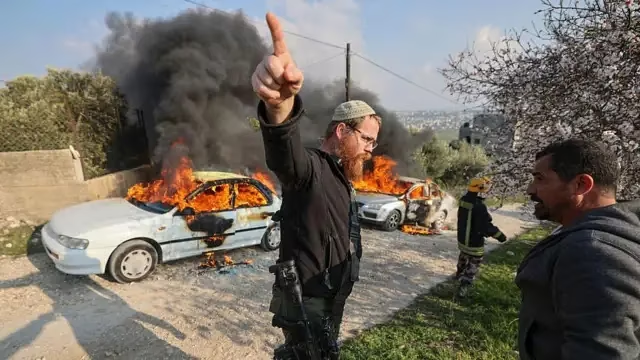
He explained that the recent wave of violence witnessed the burning of Palestinian homes, mosques, trees, and agricultural facilities, as well as the vandalism and complete destruction of some civilian properties. The attacks also led to the displacement of at least ten Palestinian families from their residential areas.
He added that, in parallel, Israeli forces tightened restrictions on the movement of Palestinians in large areas of the West Bank, which prevented thousands of people from accessing essential services, including emergency medical care, and also hindered their access to their livelihoods.
OCHA revealed that this year, more than 1,330 incidents involving Israeli settlers have been documented so far, resulting in injuries, property damage, or both, indicating an unprecedented increase in the pace of settler attacks.
According to UN data, from the beginning of 2026 until last Saturday, 77 Palestinians, including 18 children, were killed by Israeli forces or settlers, compared to three Israelis killed by Palestinians during the same period.
The UN reiterated its call for urgent protection for civilians and full adherence to international humanitarian law and international human rights law, emphasizing the need to hold all those responsible for violations accountable.
During the press conference, a correspondent for Al-Quds newspaper asked whether the UN has the authority to classify Israeli settlers or groups that commit violence against Palestinians as "terrorist organizations," in light of the escalating organized attacks targeting Palestinian villages.
Farhan Haq responded that the UN Secretariat does not have the authority to classify any entity as a terrorist organization, explaining that such decisions rest with member states or the Security Council, which adopts specific lists, including those related to Al-Qaeda and the Taliban movement. The Secretariat does not have an independent mechanism to issue or recommend such classifications.
In another question, the spokesperson was asked whether the Secretary-General believes that what is happening in Gaza, the West Bank, and Jerusalem represents a coordinated Israeli policy aimed at practically ending the possibility of implementing the two-state solution. Haq replied that the UN's position has not changed, and that the continued illegal settlement expansion represents the primary obstacle to the establishment of a Palestinian state and the achievement of peace, affirming that the organization still considers the two-state solution an indispensable central goal.
The conference also touched upon the so-called "Peace Council" for the Gaza Strip, where the spokesperson, in response to a question from Al-Quds correspondent, clarified that the UN's role is limited to the humanitarian aspect, denying any involvement of the organization in military arrangements or in coordinating the deployment of any international forces. He indicated that such arrangements fall under the responsibility of the initiative's guarantors, including the United States and relevant international envoys.
Farhan Haq's prioritization of the West Bank file over other daily briefing files reflects the UN's understanding that developments on the ground there have reached a stage where they are difficult to treat as isolated incidents. Settlement expansion, settler violence, and the imposition of military restrictions on Palestinians have become, according to the organization's description, interconnected elements within a rapidly changing reality. Therefore, the UN's warning is no longer limited to humanitarian aspects but has extended to warning of the long-term political implications that threaten to empty the two-state solution of any practical content.
The discussion about the possibility of classifying settlers involved in attacks against Palestinians as terrorist groups highlighted the limits of the UN's powers compared to the authorities of the Security Council and member states. While the organization affirms that it does not have the authority to issue such classifications, the posing of the question reflects increasing international demands to deal with settler violence as an organized phenomenon, not merely individual acts. It also reveals the widening gap between the legal description of violations and the political tools available to hold perpetrators accountable.
The UN briefing confirms that concerns are no longer limited to the rising number of casualties or the extent of destruction but extend to the nature of policies that are causing permanent changes on the ground in the West Bank. The legitimization of new settlement outposts, coupled with expanding restrictions on Palestinians and the displacement of families, paints a reality that makes returning to the negotiation path more complex. Hence, the UN's messages appear to be an attempt to legally and politically document these transformations, even if its ability to enforce change on the ground remains limited in the absence of a binding international consensus.
Share your opinion
UN Sounds Alarm on West Bank: Settlement Expansion Accelerates, Settler Violence Poses Grave Threat