






Washington Message
Washington – Said Arikat – 30/6/2026
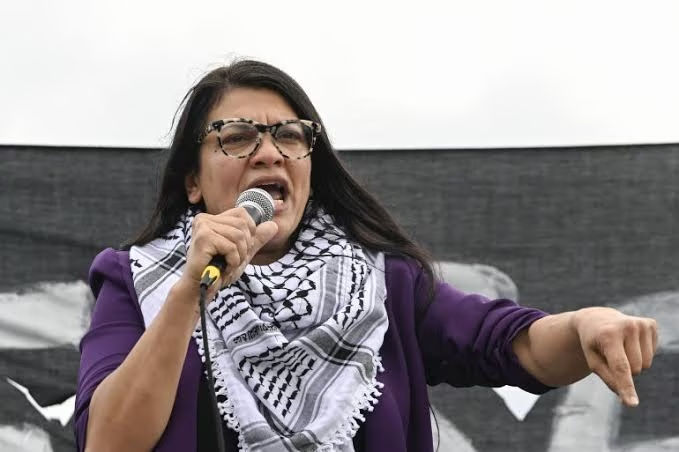
Democratic Representative Rashida Tlaib of Michigan intends to force a new vote in the House of Representatives on Tuesday, to compel the US administration to end any American military involvement in ongoing Israeli operations in Lebanon. This move reflects growing opposition within Congress to Washington's continued involvement in the war, and increasing criticism of what opponents describe as unconditional American support for Israeli military policies.
In a post on the "X" platform on Monday evening, Tlaib stated that she would force a new vote to end US involvement in what she described as "the Israeli apartheid regime's campaign of ethnic cleansing and territorial expansion in Lebanon." She added that more than 4,250 people have been killed, while twelve children are killed or injured daily, considering that continued American military and political support makes Washington a direct partner in the continuation of the war and its widespread human losses.
This move comes weeks after the House of Representatives rejected, in early June, Resolution H.Con.Res.84, which was based on the War Powers Act and aimed to end any involvement of US armed forces in hostilities related to the war in Lebanon, unless Congress explicitly authorized it.
The House had defeated the resolution by a majority of 324 representatives against only 92 in favor, a vote that reflected the continued traditional consensus within the American political establishment to protect the strategic relationship with Israel, despite escalating international criticism of Israeli military operations, and increasing questions within the United States about the extent of the US administration's adherence to the Constitution, which grants Congress the authority to declare war and oversee the use of military force.
Following the failure of the first resolution, its supporters redrafted it into a new version, H.Con.Res.108, after addressing some legal observations raised during previous discussions, while maintaining the primary goal of ending any unauthorized US military involvement in the war and reasserting Congress's oversight powers over the administration's military decisions.
In parallel, a number of Congress members are pushing for an amendment to the State Department and Foreign Operations Appropriations Bill for fiscal year 2027, which would cancel approximately $3.3 billion in military aid allocated to Israel, in an unprecedented attempt to link US funding to respect for international law, and to end a policy of financial and military support that has continued for decades without real accountability.
Observers believe that the chances of passing the new resolution remain limited given the current balances within the House of Representatives. However, merely reintroducing it reflects a growing political shift within the United States, where the debate is no longer limited to the amount of aid provided to Israel, but has extended to questioning the American role itself, and to holding successive administrations responsible for providing political, diplomatic, and military cover for the continuation of Israeli operations in the region.
The reintroduction of the resolution reveals that the core of the battle is no longer limited to the war in Lebanon, but concerns the nature of the American political system itself, and the limits of Congress's ability to curb the executive branch when it comes to Israel. For years, US administrations have continued to provide military, intelligence, and political support to Tel Aviv, even amid repeated accusations of serious violations of international law. Critics say this approach has transformed the principle of “defending Israel” into a quasi-absolute policy, overriding constitutional and humanitarian considerations, and limiting the ability of oversight institutions to hold the executive branch accountable.
The vote that defeated the resolution reflects the continued strong influence of pro-Israel lobbies within Congress, where the majority of representatives from both parties still view any attempt to restrict military aid or impose oversight on the use of force as a threat to the strategic alliance between Washington and Tel Aviv. However, the widening circle of dissenting voices, even if they remain a minority, indicates the beginning of a gradual shift in the American political mood, driven by growing popular criticism and increasing human rights reports that question the legality of Israeli military operations and their humanitarian consequences.
Although the chances of the resolution succeeding in the short term appear slim, its importance lies in forcing the American political establishment to confront questions that can no longer be ignored: To what extent can Washington continue to fund and arm Israel without bearing political and moral responsibility for the results of using those weapons? And can the United States continue to present itself as a defender of international law and human rights, while using its veto power and providing diplomatic and military cover for an ally facing increasing accusations of widespread violations against civilians? These questions have become a central focus of the political debate within the United States, and are likely to become more prominent as the midterm elections approach.
Share your opinion
Tlaib reignites congressional battle to halt military aid to Israel in Lebanon amid sharp division within the House of Representatives