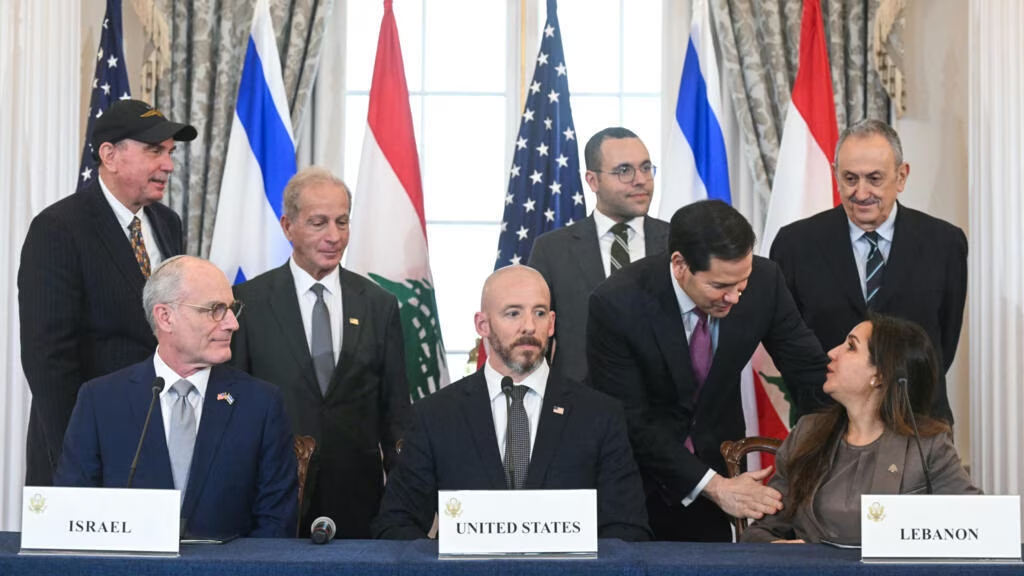







Dr. Ahmed Rafiq Awad: Iran is unlikely to accept the proposed formula for the Lebanese-Israeli agreement, which may doom this understanding to failure from the outset. Areeb Rantawi: The agreement is a "consolation prize" for Israel at the expense of the Lebanese, and its terms reflect a priority of targeting Hezbollah and Iran more than addressing the issue of the occupation of southern Lebanon. Dr. Amjad Shihab: The specter of civil war may push various Lebanese forces to overturn the agreement, based on the conviction that the cost of sliding into internal conflict will be much greater. Firas Yaqhi: The agreement may establish a new relationship between Lebanon and Israel with elements similar to the Oslo Accords, based on security coordination and linking any withdrawal to disarmament. Dr. Raed Al-Dabai: The most prominent mistakes of the agreement are falling into the trap of temporariness by postponing fundamental issues and linking their resolution to the issue of disarming Hezbollah according to the American-Israeli vision. Samer Anabtawi: The agreement paves the way for creating an internal division between a current that supports direct negotiations with Israel and another that adheres to the option of resistance and linking the Lebanese file to the regional context. Ramallah – Exclusive to "Al-Quds" – Warnings are increasing that the Lebanese-Israeli framework agreement, under American patronage, may lead to the reproduction of the Oslo Accords model for the Palestinian issue, within long-term transitional agreements that grant Israel security and political gains, in exchange for postponing fundamental issues related to sovereignty, withdrawal, and borders.
Writers and political analysts agree that the terms of the agreement between Lebanon and Israel give the latter an advanced position in managing the next phase, and link any withdrawal from southern Lebanon to the issue of disarming Hezbollah, which raises widespread doubts about the possibility of its implementation.
They believe that the agreement goes beyond being security understandings to form part of a rearrangement of the regional scene, by separating the Lebanese file from the path of American-Iranian understandings, and reducing the Iranian role in Lebanon, while opening the door for new security and political arrangements.
They warn that the absence of internal Lebanese consensus, and the continued disagreement over Hezbollah's weapons, may turn the agreement into a source of internal division, and lead to an escalation of political and security tensions, and perhaps open the door for wider regional interventions.
In their reading of the potential scenarios, they suggest that the agreement will face significant difficulties preventing its full implementation, given Israel's adherence to its security priorities and linking withdrawal to complex conditions, in addition to expected rejection from Hezbollah and Iran, and continued disagreements over border and sovereign issues.
Intersection of the Agreement with Oslo Political writer and analyst Dr. Ahmed Rafiq Awad believes that the framework agreement between Lebanon and Israel does not represent a repetition of the Oslo Accords in terms of circumstances, objectives, implementation mechanisms, or results, but it intersects with it in a set of basic features that give Israel political and security superiority, and make it the decisive voice in the success or obstruction of the agreement, considering that this constitutes one of the most dangerous aspects of the proposed understanding.
Awad explains that both agreements share in giving Israel freedom of movement and indirectly legitimizing the reality of occupation, in addition to consecrating the recognition of Israel as an existing entity, rather than defining its final borders, which opens the door for strengthening its regional and international acceptance.
Political Objectives Beyond Lebanese Affairs Awad emphasizes that the Lebanese-Israeli agreement carries political objectives that go beyond Lebanese affairs, as it seeks to separate what is known as "unity of fronts," and consolidate Israeli hegemony and influence in the region, as well as pave the way for a broader normalization process that may include Lebanon, and perhaps Syria and other countries.
In his reading of the future of the agreement, Awad proposes several potential scenarios, the first of which is the possibility of a direct confrontation between the Lebanese state and Hezbollah, which may lead to the outbreak of civil war within Lebanon, in light of the internal division over the agreement and its implementation mechanisms.
Awad points out that the second scenario is the expansion of the conflict if internal confrontations develop into the intervention of Arab and regional parties, similar to what the Lebanese arena witnessed during the 1970s, noting that the agreement gives the Lebanese state the possibility of seeking assistance from external parties, which may open the door for regional interventions, including Syria, threatening to reignite the situation in the region.
Awad refers to a third scenario based on the success of the United States and the Lebanese government in limiting Hezbollah's influence within specific areas, or removing it from some areas, considering that this possibility exists, but it faces significant challenges that reduce the chances of its full implementation.
Iran's Rejection of the Agreement The scenario that Awad favors is Iran's rejection of the agreement and its efforts to thwart it, based on previous understandings between Tehran and Washington regarding a ceasefire in Lebanon.
He believes that Iran is unlikely to accept the proposed formula for the Lebanese-Israeli agreement, which may doom this understanding to failure from the outset, and place serious obstacles to its entry into force, given the complexities of the Lebanese and regional scenes.
Significant Political and Security Gains for Israel The director of the Jerusalem Center for Political Studies, Areeb Rantawi, believes that the framework agreement between Lebanon and Israel has granted Tel Aviv significant political and security gains, compensating for the frustration it experienced after the American-Iranian memorandum of understanding, describing the agreement as a "consolation prize" for Israel that came at the expense of the Lebanese, and emphasizing that its terms reflect a priority of targeting Hezbollah and Iran more than addressing the issue of the Israeli occupation of southern Lebanon.
Rantawi explains that the agreement is not limited to similarity with the Oslo Accords, but goes to a worse formula, noting that its fourteen terms did not include any explicit reference to an Israeli withdrawal from Lebanese territories, while the talk of disarmament was repeated five times, which reflects that the agreement places Hezbollah and Iran in the position of "enemy," and grants Israel legitimacy to continue in the security zone in southern Lebanon under the names of experimental areas.
The Primary Goal of Weakening Hezbollah and Iranian Influence Rantawi emphasizes that the drafting of the agreement and the arrangement of its priorities and commitments confirm that the primary goal is to weaken Hezbollah and Iranian influence, considering that the Lebanese government does not have the political or field capability to implement the commitments contained therein without an understanding with Hezbollah, which makes its chances of implementation limited, recalling the May 17, 1983 agreement that did not last and was later overturned.
He points out that the agreement was born in rapidly changing circumstances within a race between two negotiating tracks, one led by Washington and the other linked to the Islamabad-Geneva track, considering that the rush to announce it was to show progress in the American track, despite many fundamental issues remaining unresolved.
Rantawi notes that the full text of the agreement has not yet been published, and what is currently circulated is based on Israeli and Lebanese readings, which makes its final evaluation premature.
Amending the Outcomes of the Memorandum of Understanding with Iran Rantawi believes that the agreement comes in the context of broader American moves to reinterpret or amend the outcomes of the memorandum of understanding with Iran, citing the Manama meeting and its outcomes that focused on missile files, armed arms, and disarmament, considering that what happened in Washington represents an extension of this trend.
Regarding future scenarios, Rantawi expects an escalation of tension in the Lebanese arena and perhaps at the level of confrontation with Iran, pointing out that Washington realizes that Tehran and Hezbollah will not accept the current formula of the agreement, which may push the American administration to search for a new formula that prevents the collapse of the basic memorandum of understanding.
Rantawi believes that the agreement reflects a divergence within the American administration between the hardline current represented by Secretary of State Marco Rubio, and other parties seeking to preserve the path of understandings with Iran, suggesting that the agreement may remain a beginning that may not reach its end.
Similarity with Oslo in Security Structure and Implementation Mechanisms Political science and public law professor Dr. Amjad Shihab believes that the Israeli-Lebanese framework agreement is essentially based on security arrangements that grant Israel strategic gains without making real concessions, pointing to a great similarity between it and the Oslo Accords in terms of security structure, implementation mechanisms, and expected results.
He refers to a Jewish proverb that states: "Give your enemy the impression that you have made a concession, while in reality you have given nothing," considering that this principle is clearly reflected in the content of the agreement.
Shihab explains that the agreement grants Israel a direct role in security arrangements within southern Lebanon, including supervising the selection of soldiers who will be deployed in the area, considering that the primary goal is to transfer the confrontation with Hezbollah from Israel to the Lebanese state, and push the Lebanese government to bear the responsibility of disarming the party, with the possibility of seeking assistance from Arab countries to carry out this task, which represents a major political and security victory for Israeli Prime Minister Benjamin Netanyahu.
Disarming Hezbollah and the Impossible Condition Shihab points out that Israel has not made any actual commitment to withdraw from southern Lebanon, as it linked that to disarming Hezbollah throughout Lebanon, which is an almost impossible condition to implement given Hezbollah's popular and political weight, which suggests that the security belt will remain under Israeli control for a long time.
Shihab explains that Israel destroyed the villages within this area with the aim of consolidating its presence and reducing its human losses in any future war of attrition.
Increasing Doubts About the Implementation of Any Withdrawal from Southern Lebanon Shihab believes that the agreement reproduces the experience of the Oslo Accords, as it is based on recognition of Israel's sovereignty in exchange for future promises of withdrawal, citing that Israel, more than three decades after the signing of Oslo, has not withdrawn from the West Bank, which reinforces doubts about the implementation of any withdrawal from southern Lebanon.
Shihab expects the agreement to turn into a temporary understanding that is difficult to implement in practice, with the possibility of escalating internal tensions if the Lebanese government tries to implement it or if Hezbollah manages to overturn it, noting that the party's announcement of its non-commitment to these understandings, in addition to popular reactions, may hinder their implementation.
Continued Assassinations and Bombings Shihab points to the possibility of Israel continuing to carry out assassinations and bombings based on the "freedom of action" clause, and perhaps directing new strikes against the party's leaders.
He believes that overturning the agreement remains a possibility, whether legally based on the Lebanese constitution which considers Israel an enemy state, or practically due to the government's inability to implement it and the lack of necessary political cover.
Shihab believes that the specter of civil war, which is still present in Lebanese memory, may push various forces to overturn the agreement, based on the conviction that the cost of sliding into internal conflict will be much greater than the continuation of the status quo.
An Attempt to Separate the Lebanese File Political writer and analyst Firas Yaqhi believes that the Israeli-Lebanese framework agreement under the patronage of US Secretary of State Mark Rubio represents a political and security shift that, on the whole, serves Israel's interests, considering that it constitutes an American attempt to separate the Lebanese file from the negotiation process with Iran, and at the same time support Israeli Prime Minister Benjamin Netanyahu politically and restore his internal position, in light of the ongoing American-Iranian understandings.
Official Lebanese Recognition of Israel Yaqhi points out that the agreement, consisting of 14 clauses, entrenches the concept of sovereignty between Lebanon and Israel without defining geographical borders according to international legitimacy resolutions, considering that this amounts to official Lebanese recognition of Israel.
Yaqhi notes that the initial Israeli withdrawal is limited to two areas outside what it calls the "security zone," while the full withdrawal remains conditional on the disarmament of Hezbollah and other armed groups from all Lebanese territories, not just the south, in addition to additional security arrangements, which means that Israel does not make a final commitment to withdraw.
Elements Similar to the Oslo Accords Yaqhi explains that the agreement grants Israel freedom of movement within the security zone, and includes clauses that speak of forming working groups, contact, and security cooperation between the two sides, as well as cooperation in pursuing armed groups and drying up their sources of funding, considering that this may establish a new relationship between Lebanon and Israel with elements similar to the Oslo Accords, based on security coordination and linking any Israeli withdrawal to disarmament.
Yaqhi believes that the agreement practically ends any Iranian role in the ceasefire and Israeli withdrawal from southern Lebanon, and grants the United States a wider space for maneuver in its negotiations with Tehran.
Yaqhi believes that the agreement allows the Lebanese government to request support from Arab countries to eliminate Hezbollah, which is consistent with US President Donald Trump's statements about a future Syrian role in Lebanon.
Yaqhi notes that the agreement includes restrictions on Lebanese movements in international institutions, and restricts Beirut's ability to take political or legal stances against Israel, and also links the files of prisoners and remains to goodwill measures, without a clear Israeli obligation to release all prisoners.
A New Phase of Internal Lebanese Division Yaqhi points out that the agreement establishes a new phase of internal Lebanese division, warning that it may sow the seeds of discord and civil conflict if implemented, in light of what he considers a political alignment between the Lebanese presidency and the premiership on the one hand, and the Shiite duo on the other.
He proposes three potential scenarios for the next phase, the first being Lebanon sliding into internal confrontation or civil war, the second being the collapse of the ceasefire and the return of military confrontation between Hezbollah and Israel, and the third being the continuation of the status quo due to the inability of the Lebanese state to implement the terms of the agreement, with the continuation of the equation of "calm for calm and escalation for escalation."
Yaqhi believes that the most dangerous possibility is the transformation of the internal Lebanese conflict into a wider regional confrontation through the intervention of external parties, pointing out that the framework agreement may not see the light of day due to the nature of internal political balances in Lebanon.
Risks of Reaching Outcomes Similar to the Oslo Experience Political science professor at An-Najah National University, Dr. Raed Al-Dabai, believes that the agreement between Lebanon and Israel does not constitute a new version of the Oslo Accords from a legal and political perspective, but it carries the risks of reaching outcomes similar to the Oslo experience, by producing a long-term transitional agreement that grants Israel security gains and postpones the resolution of fundamental sovereign issues, foremost among them the Israeli occupation of parts of Lebanese territories and the files of borders and natural resources.
Al-Dabai explains that there are fundamental differences between the two cases, most notably that Lebanon is a sovereign state according to international law, unlike the status of the Palestine Liberation Organization when the Oslo Accords were signed, and that Hezbollah represents a party and military actor within a regional axis, and is not the sole representative of the Lebanese people.
Al-Dabai believes that the elements of similarity remain present, foremost among them the imbalance of power in favor of Israel militarily, security-wise, and economically, in addition to the pressures faced by Hezbollah as a result of the war of attrition and the regional changes that followed October 7, 2023, which recalls the circumstances that surrounded the Palestinian issue after the First Gulf War.
American Sponsorship of the Lebanese Agreement Reflects the Same Approach Al-Dabai points out that the American sponsorship of the Lebanese agreement reflects the same approach that governed the Palestinian settlement process, where Washington remained the most influential party in managing the negotiations in line with Israeli security and expansionist priorities, despite France's attempts to play a supportive role.
Al-Dabai believes that the talk of restoring Lebanese sovereignty recalls the slogans that accompanied the promises of establishing a Palestinian state, without reaching tangible results.
Falling into the Trap of Temporariness Al-Dabai believes that the most prominent mistakes of the agreement are falling into the trap of temporariness, by postponing fundamental issues such as the Shebaa Farms, the village of Ghajar, land borders, and aerial violations, and linking their resolution to the issue of disarming Hezbollah according to the American-Israeli vision.
Al-Dabai believes that the agreement repeats the logic of prioritizing security over politics and rights, as any Israeli withdrawal is linked to ending what Israel considers a threat posed by Hezbollah, which reproduces the equation of prioritizing security at the expense of political and sovereign issues.
Al-Dabai emphasizes that the absence of internal consensus represents another common factor with the Oslo experience, warning that any agreement that does not receive understanding from Hezbollah and its political environment may turn into a source of internal crisis.
Continuation of Fragile Calm Regarding future scenarios, Al-Dabai suggests the continuation of a fragile calm based on a limited security agreement that establishes a relative ceasefire, with the issues of Hezbollah's weapons, Israeli violations, and border issues remaining unresolved, considering that this scenario is the most realistic.
As for the scenario of the collapse of the agreement and what it may lead to in terms of civil war, or its transformation into a comprehensive agreement, Al-Dabai considers it less likely given the absence of the necessary political environment and American and Israeli will to achieve that.
More Dangerous Repercussions Than the Oslo Accords Political writer and analyst Samer Anabtawi believes that the announced principles agreement between Lebanon and Israel came in circumstances very similar to the Oslo Accords, and may even be more dangerous in terms of its repercussions, given the different balance of power within Lebanon and the continued Israeli presence in the south.
He points out that the agreement grants Israel strategic gains and restricts the Lebanese position in any subsequent negotiations.
Anabtawi explains that the Lebanese government sought, through the agreement, to confirm that the Lebanese file is subject to state authority and not to Iran, and to prove that it is an internal file that enjoys Arab support, away from the path of American-Iranian negotiations.
Anabtawi believes that this approach came at the expense of fundamental constants, after it provided Israel with legitimacy to continue its occupation of southern Lebanon, at a time when regional pressures, especially Iranian, were pushing for a comprehensive ceasefire and linking the Israeli withdrawal to the ongoing negotiations with Washington.
The Agreement and Weakening Lebanese Bargaining Chips Anabtawi points out that the agreement weakened Lebanese bargaining chips, after separating the Lebanese file from regional negotiations, and granting Israel the role of observer and arbiter in implementing its terms, by adopting experimental areas subject to its evaluation, which allows it to postpone any withdrawal under the pretext that the Lebanese government is unable to assert its control or disarm the resistance, which may prolong the stay of its forces in the south.
Anabtawi believes that the agreement paves the way for creating an internal division in Lebanon between a current that supports direct negotiations with Israel, and another that adheres to the option of resistance and linking the Lebanese file to the regional context, warning that this division may develop into an internal conflict for which the Lebanese will pay the price, while Israel benefits from it to advance its political and military objectives.
Netanyahu's Attempt to Present the Agreement as a Political Victory Anabtawi points out that Israeli Prime Minister Benjamin Netanyahu tried to leverage the agreement to present it as a political victory that strengthens his internal position, while American objectives differ, as Washington seeks to calm the Lebanese arena in preparation for addressing broader regional issues, while Israel continues to expand its operations in the West Bank and Gaza Strip, while seeking to consolidate its control in southern Lebanon, and perhaps repeat the same model in southern Syria.
Significant Difficulties in Implementation Regarding the future of the agreement, Anabtawi suggests that it will face significant difficulties in implementation, due to the rejection of resistance forces and Israel's non-compliance with its terms, expecting continued Israeli violations and stalled withdrawal, in addition to the possibility of Iran insisting on re-linking the Lebanese file to regional negotiations.
Anabtawi did not rule out an escalation of resistance operations or an internal confrontation between the Lebanese government and the resistance, considering that all scenarios remain open, given the Lebanese government's haste and failure to learn from past experiences that showed that Israel does not abide by agreements when they conflict with its interests.



Share your opinion
The Lebanese-Israeli Agreement.. Warnings of Falling into the "Trap" of Temporariness and Division