






Corruption in the Palestinian Context: A Threat to Resilience and Existence
In the exceptional Palestinian context, corruption is not merely a transient financial waste or an administrative deviation that can be overlooked; rather, it constitutes a direct threat to existence and the ability to endure. National efforts to raise the voice of truth come as part of a universal solidarity celebrated globally on International Whistleblowers Day, reminding communities that breaking the silence is the fundamental pillar of any democratic structure. The Palestinian people, facing complex political, economic, and existential challenges, need to fortify their internal front and protect their limited resources to ensure their continued survival and steadfastness on their land. From this perspective, reporting corruption acquires double importance, transcending traditional legal frameworks, transforming from a mere civic duty into an essential tool for protecting national capabilities, reducing opportunities for the spread of corruption, and creating a deterrent environment that prevents those in power from encroaching upon public rights and the supreme interests of society.
The Efficacy of Reporting: Fortifying Public Funds and Creating a Deterrent Environment
The utmost importance of reporting corruption is evident in its role as the first line of defense for public funds and national resources, a large part of which depends on volatile external aid or taxes collected from citizens burdened by economic hardships. When a citizen or public official decides to break the silence and report a financial or administrative transgression, they directly contribute to closing the loopholes through which corrupt individuals infiltrate, and prevent the waste of funds that rightfully belong to future generations. This courageous act inevitably reduces the opportunities for the spread and continuation of corruption, especially since corruption grows and thrives in darkness and under the cover of silence and complicity, making reporting a light that exposes these practices and dismantles illicit networks of interests before they turn into centers of power immune to accountability.
Furthermore, continuous and organized reporting constitutes a real deterrent tool within the institutional structure; when an official or employee, regardless of their position or influence, realizes that there are vigilant community eyes and that silence is no longer the prevailing or acceptable option, they will think carefully before exploiting their position for personal gain. This deterrence does not only come from the fear of subsequent legal punishment, but primarily stems from the fear of societal exposure and the loss of moral and social immunity, which rebuilds the lost trust between the citizen and the public institution.
Necessary Measures to Break the Barrier of Fear
Despite the critical importance of reporting, reluctance to do so remains a concern that plagues anti-corruption efforts in the Palestinian experience. The main reason for this is the fear of retaliation, malicious prosecution, or loss of employment and social status. Based on this, a system of enhanced reporting procedures becomes an imperative necessity to protect and encourage whistleblowers. This system begins with a protective legislative environment that, through strict legal texts, ensures that whistleblowers are not subjected to any administrative penalties or harassment in their work environment, in parallel with providing secure and encrypted communication channels that guarantee the absolute confidentiality of their personal data and non-disclosure of their identity except with their explicit consent. These measures are complemented by providing psychological, legal, and financial support, and offering fair compensation to whistleblowers who may suffer professional harm as a result of their testimony, and supporting them in court, which transforms the act of reporting from an unsafe personal risk with unknown consequences into a safe and valued national responsibility that encourages everyone to come forward without fear.
"AMAN": Community Leadership and Dismantling the Culture of Silence
In the ongoing battle against corruption, the Coalition for Integrity and Accountability (AMAN) stands out as a key player and a primary driver for strengthening the transparency system in Palestine. AMAN has not merely monitored transgressions or issued annual documentary reports; it has led a profound intellectual and societal transformation through strategic and systematic interventions aimed at dismantling the culture of fear and indifference, replacing it with a culture of initiative that encourages reporting and rejecting corruption in all its forms.
Transforming the Whistleblower from a Circle of Fear to a National Hero
Among the most influential of these interventions was the launch of the annual National Integrity Awards, which AMAN initiated out of a commitment to honor the values of honor and honesty in an environment where corruption might seem disheartening. These awards are not only aimed at rewarding public officials, citizens, or journalists who have exposed corruption cases, but also carry a tremendous symbolic and social message that restores dignity to the whistleblower, transforming them in the eyes of society from a troublemaker into a national hero celebrated for their integrity and courage, thereby boosting the morale of the Palestinian street and creating a great moral incentive for others to follow suit.
The Media as a Supervisory Arm Revealing Facts
In a parallel track, AMAN recognized early on that the media is the fourth estate capable of penetrating closed fortresses and revealing what goes on behind the scenes. Therefore, it invested heavily in building the capacities of Palestinian journalists and encouraging investigative journalism. Through specialized training, financial, logistical, and legal support, AMAN contributed to empowering journalists to produce solid investigative reports based on facts and evidence, which succeeded in exposing corruption and mismanagement of public funds in vital and sensitive sectors such as health, education, and public services. These investigations not only informed public opinion but also constituted a powerful and direct pressure tool that often forced decision-makers to open official investigations and hold transgressors accountable.
The Advocacy and Legal Guidance Center: A Safe Umbrella for Pursuing Transgressions
The Coalition's efforts were not limited to honorary and media aspects; the executive and legal arm to support citizens was embodied in the establishment of AMAN's Advocacy and Legal Guidance Center, which has become the actual lifeline for whistleblowers and ordinary citizens in Palestine. This center operates as a safe, free, and reliable platform that receives citizens' complaints and reports about suspected corruption, nepotism, and favoritism they encounter in their daily lives. The center's role does not stop at receiving reports; it extends to providing citizens with accurate legal guidance, thoroughly examining the case to determine the seriousness of the suspicions, and then following up on it in its official capacity with the competent authorities, such as the Anti-Corruption Commission or the Public Prosecution, without endangering the identity of the original citizen, which gives whistleblowers a real sense of security and that there is a strong institution standing behind them and protecting their interests.
Future Horizon: Towards a State of Institutions and Social Justice
The battle against corruption in Palestine is not a battle for a single institution, nor is it a purely legal matter that ends with the issuance of judgments. Rather, it is primarily a battle of awareness and collective culture. The progress made by Palestinian society, with clear support from civil society organizations, especially the AMAN Coalition, proves that awareness of the importance of reporting is continuously growing despite all complex political challenges.
This escalating awareness coincides with the ongoing global trend to stand by truth-tellers and emphasize the principles upheld by International Whistleblowers Day as an urgent humanitarian and human rights necessity. Protecting Palestinian capabilities and enhancing citizens' steadfastness on their land require the sustainability and integration of these efforts, and the development of the legislative structure to provide full immunity for whistleblowers, and ensure the independence of judicial and oversight bodies. When collective awareness matures to the point where reporting corruption becomes a natural, protected, and valued behavior by both the state and society, we will have taken a huge and sincere step towards building a Palestinian state of institutions based on justice, integrity, and equal opportunities, as an indispensable cornerstone for achieving true freedom and independence.
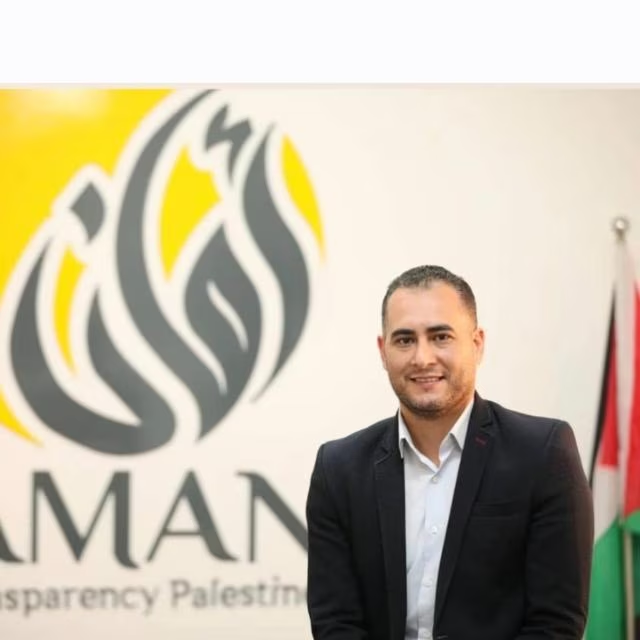
Wael Ibrahim Baalousha, Regional Office Director - Gaza Strip, Coalition for Integrity and Accountability_AMAN, holds a Master's degree in Regional Studies, Bachelor of Political Science.
Share your opinion
Reporting Corruption in Palestine: A Lever for Integrity, Protection of Resources, and Guarantee of Social Justice