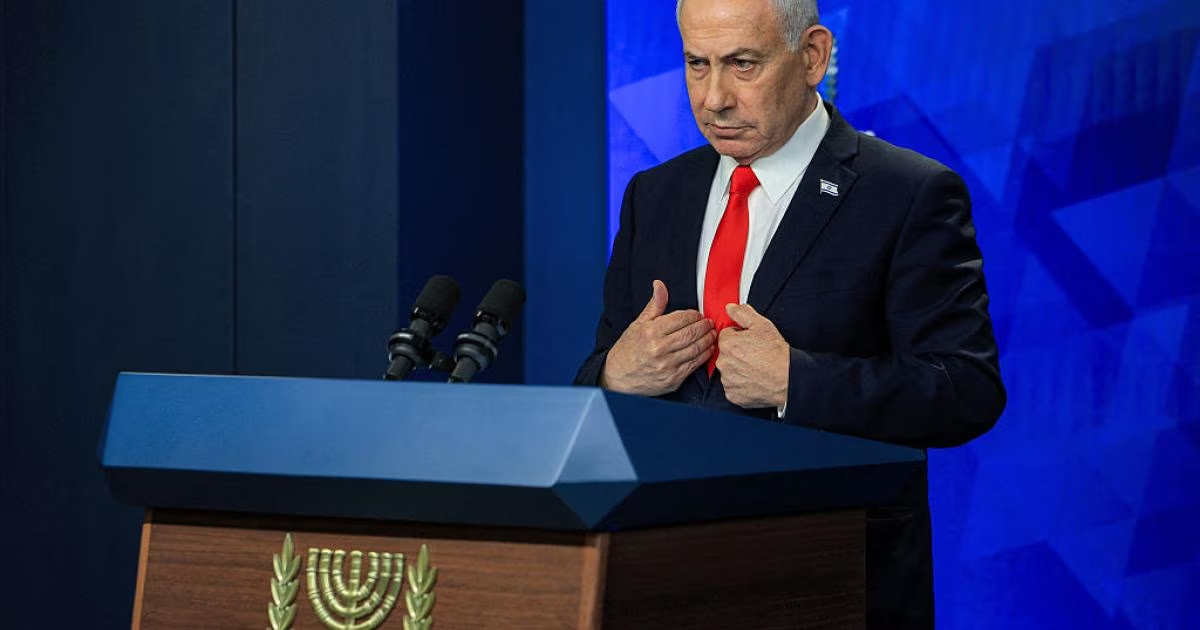







Official media sources reported that Israeli Prime Minister Benjamin Netanyahu's joining of the so-called 'Peace Council', which is concerned with the administration of the Gaza Strip, faces serious legal obstacles within the Israeli system. Reports clarified that this step was taken without obtaining the necessary authorization from the government, which makes the signing of the Council's charter a violation of the procedures followed in making essential sovereign decisions.
The American administration had adopted new structures in mid-January for managing the transitional phase in the Gaza Strip, which included the formation of a 'Peace Council' and an 'Executive Gaza Council' in addition to an international stabilization force. Netanyahu had already participated as a member in the first meetings of this council, which were held in the capital Washington under the chairmanship of US President Donald Trump during the past February.
Sources in the office of the government's legal advisor warned of the repercussions of this unilateral move, indicating that it could create a deep gap between the commitments Israel has made on the international stage and its legal ability to actually implement them. The sources suggested the necessity of obtaining retroactive governmental approval to correct the legal course and ensure official cover for this membership.
In contrast, the Israeli Ministry of Justice tried to downplay the crisis, considering that joining the council is a purely political decision that falls within the powers of the supreme political leadership. The ministry affirmed its readiness to provide the necessary technical and legal support to assist the Prime Minister in moving forward with this step in accordance with the applicable government work systems, provided he wishes to do so.
On the ground, informed sources revealed that the Trump administration recently intervened to obstruct an Israeli military operation that was planned in the Gaza Strip, after American officials expressed their dissatisfaction with its details. Washington asked the Israeli side to freeze these plans for the time being, which reflects a divergence in tactical visions between the allies despite continuous coordination.
Instead of major military operations, data indicates that the occupation army has begun implementing a strategy of 'creeping annexation' in various areas of the Gaza Strip away from the spotlight. These moves aim to impose a new geographical and security reality through the gradual control of large areas, in an attempt to circumvent international pressures demanding a complete withdrawal.
At the same time, Washington is pushing for the immediate start of reconstruction operations in the Gaza Strip, even before a final formula for disarming resistance factions is reached. This is met with an absolute rejection by Israel, as Netanyahu's government insists on linking any reconstruction effort to the complete dismantling of Hamas's military capabilities in the targeted areas.
Estimates by observers in occupied Jerusalem indicate that Netanyahu seeks to keep the fronts of conflict open for internal political goals, especially with the upcoming Knesset elections scheduled in three months. Analysts believe that the Israeli Prime Minister prefers the continuation of escalation, and perhaps its expansion to include a direct confrontation with Iran, which raises the concern of the American administration.
The current American administration realizes that the continuation of open wars carries a heavy political, economic, and security cost that it does not wish to bear during this phase. Media sources confirm that the divergence in positions regarding the timing of resuming military operations reflects Washington's desire to contain the conflict, while Netanyahu sees escalation as a means to maintain his ruling coalition.
This political movement comes at a time when the occupation continues to impose a strict blockade on the Gaza Strip, despite previous ceasefire agreements. The humanitarian suffering of Palestinians continues amid the prevention of sufficient medical and food aid, while statistics indicate that more than 73,000 martyrs have fallen since the start of the genocide war in October 2023.
Netanyahu's joining of the Peace Council on behalf of Israel and his signing of its charter was a step taken without adhering to the legal rules that require government approval.





Share your opinion
Legal disputes dog Netanyahu's joining of 'Peace Council' as Trump administration obstructs military plans in Gaza