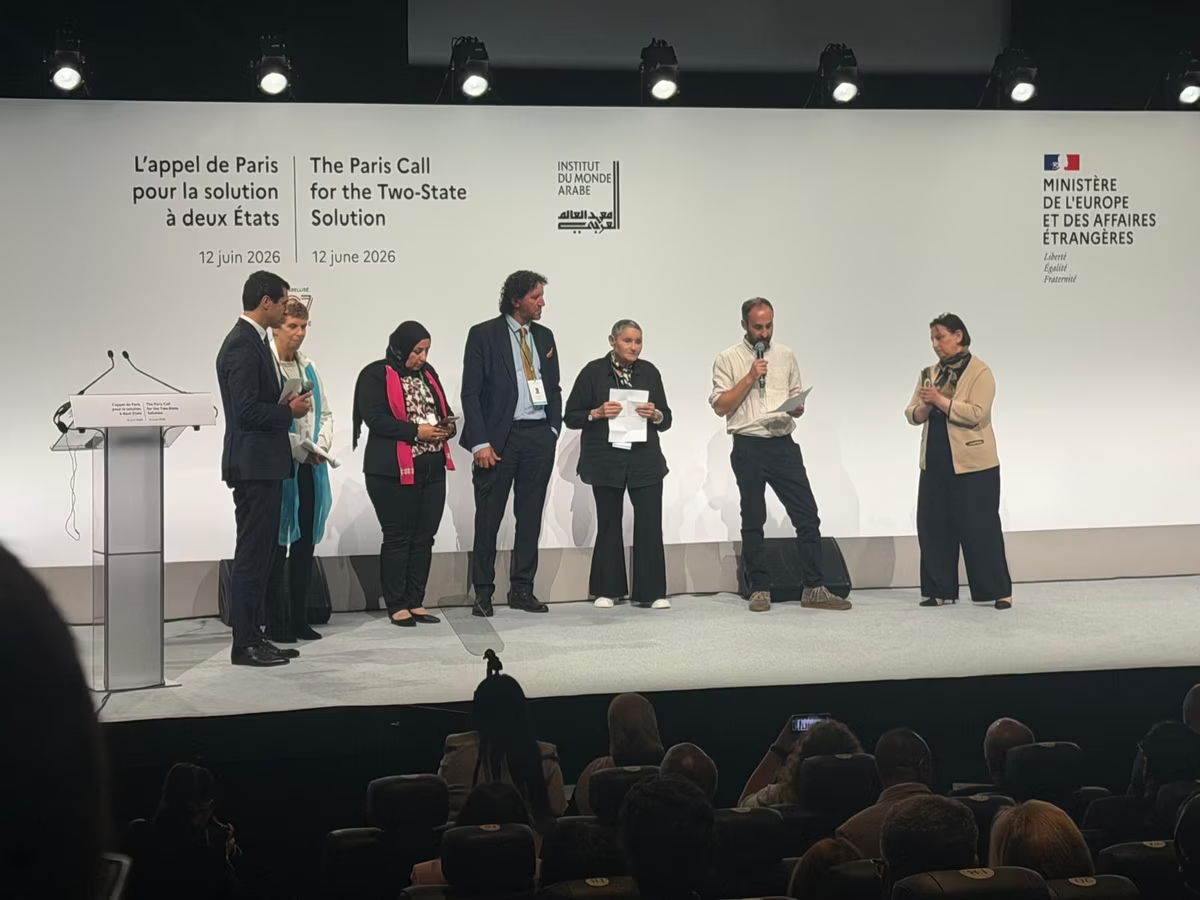







- Kallas: "The two-state solution remains the only viable path to achieving lasting peace and stability in the Middle East." - "The situation in the West Bank is alarming, settlements continue to expand at an unprecedented rate, and settler violence is increasing without accountability." - The necessity of Israel's withdrawal from the Rafah crossing, ensuring its full opening, unimpeded flow of aid, and reconstruction in Gaza.
Paris - Mohamed Abu Khdeir - In a significant diplomatic move, the Arab World Institute in the French capital, Paris, hosted on Friday the international conference "The Paris Call for a Two-State Solution," which brought together a selection of foreign ministers and senior officials from over 15 countries, alongside representatives from Palestinian and Israeli civil society, just days before the G7 summit in Evian. The conference, which coincided with the first anniversary of the "New York Declaration" adopted by the United Nations in July 2025, provided an exceptional dialogue platform that brought conflict parties to one table, resulting in the "Paris Call 2026 document," which included an 8-point action plan, submitted to world leaders gathered at the Evian summit last Monday. In his opening speech, the French Minister for Europe and Foreign Affairs, Jean-Noël Barrot, delivered a strong message to the attendees, saying: "We could have found every reason in the world to give up and despair, but you are here! Your testimonies alone are motives for hope and action. France refuses to let the party of war triumph over the party of peace." Barrot added: "You are the true builders of peace, and without your courage and integrity, there will be no peace. Peace is not imposed by decrees; it must be rooted in minds and hearts." The French minister affirmed that "this year could be decisive," noting that the Palestinian and Israeli peoples are called to vote in the coming months; legislative and presidential elections in Palestine before the end of the year, to which President Mahmoud Abbas is committed, and legislative elections in Israel by autumn. For her part, the Vice-President of the European Commission and High Representative of the European Union for Foreign Affairs and Security Policy, Kaja Kallas, affirmed that "the two-state solution remains the only viable path to achieving lasting peace and stability in the Middle East." In her speech to the attendees, she said: "The lesson is clear: civil society is not an afterthought in diplomacy, but an indispensable element for building peace, and a source of hope." The European official warned of the deteriorating situation in the West Bank, stating: "The situation in the West Bank is equally alarming. Illegal Israeli settlements continue to expand at an unprecedented rate, and violence perpetrated by settlers is increasing without adequate accountability." She stressed the necessity of "Israel's withdrawal from the Rafah crossing and ensuring its full opening," and "unimpeded flow of humanitarian aid" and "the start of recovery and reconstruction efforts" in Gaza. The conference saw broad ministerial participation, with foreign ministers from Andorra, Belgium, Brazil, Canada, Iceland, Luxembourg, and Monaco attending. Deputy ministers and ministers of state from Spain, Ireland, Norway, Mexico, Turkey, the United Arab Emirates, Qatar, Egypt, and the EU Commissioner for the Mediterranean were also present. The conference concluded with the issuance of the "Paris Call 2026" and its 8-point "Action Plan": imposing a permanent ceasefire and protecting civilians in Gaza, establishing a timeline for implementing the two-state solution with international guarantees, immediately halting annexation and settlement expansion, with sanctions for violence, ensuring aid access and funding Gaza's reconstruction with genuine Palestinian participation, disarming factions and providing regional security guarantees, supporting Palestinian Authority elections to prevent its collapse and reconnect Gaza and the West Bank, using regional integration as a catalyst for ending the occupation, not a substitute for it, launching an international fund to support peace institutions and civil society, in fulfillment of the G7's commitment. The conference saw an official American and Israeli absence. The Israeli Embassy in Paris commented on the non-attendance, stating that the conference "does not serve to promote peace," claiming that Palestinians "rejected proposals for a Palestinian state on five occasions." In contrast, the conference witnessed a symbolic closing moment on the Tournelle Bridge, where participants raised a peace banner, and artists Noa and Mira Awad performed an artistic segment embodying the spirit of hope. The "Paris Call" document was officially delivered to the leaders of the G7 countries, led by French President Emmanuel Macron, during the opening of the summit in Evian on Monday, in a step demonstrating that the political horizon remains open, and that peace remains a strategic option that cannot be abandoned. Text of the message submitted: Your Excellency Jean-Noël Barrot, Minister for Europe and Foreign Affairs of France, Heads of State and Government of the G7, World leaders gathered in Evian, Since we last addressed you, exactly one year ago, France and 14 additional countries recognized the State of Palestine. The New York Declaration, President Trump's 20-point plan, Security Council Resolution 2803, and the ceasefire in Gaza, have provided the necessary framework to advance a two-state solution based on peace, security, mutual recognition, and respect. However, the division in the region continues to widen. Gaza is devastated, and Israel remains under threat. Settler terrorism, settlement expansion, de facto annexation, as well as threats to the Palestinian Authority, continue to undermine the viability of a future Palestinian state. Israelis and Palestinians remain trapped in a cycle of fear, insecurity, and trauma. We meet again, because while the G7 countries gather in Evian, the conflict may once again be pushed to the sidelines. The window for a solution remains open, but the opening is narrowing. This time urgently calls for diplomacy based on partnership with civil society. Therefore, we appeal to you – the leaders of the G7 countries in Evian, and all countries represented here in Paris – to take the following actions: Impose a permanent ceasefire and protect civilians. Ensure and solidify the ceasefire to become a permanent and monitored arrangement, providing protection for civilians including medical teams, aid agencies, journalists, and civilian infrastructure. Transition the second phase of Gaza to a broader political-security track: guarantees against renewed attacks, reconstruction, governance transfer, regional security guarantees, and a credible process for disarming Hamas. Bring all initiatives into a single implementation track for a two-state solution in a regional format. A credible political horizon that can lead to a two-state solution on the 1967 borders with Jerusalem as the capital of both states, based on the viability of the West Bank, Israel's security, effective Palestinian governance, and the reconstruction and stability of Gaza. This is also what makes regional integration possible and meaningful. These are not separate issues, but interconnected goals that must be addressed as part of a single implementation track. Linking the New York Declaration, UN Security Council Resolution 2803, President Trump's 20-point plan, the International Alliance, and the Peace Council, into one coordinated implementation mechanism, supported by funding, including the vital work of civil society, to ensure both the ceasefire and the political horizon. Halt annexation to preserve a viable political horizon. Immediately halt annexation and settlement expansion to preserve the territorial integrity of the future Palestinian state. Protect Palestinian communities, dismantle the infrastructure of settler violence, and the impunity that protects it. Meaningful consequences for settlement expansion, settler terrorism, forced displacement, home demolitions, and all measures aimed de facto or de jure at annexation, including in areas such as E1, must include targeted sanctions, as appropriate, against individuals, entities, and contractors responsible for planning, funding, or building settlements, as well as against those directly involved in settler violence. Rebuild Gaza – for its people. Ensure unrestricted access for humanitarian aid and funding for essential services: hospitals, water, electricity, shelter. Significant progress in reconstruction, employment, protection, and services is part of the recovery process. This must be funded through a transparent multi-year mechanism, in which Palestinians have genuine ownership, including civil society and the private sector, involved in planning and implementation, to support the reconstruction and reconnection of Gaza and the West Bank. Strengthen mutual security through a responsible and human-centered security framework. Ensure that the security of Israelis and Palestinians is not at each other's expense, but through recognizing their essential interdependence. Disarm Hamas and armed groups. Protect Palestinians from violence, displacement, restrictions on freedom of movement, and violations of fundamental rights, and support a legitimate, reformed Palestinian police force. Support multilateral security guarantees, through G7 countries and regional partners, with security assistance conditioned on civilian protection, de-escalation of tensions, and accountability. Support the renewal of legitimate Palestinian governance through elections and institutional reform, prevent the collapse of the Palestinian Authority, and reconnect Gaza with the West Bank. Support the renewal of governance through presidential and parliamentary elections, which must take place this year, and must be enabled to be free and fair among all members of the Palestinian people. Strengthen institutional reform and improve service delivery, with significant participation from Palestinian communities. Preventing the collapse or emptying of the Palestinian Authority must be treated as a major security priority for Palestinians, Israelis, and the entire region. It is crucial to take immediate steps to release withheld tax revenues, restore banking correspondent channels, and ease movement restrictions. Otherwise, instability in the West Bank will deepen, Hamas's entrenchment in Gaza will accelerate, and Israel will be forced to confront a escalating security crisis with no political way out. Address regional integration as a catalyst for ending the occupation and promoting the two-state solution. Regional integration should serve as a catalyst for ending the occupation and promoting the two-state solution, not as a substitute for a Palestinian state. This means establishing a demilitarized Palestinian state through a political process, with concrete timelines and multilateral guarantees, with measurable progress towards statehood and territorial contiguity between Gaza and the West Bank. Expanding support for civil society networks and initiatives across the region, Palestinian, Israeli, Iranian, and Arab, is essential to curb regional escalation, including that between Israel and the Islamic Republic and its proxies. Join the International Fund for Israeli-Palestinian Peace, establish an expert advisory mechanism, and invest in political legitimacy, public narratives, and civil protection. No political or security framework will endure without a public capable of understanding, shaping, and supporting it. International and regional actors should establish an advisory mechanism bringing together Israeli and Palestinian experts, civil society representatives, private sector actors, women leaders, and youth representatives. This must be coupled with sustained investment in Israeli, Palestinian, and regional communities to prepare the ground for diplomacy. Join the International Fund for Israeli-Palestinian Peace launched this week by the UK, Canada, and Australia, and ensure it is adequately resourced to provide broad support directly to peacemakers, while fulfilling the G7's commitment to institutionalize the role of civil society. You do not bear this burden alone. We are already actively working in various arenas, both local and institutional. We need your help in using all diplomatic, economic, and political tools available to us, to help break this cycle. Invest in civil society as allies and partners, for we are ready to work with you on this vital mission to create a better future.
Share your opinion
Delivery of the "Paris Call" document to G7 leaders and American and Israeli absence