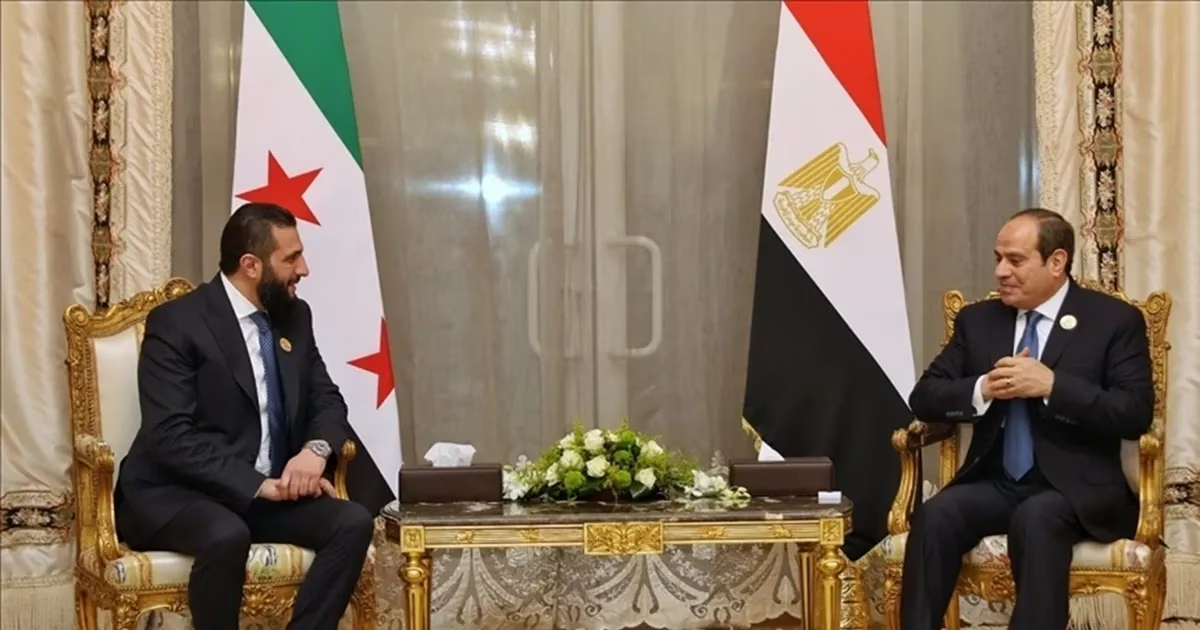







International relations are not always subject to the logic of pragmatism and major interests, especially in the Arab region where political psychology plays a pivotal role. Interpreting political stances and phenomena sometimes requires delving into the psychological turmoil of decision-makers, away from traditional strategic calculations that may not explain current behaviors.
This situation is evident in Egypt's recent stance towards Syria, where the Ministry of Foreign Affairs in Cairo refused to accredit the credentials of Syrian Ambassador Mohamed Taha Al-Ahmad. Al-Ahmad holds the position of Director of Arab Affairs in the Syrian Foreign Ministry, but his rejection came without direct explanation, raising questions about the future of relations between the two countries.
Historically, the 1961 Vienna Convention regulates the procedures for appointing ambassadors, which begin with the selection of the candidate and end with the presentation of credentials to the head of the receiving state. Although states have the right to refuse, it is rare for the development of bilateral relations between two countries of the stature of Egypt and Syria to be linked to the appointment of a specific person to the diplomatic mission.
Looking at previous experiences, we find that diplomatic relations can continue despite dissatisfaction with mission personnel, as happened between Jordan and Syria in 2009. At that time, the Assad regime appointed a controversial security figure as ambassador to Amman, and despite Jordanian reservations, higher interests prevented taking stances that would lead to a diplomatic rupture.
Since 2013, security concerns have been the sole criterion governing Cairo's view of the Syrian file, with secret security cooperation emerging with the former regime. This cooperation was primarily based on converging interests in confronting Islamist movements, which made the Egyptian stance less severe towards Damascus compared to other Arab countries.
Today, after the fall of the former regime and the changing landscape in Damascus, it appears that security considerations still govern the Egyptian vision, but with a different nuance. Analyses suggest that the current stance may be linked to personal and political considerations that go beyond the direct strategic interests of the Egyptian state.
The divergence in Arab positions is clearly evident when comparing Egyptian and Saudi behavior towards the recent Syrian transformations. Despite the shared animosity towards radical Islam, Riyadh took a different path. This divergence indicates that calculations in Cairo are influenced by internal factors related to the legitimacy of the ruling model and its fear of alternatives.
The core of Egyptian apprehension, according to analytical readings, lies in the success of the new Syrian experiment in presenting a stable and successful governance model. This success could restore credibility and confidence to forms of governance that Cairo sought to overcome, which could reflect on the aspirations of the Egyptian and Arab streets in general.
If the issue were only about the presence of opposition Egyptian figures in Syria, it would have been more appropriate for Cairo to approach Damascus to exert direct pressure. Building strong relations with the new authority gives Egypt greater ability to influence sensitive security files, instead of a policy of coolness and distance.
Risking the loss of relations with a country the size of Egypt is not in the interest of the new rulers in Syria, no matter how important the figures they have. The Egyptian state remains a fundamental pillar in the regional system, and cooperation with it is a strategic necessity for any regime seeking legitimacy and stability in the region.
The recovery phase in Syria requires openness to major regional powers, especially Egypt and Saudi Arabia, in addition to Turkey and Qatar. This regional quartet is the only guarantee for Syria to restore its position, and Egypt remains the strongest and most capable party to exert actual influence in this path.
New rulers in Damascus must realize that Egypt is greater than any personal considerations, and its position is a necessity for every Arab country seeking to rise from the rubble. Complying with some Egyptian demands, even if they seem difficult, may be a necessary price to secure the necessary Arab cover for the transitional phase.
Ultimately, the question remains about the extent of Egyptian diplomacy's ability to overcome psychological and political apprehensions in favor of a comprehensive pragmatic vision. The stability of Syria serves Egypt's national security interests, and diplomatic rupture or coolness will only serve parties seeking to keep the region in a state of flux.
The future of relations between Cairo and Damascus will remain hostage to the balances between internal fears and external interests, and while awaiting the outcome of upcoming diplomatic moves, the file of the new Syrian ambassador remains an indicator of the depth of the gap that needs bridges of mutual trust.
The Egyptian position is linked to personal considerations and the fear of the success of the Syrian governance experiment, which could restore confidence in this model in the eyes of the Arab street.
Share your opinion
Psychology of Politics: Why is Cairo apprehensive about the new transformations in Syria?