







Washington Message
Washington – Said Arikat – 13/6, 2026
News Analysis
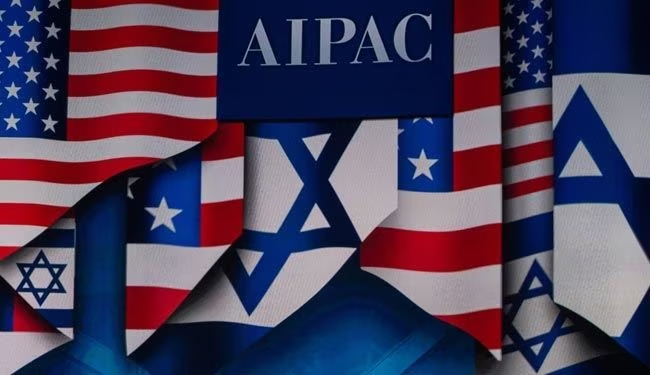
In a new indicator of the profound shifts affecting the American political landscape, the New York Times revealed in an article published on Friday, June 12, that the American Israel Public Affairs Committee (AIPAC), which for decades was the most prominent guardian of American consensus supporting Israel, is now facing a growing rebellion within the Democratic Party itself, to the extent that attacking it electorally has become, in some Democratic circles, a means of gaining votes, not losing them.
This is not merely a fleeting political disagreement or a local electoral competition, but a strategic shift reflecting a broad re-evaluation of the American-Israeli relationship within Democratic circles, especially among younger generations and progressive voters who now view Israel from the perspective of occupation, settlement, and the war on Gaza, rather than from the traditional narrative that prevailed for decades in Washington.
According to the newspaper, AIPAC's name prominently emerged during the Democratic Party primaries in New York, where some candidates made refusing to submit to the organization's influence a central theme of their campaigns. This phenomenon was, until recently, considered a form of political suicide in American public life.
However, the most significant shift lies not in criticizing AIPAC itself, but in the reasons that led to it. The group, which built its influence on the claim that it represents a broad American consensus on Israel, is now accused of using massive political funds to silence dissenting voices, and of defending the policies of the Israeli government, no matter how extreme or contradictory they are to the values upheld by the Democratic Party.
AIPAC's influence for decades was based on a simple idea: that the interests of the United States and Israel are identical, and that supporting Israel is part of American national security. But this premise has suffered successive cracks in recent years, especially with the rise of Israeli right-wing governments led by Benjamin Netanyahu, increasing American criticism of settlements, and then the devastating war on Gaza that caused tens of thousands of Palestinian casualties.
The New York Times indicates that the main turning point began during the battle over the nuclear agreement with Iran during the era of former President Barack Obama. At that time, the Netanyahu government not only opposed the agreement but entered into a direct confrontation with the White House, in an unprecedented scene that culminated when Netanyahu delivered a speech to Congress against the policy of an elected American president.
Since then, Israel has gradually begun to lose its status as an issue enjoying bipartisan consensus, transforming into a divisive partisan issue. Netanyahu, more than any other figure, was responsible for this shift after almost completely betting on an alliance with Republicans and the American right.
In an attempt to contain this decline, AIPAC shifted from traditional lobbying methods to using more aggressive tools, by establishing massive electoral spending committees capable of injecting millions of dollars into primary elections. However, this strategy often produced counterproductive results.
Instead of enhancing the organization's image, the massive funds it spends became additional evidence for its critics of the unbalanced influence it wields within the American political system. Worse still, an increasing number of Democratic candidates began to discover that attacking AIPAC might be more popular among the party's base than aligning with it.
The irony is that the biggest challenge facing the organization does not come from the progressive wing, known for its historical stances toward Israel, but from "moderate" Democratic figures who affirm their support for Israel's existence and security, but refuse to grant Israeli governments absolute political immunity or unconditional military support.
Here lies the real crisis. When critics come from within the pro-Israel camp itself, the effectiveness of traditional accusations of anti-Semitism or political extremism diminishes. It also becomes difficult to portray any criticism of the Israeli government as hostility to Israel or the Jewish people.
What these developments reveal is that the crisis is no longer a public relations crisis for AIPAC, but a crisis of political and moral legitimacy. New generations of Democrats do not view Israel in the way their parents and grandparents did after World War II. Moreover, the scenes of destruction in Gaza and the continuous violations in the occupied Palestinian territories have significantly weakened the traditional discourse that the organization relied on to justify unconditional support for Israel.
Perhaps the cruelest irony is that AIPAC, which was originally established to maintain the strength of the American-Israeli relationship, today appears to be contributing, unintentionally, to accelerating the erosion of that relationship. The more it escalates the confrontation against voices critical of Israel within the Democratic Party, the more intense the debate becomes about the nature, limits, and future of this alliance.
Ultimately, the current battle is not just about AIPAC, but about a larger question that strongly imposes itself within American politics: Will American support for Israel continue as an unquestionable commitment, or will it transform into a relationship subject to accountability and scrutiny like any other relationship between two states? Current indicators suggest that this question is no longer marginal, and the answer to it may redraw the contours of American policy toward Israel for decades to come.
Share your opinion
AIPAC and the Losing Influence War: How Israel Contributed to Undermining its Allies within the Democratic Party