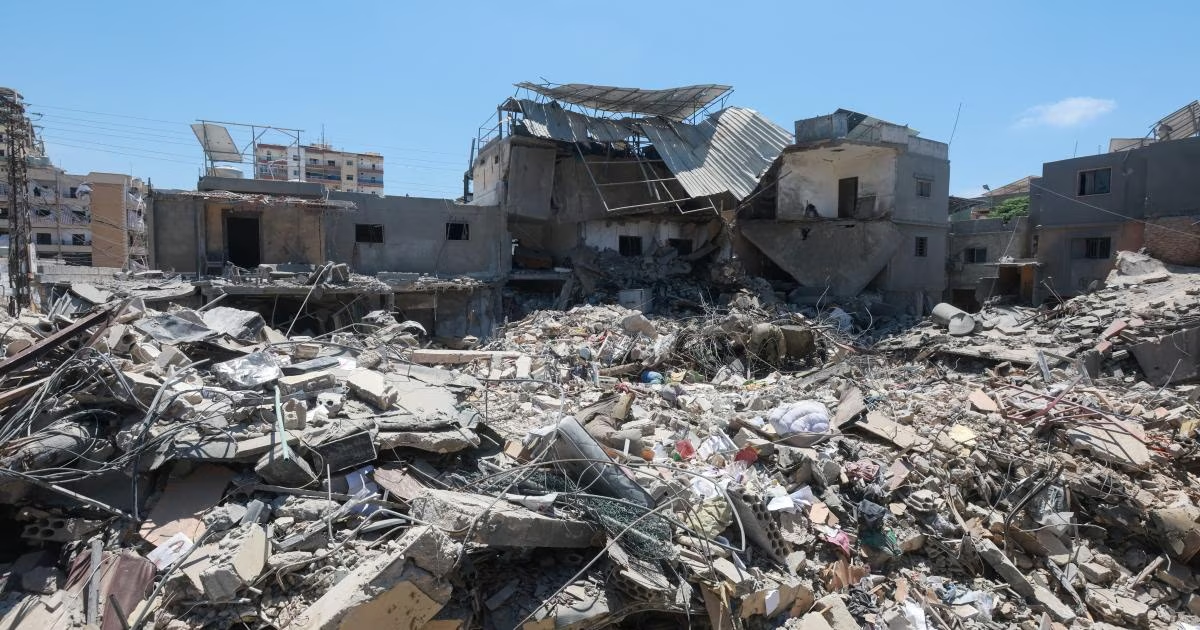







Lebanon is currently experiencing a state of cautious anticipation, as the country sways between the hammer of continuous Israeli raids and the anvil of stalled political negotiations. The occupation forces are drawing new boundaries for engagement in southern Lebanon with iron and fire, by issuing evacuation warnings and carrying out specific military operations that have reached deep into Lebanese territory.
On the political front, the Lebanese government insists on adhering to the negotiation path led by Washington, considering it the only available passage to stop the aggressions and ensure the withdrawal of the occupation forces. Official circles in Beirut believe that diplomatic efforts must continue despite the increasing field complexities and the pressures exerted by international parties.
In contrast, Hezbollah expresses strong reservations about the nature of the ongoing political moves, with sources close to it describing what is happening as an attempt to impose dictates rather than genuine negotiation. The party warned that proceeding on this path could lead to political suicide and increase the severity of internal divisions at a time when the country needs unity.
Mutual accusations about external interventions are emerging, as the Lebanese Prime Minister pointed to a deep Iranian influence that directly affects the independence of national decision-making. This political tug-of-war reflects the size of the gap between the official vision of the state and the vision of the armed forces engaged in direct confrontation with the occupation.
For its part, the American capital, Washington, is preparing to host a new round of talks, amid hopes that this round will be a last chance to establish sustainable de-escalation. Observers believe that the success of this round depends primarily on the ability of international parties to curb Israeli military ambitions and meet minimal Lebanese demands.
In an analysis of the regional situation, sources reported that Iranian policy towards Lebanon has begun to bear fruit through indirect pressure on the American administration. This pressure prompted Washington to exert its influence on Benjamin Netanyahu to announce a ceasefire as an initial step preceding any long-term security arrangements.
Leaked data indicates that Tehran will not give the green light to any framework agreement that does not include a comprehensive and complete ceasefire on all Lebanese fronts. The regional powers supporting the resistance also stipulate clear guarantees that prevent Israel from having freedom of military action or violating Lebanese sovereignty in the future.
Political researchers believe that positive signs have begun to emerge regarding the Iranian nuclear file, which may directly and positively reflect on the Lebanese arena. Experts considered that the stability of the region is organically linked to ending the war in Lebanon, which opens a window of opportunity that the Lebanese must seize to end the suffering.
On the other hand, the issue of disarming Hezbollah remains the most prominent sticking point in the negotiation process, as the Israeli occupation insists on this condition as a guarantee for its northern security. This demand faces outright rejection from the party and its allies, making the issue of the 'day after' the truce a political and security challenge beyond the ability of local parties to resolve.
In conclusion, the fate of the displaced, the return of prisoners, and the reconstruction of what the war destroyed remain unresolved issues awaiting what the coming days will bring in the corridors of international diplomacy. While the cannons continue to speak on the borders, the bet remains on a major regional settlement that puts an end to the cycle of violence plaguing Lebanon.
The equation imposed by Iran, which consists of targeting northern Israel in exchange for the southern suburb, has proven the effectiveness of the current negotiation path.

Share your opinion
Lebanon and the Occupation Negotiations: A Struggle Between Political De-escalation and Field Pressures