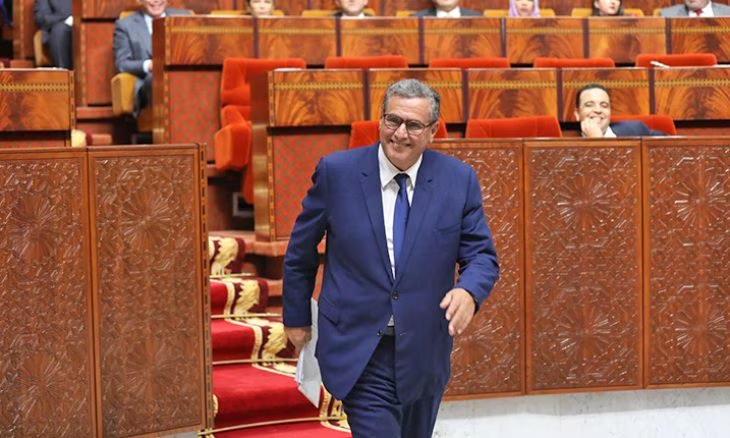







Over the past two weeks, the Moroccan political scene has witnessed a series of events that sparked a widespread wave of sarcasm and ridicule among citizens. Many considered this a form of 'moral revenge' against government policies that some view as biased towards specific groups. The Prime Minister took center stage during his recent appearance in Parliament, where he showed signs of extreme tension in the face of opposition criticism, causing him to lose his composure and direct sharp questions at MPs, reflecting the extent of political pressure he is experiencing as the elections approach.
The sarcasm was not limited to the Prime Minister alone but extended to the new leadership of the leading government party, which appeared on a television talk show with a level that did not meet the expectations of viewers. The party official fell into the trap of complex terms like 'actuarial balances,' which he struggled to pronounce clearly, turning the episode into rich material for mockery across social media platforms, especially with his attempt to paint a rosy picture of the country's living reality that contradicted daily complaints about high prices.
In a related context, the party official's statements about citizens' well-being sparked widespread controversy, especially when he cited the ability of everyone to buy Eid sacrifices by pointing to trash cans overflowing with waste. This approach, described by observers as the 'garbage theory' in sociology, was considered an attempt to escape the difficult economic reality faced by Moroccan families, prompting activists and artists to refute these claims with comedic methods that mimic lived reality.
Regarding young ministers, an incident stood out where a minister claimed that a simple worker in the city of Taroudant could earn 400 dirhams in a few hours of morning work. This was refuted by a comedian from the same city during a theater festival. The artist, in a satirical segment, affirmed that reality dictates that young people work long hours for meager sums not exceeding 20 dirhams, revealing the significant gap between official discourse and the on-the-ground reality experienced by laborers in the provinces.
In conclusion, it seems that black humor has become the most prominent weapon for Moroccans in confronting what they describe as 'political absurdity,' having moved from cafes to the 'blue space' (social media) supported by artificial intelligence technologies. This wave raises fundamental questions about the extent to which officials listen to the pulse of the street, especially since the electronic army mobilized to polish the image of the ruling party seemed unable to withstand the storm of ridicule that swept popular circles ahead of the scheduled September elections.
Is this a new theory in economic sociology that deserves to be called the 'garbage theory'? Or are officials living in a parallel world, far from the pulse of the street?



Share your opinion
Between 'Actuarial Balances' and Trash Cans.. How Do Moroccans Confront Their Government with Sarcasm?