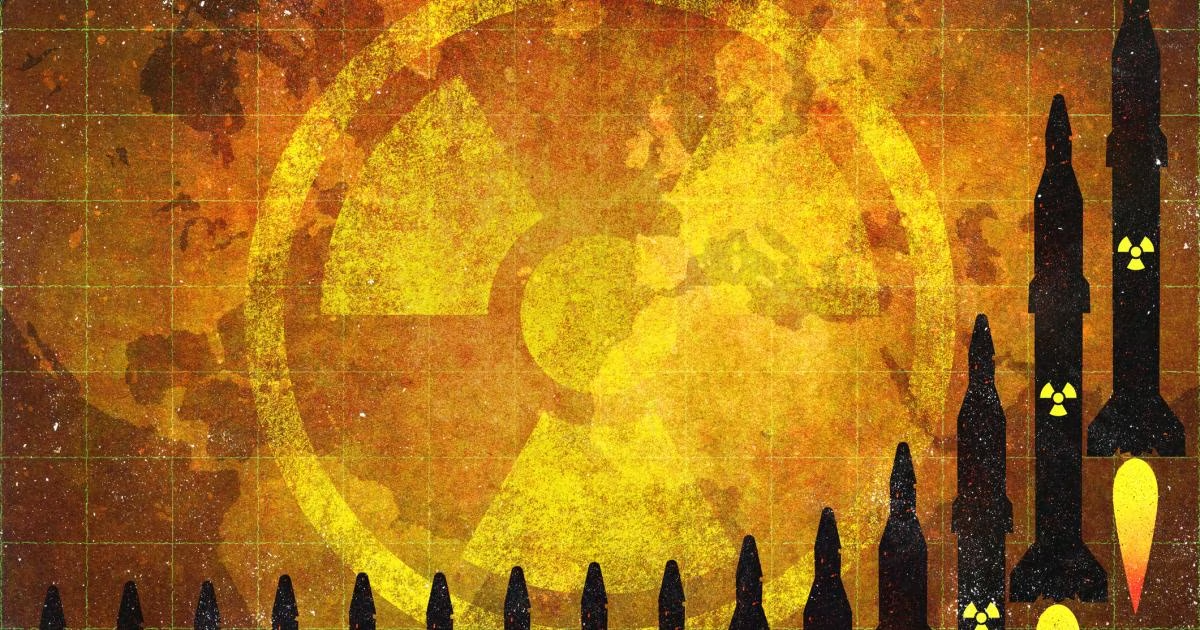







International researchers have issued serious warnings regarding the current trends of nuclear states towards enhancing their combat readiness, by transferring warheads from central storage to direct launch platforms. A recent report by the Stockholm International Peace Research Institute (SIPRI) indicated that nuclear weapons are playing an increasingly pivotal role in the contemporary international political and security landscape.
According to statistics in the report, the world currently has approximately 12,187 warheads, of which 9,745 are stored and ready for immediate use if necessary. Despite a slight decrease in the total number compared to previous years, the pace of dismantling old weapons has begun to slow significantly in the face of accelerating new manufacturing and modernization operations.
Informed sources reported that the real concern lies in the escalating intensity of nuclear threats despite the slight quantitative decline in global stockpiles. Experts anticipate a shift in the downward curve of stockpiles in the coming years, as the number of warheads is likely to start rising again with advanced weapons entering active service.
The report attributed these risks to the collapse of strategic arms control systems and international agreements that regulated competition between major powers. This erosion of international commitments has created an environment of uncertainty, prompting nuclear states to re-evaluate their military doctrines and rely more heavily on nuclear deterrence.
The United States and Russia hold the lion's share of the global arsenal, jointly controlling about 83% of the world's total nuclear weapons. Each country possesses more than 5,000 nuclear warheads, with ongoing comprehensive modernization programs to keep pace with rapid technological developments in launch systems.
The American modernization program has faced challenges related to planning and funding, which could lead to delays in timelines and significantly increase overall costs. In contrast, Russian programs have suffered some failures in intercontinental ballistic missile tests, affected by economic sanctions and pressures resulting from the ongoing war in Ukraine.
China stands out as the fastest-growing nuclear power currently, working to expand its arsenal at an unprecedented pace compared to other countries. Estimates indicate that Beijing possesses about 620 warheads, with ambitions to bring its intercontinental ballistic missile capabilities to levels close to those of Washington and Moscow by 2030.
On the European front, France and Britain have maintained relative stability in their nuclear stockpiles, with 290 and 225 warheads respectively. However, forecasts indicate a potential increase in the British stockpile in the future, while French presidential orders have been issued to increase nuclear capabilities to enhance defensive sovereignty amid regional changes.
In South Asia, India has increased its nuclear arsenal to 190 warheads, while Pakistan has maintained an estimated stockpile of 170 warheads. Despite the stability of the Pakistani number, the continued accumulation of fissile materials clearly indicates Islamabad's intention to expand its nuclear capabilities over the next decade to address security challenges.
As for the Korean Peninsula, Pyongyang continues to achieve its declared goals of rapidly expanding its arsenal, with the institute estimating it possesses about 60 nuclear warheads. North Korea continues to develop its ballistic missile technologies despite international pressure and sanctions imposed on it, which further complicates the security landscape in East Asia.
Regarding Israel, which follows a policy of nuclear ambiguity and does not acknowledge possessing these weapons, the report indicated that it is actively working to modernize its arsenal. International sources estimate that the Israeli stockpile reached about 90 nuclear warheads at the beginning of this year, with continued development of multiple launch systems.
The report concludes that the world is entering a new phase of the nuclear race characterized by high complexity and danger due to the absence of strategic dialogue. This trend towards the militarization of international politics and reliance on nuclear weapons as a tool of pressure threatens to undermine decades of efforts aimed at arms control and global disarmament.
What is alarming is that despite the decrease in the quantities of nuclear weapons, the level of nuclear risks and threats is significantly increasing.

Share your opinion
International warnings of a nuclear arms race and expansion of major military arsenals