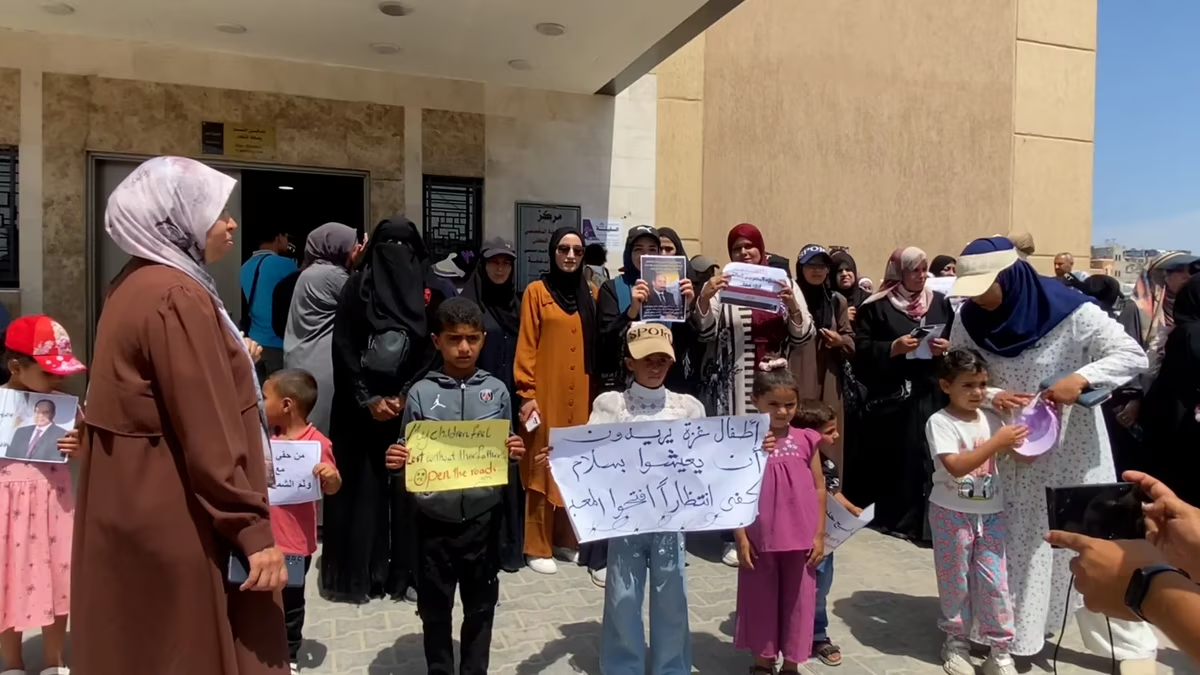







The cries of hundreds of Palestinian wives trapped in the Gaza Strip are escalating, as they find themselves and their children caught between the hammer of war and the anvil of forced separation from their husbands residing abroad. In the overcrowded displacement camps in the Al-Mawasi area west of Khan Yunis, these families endure endless chapters of daily suffering, as the siege and strict Israeli restrictions prevent the realization of their dream of family reunification.
Alaa Lafi, one of these women, bitterly recounts how she lives with her five children in a dilapidated tent that offers no protection from the summer heat or winter cold, while her husband awaits their arrival in Belgium after they obtained the right to family reunification. Alaa's suffering is compounded by her cancer diagnosis, as the collapsed hospitals in the Strip lack the necessary treatment, making her travel an urgent medical and humanitarian necessity to save her life.
For the third consecutive week, these women have been organizing protest vigils in various parts of the Strip, raising banners demanding the fundamental right to movement and to live under one roof with their husbands. These events express the state of despair that families have reached, in light of the continued closure of vital crossings, especially the Rafah crossing, which is completely controlled by the occupation forces.
Hanadi Al-Adeini, a mother of four, describes a bitter reality where her children are forced to bear responsibilities beyond their years, such as searching for water and securing simple meals amidst continuous displacement. Hanadi, who survived a previous Israeli airstrike with her children, bitterly wonders about the world's silence regarding their tragedy, while their father has been away for years in search of a livelihood.
In a poignant scene, the child Fidaa Abu Suleiman cries with longing for her father, whom she has not seen since she was a baby in her first year, as he left the Strip six years ago and has not been able to return. Her mother, Haneen, confirms that the father's absence has created a significant emotional and psychological void for the children, whose only connection to him is through his pictures and intermittent video calls.
The child Abdul Rahman Abu Teir, who lives in a tent in the Al-Mawasi area after his family was forcibly displaced from eastern Khan Yunis, represents the voice of thousands of children deprived of their fathers. Abdul Rahman raises a banner demanding his right to live with his father, who has been an expatriate for eight years, emphasizing his desire to live a normal life, play, and learn like other children in the world, away from the atmosphere of war.
Estimates reported by local sources indicate that there are approximately 830 wives and fiancées stranded in the Strip, with nearly 1,500 children, most of whom live in shelters and tents. These women have lost their homes and possessions during the ongoing military operations, and their hopes are pinned on an international or humanitarian decision that will open the closed crossings for them.
Hadeel Hussein Habib, spokesperson for the stranded wives, recounts her personal story as the fiancée of a young man residing in Jordan, where their marriage contract was signed three years ago, but she has been unable to travel to complete the wedding. Hadeel currently lives in a classroom within a school that has been converted into a shelter in Hamad City, after the occupation destroyed her family's apartment and their home in the Al-Shuja'iyya neighborhood.
Hadeel emphasizes that the lives of hundreds of girls and women are in limbo, as they fear for their future in the absence of a political horizon and the continued Israeli control over land crossings. These women appeal to Arab and European countries for urgent intervention to evacuate them humanely and facilitate their joining their families who await them across the borders.
The suffering is not limited to the physical dimension but also extends to the heavy economic burdens borne by mothers in the absence of a breadwinner, especially amidst the insane rise in prices and the scarcity of basic necessities. The mother finds herself forced to play the role of both father and mother in an environment lacking the minimum elements of safety, causing immense psychological pressure on all family members.
The restrictions imposed on the Rafah crossing since May 2024 have further complicated the situation, as the movement of travelers and humanitarian cases has almost completely stopped, leading to the accumulation of thousands of pending cases. This systematic closure is considered by human rights activists to be part of the collective punishment policy practiced against the residents of the Strip, which deliberately disperses Palestinian families.
In every corner of the displacement camps, a new story emerges of a family torn apart by the siege, where an entire generation of children grows up knowing nothing of their fathers except their voices over the phone. This state of family fragmentation creates far-reaching social consequences and increases public resentment towards the international silence regarding these blatant humanitarian issues.
The stranded wives demand a clear and transparent mechanism for travel, ensuring their safe exit with their children without being exposed to the dangers of the road or the financial extortion that travelers may sometimes face. The continuation of this situation means that hundreds of children will remain in an unhealthy and unsafe environment, away from the parental care guaranteed by all international laws and conventions.
In conclusion, the issue of stranded wives in Gaza remains a bleeding wound in the body of Palestinian society, and a cry to the global conscience to act and end this tragedy. Opening the crossings and facilitating family reunification is not just a political demand, but an inherent human right that should not be subject to military bargaining or narrow political calculations.
My children ask me every night: When will we see Dad? And I find no answer but tears that I try to hide from them.
Share your opinion
Diaspora Behind the Siege: Hundreds of Wives and Children in Gaza Demand Family Reunification with Relatives Abroad