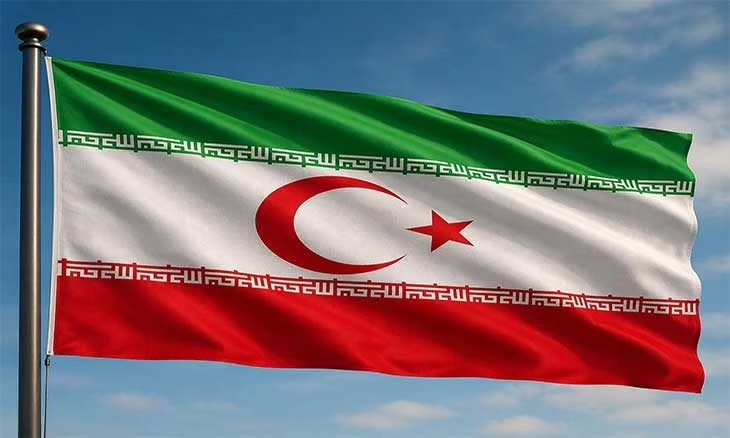







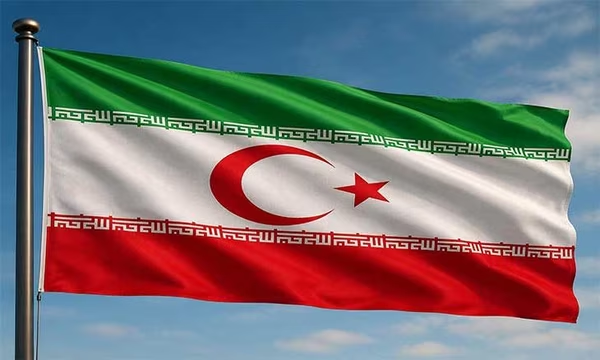
Talk of Israel and the United States targeting the Turkish state is no longer mere fleeting analysis; it has moved into the open, voiced by senior Turkish officials. Foreign Minister Hakan Fidan stated that Israel, by its nature, which feeds on the existence of an external enemy, will direct its animosity towards Ankara as soon as it concludes its current confrontation with Tehran. This proposition raises fundamental questions about whether Western circles and Tel Aviv view Turkey and Iran as a single civilizational bloc that cannot be separated despite current political differences.
Historically, the overlap between Turkish and Iranian identities reveals astonishing depth; Iran was ruled by dynasties of Turkish origin for nearly ten continuous centuries, starting with the Ghaznavid state in 962 AD and extending to the Qajars in 1925 AD. During these centuries, the features of the Iranian state were shaped by Turkish leaders such as Tughril Beg and Malik-Shah I, and even the Safavid state, which solidified the Shiite doctrine, had its military and political core from Azerbaijani Turkish tribes, making the two civilizations merge into a shared cultural and linguistic mold that is difficult to separate.
This fusion did not end with the fall of Turkish dynasties and the rise of the Pahlavi dynasty; it remains present at the core of the contemporary Iranian state, where Turkish ethnic groups constitute about a quarter of the country's population. This fact is clearly evident when looking at the top of the political hierarchy in Tehran, as Supreme Leader Ali Khamenei and current President Masoud Pezeshkian are of Azerbaijani Turkish origin. This demographic and political presence reinforces the hypothesis of a deeply rooted civilizational partnership that transcends the boundaries of immediate political interests and drawn geographical borders.
In light of these facts, the statements of American and Israeli leaders take on more serious dimensions, especially with former President Donald Trump's hints about targeting Persian civilization. It appears that Washington and Tel Aviv have begun to re-evaluate the region based on this shared heritage, which explains the expansion of the circle of threats to include Turkey. The upcoming conflict may not be merely political, but rather a confrontation with a civilizational bloc that regional and international powers see as an obstacle to their ambitions to redraw the map of the Middle East.
Israel cannot live without an artificial external enemy, and therefore it will antagonize Turkey after concluding its confrontation with Iran.
Share your opinion
Why is Israel Targeting Turkey After Iran?