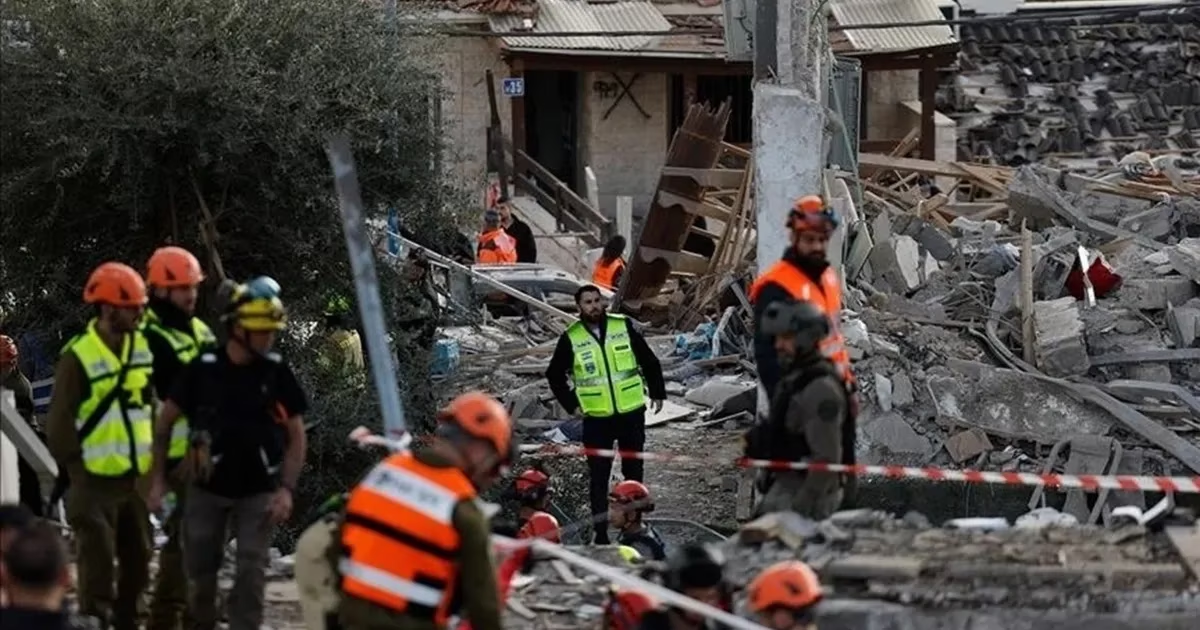







Today, the world enters a state of fragile truce, the resilience of which cannot be predicted against the aggressors' desire to break it. In this context, the Iranian negotiator emerges as a player with a strength no less than that of a warrior in the field, seeking to achieve diplomatic gains that may transcend what the language of weapons dictates, raising major questions in the region about the desired form of peace.
Postponing talk of victory and defeat gives us an opportunity to reflect on the historical and political lessons this war has cast upon the roadside. This confrontation is not just a fleeting event; rather, it is rich material for analysis, offering a thousand lessons for those who wish to understand the complexities of the existential conflict in the heart of the Middle East.
The first axiom that the Arab mind agrees upon is that there is no stability, no development, and no hope for a bright future with the Zionist entity embedded in the body of the region. However, this agreement in analysis has not yet translated into a unified political or military stance, reflecting a deep gap between the aspirations of the peoples and the decisions of the regimes.
Events have revealed that the entity did not launch its current war by chance; rather, it is the product of planning that lasted for more than forty years. Despite the popular Arab and Islamic consensus, Gaza found itself fighting alone, followed by other fronts in Lebanon and Iran, in the absence of a common defensive strategy to confront this aggressive expansion.
One of the most prominent lessons of this stage is the shattering of the entity's prestige and the exposure of its weakness in the face of the resistance's strikes, which opens the door to questioning the lost Arab position. If Arabs and Muslims had sincerely supported the resistance forces, the historical scene would have completely changed, and the prophecies of salvation would have been realized faster.
Confrontations have proven that the Zionist-American power is capable of defeat and retreat, just as happened in previous historical experiences. The aggressor, who possesses the latest military arsenals, showed clear cowardice in direct confrontations, and its traditional allies began to re-evaluate their positions after finding themselves without real support.
The international scene is witnessing a new formation, as international powers are beginning to emerge that are not afraid to criticize American policies but rather seek cooperation against its hegemony. This shift provides those seeking new alliances with avenues for power and weapons, away from the absolute dependence imposed by past decades.
The American interior itself is no longer as it was, as taxpayers have begun to realize that their interests are not necessarily linked to the survival of the Zionist entity. Voices rising within the United States reject dying for a corrupt political class, which weakens the fundamental pillar on which the occupation relies for its continuation.
The argument of regimes that justified their inaction by showing compassion for their peoples from the ravages of war has fallen, as peoples have proven their readiness to pay heavy prices with their lives for freedom. The popular and field exposure confirmed that the will for liberation is stronger than the daily bread calculations that the authorities tried to hide behind.
The conviction that was solidified in the 'Al-Aqsa Flood' is that this entity is capable with others and helpless on its own, as its army lacks courage in direct confrontation wars. This reality makes continuous threats towards countries like Syria, Egypt, and Turkey merely attempts to export internal crises and escape the reality of military weakness.
The West Bank is currently undergoing a silent occupation process through the daily encroachment on lands, a danger that extends to Jordan, which may find itself in the targeting circle soon. The entity by its nature cannot live in peace with its neighbors, because its origin is based on continuous aggression and the colonial function for which it was planted.
The normalization paths taken by some neighbors have only resulted in the humiliation of national dignity and economic and political dependence without real compensation. Peace with an entity whose function is war is an illusion from which the normalizers have reaped nothing but disappointment and the erosion of internal sovereignty in the face of their peoples who reject these paths.
What pains the Arab citizen is that these facts are as clear as day, yet official positions remain stagnant. The pain intensifies when we see that every war reminds us of the axioms of the conflict, but it does not produce a common defensive stance that protects the region from continuous Zionist aggression.
In conclusion, we do not need a thousand lessons to understand the nature of the stage; one lesson is enough: this entity is capable of defeat and complete erasure. Whoever understands this truth and acts accordingly will secure their place in the annals of glory, while the hesitant will remain on the sidelines of history, awaiting an inevitable future war.
The Zionist entity is capable with others and helpless on its own, and the Al-Aqsa Flood war has proven that its weapons are less than its aggression and its army is more cowardly than a man-to-man confrontation.
Share your opinion
Lessons of Confrontation: Has the End of the Myth of the Invincible Entity Approached?