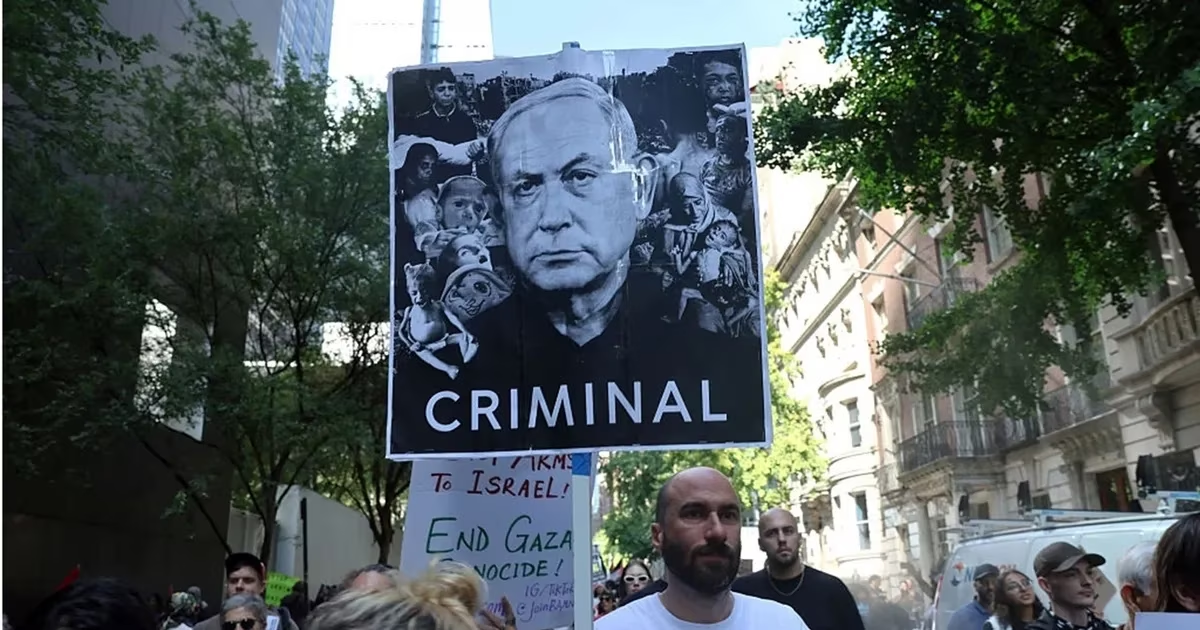







Political science and international affairs professor Marc Lynch affirmed that the Israeli leadership made a grave strategic error by shifting from a policy of conflict management to an attempt to resolve it by absolute force. Lynch explained in an article published by 'Foreign Policy' magazine that this approach, adopted by Benjamin Netanyahu after the October 7 attacks, led to completely counterproductive results, as the occupation army became mired in a spiral of military and political attrition with no prospect of victory.
The analysis indicated that the new security doctrine formulated by Netanyahu was based on the illusion of being able to completely eliminate regional threats instead of dealing with them. Despite Netanyahu's claims of achieving 'historic accomplishments' in propaganda videos, the reality on the ground, especially after the events of 'Bloody Wednesday' in Beirut, revealed strategic confusion that threatens fragile international understandings.
Lynch believes that the state of frustration within Israeli society extends beyond Netanyahu himself to encompass the failure of an ambitious government vision that sought to achieve regional transformation through unrestricted military intervention. The war's objectives expanded to include the complete destruction of Hamas, the disarmament of Hezbollah, and regime change in Tehran—goals that have proven over time to exceed the capabilities of military force, no matter how brutal.
Decisive victory eluded the occupation state on every front it opened, despite the use of unprecedented violence and flagrant violations of international norms and law. Lynch adds that the return to talking about weakening capabilities instead of crushing them is an implicit admission of defeat, and a forced return to the 'mowing the grass' strategy that Netanyahu had hoped to abandon permanently.
Before October 7, Tel Aviv relied on short, intense military campaigns aimed at enhancing deterrence while avoiding comprehensive escalation, a policy that ensured relative stability. However, the breach of the border fence by Hamas fighters shattered this strategic consensus, pushing Israeli leaders towards a major gamble aimed at imposing a 'Hebrew peace' based solely on the occupation's terms.
This extremist vision sought to permanently remove the Palestinian issue from the international agenda by expanding the 'Abraham Accords' and building a regional security structure that excluded Palestinians. Unconditional American support, from both the Biden and Trump administrations, encouraged Israeli leaders to believe they possessed complete immunity from punishment, no matter the atrocity of the crimes committed in Gaza.
However, technological successes such as the Iron Dome and the assassination of Hezbollah leaders in September 2024 gave the occupation a false sense of being able to decisively resolve matters. This feeling of impunity was reinforced after airstrikes in Syria and Iran, leading Tel Aviv to believe it could reshape the region with minimal costs and military risks.
But these ambitions collided with the harsh reality in Lebanon, where the occupation army failed to impose its will as Hezbollah reasserted its field capabilities and the costs of a ground invasion increased. The comprehensive air war against Iran also failed to achieve its primary goal of regime change, instead leading to a severe depletion of Israeli interceptor missile stockpiles.
On the diplomatic front, the horrors of the war in Gaza led to a radical shift in global public opinion, with people in Europe and the United States beginning to view the occupation as a rogue state. In the Arab region, reckless interventions convinced many countries that Israel represents a direct security threat, not a potential partner in any future alliance.
The Israeli strike targeting a meeting in Doha in 2025 marked a negative turning point in the occupation's relations with Gulf states, revealing Tel Aviv's disregard for its allies' sovereignty. This incident, along with the aggression against Lebanon and Iran, reinforced fears that Israeli policies aim to spread chaos and state collapse, threatening the stability of the entire region.
Israeli actions in the West Bank also embarrassed Arab leaders and made it difficult to justify any security cooperation with the occupation to their populations. Cracks appeared in regional alliances, such as the Saudi-Emirati dispute at the end of 2025, as a direct result of apprehension about the expansion of Israeli influence and its negative impact on Arab national interests.
Recent military developments proved that American bases in the region have become targets rather than protective shields, revealing the limits of security guarantees offered by Washington. Gulf states found themselves facing existential threats to their oil infrastructure, at a time when the United States appeared unwilling or unable to secure navigation in the Strait of Hormuz.
Ultimately, Lynch concludes that the occupation's strategy after October 7 fundamentally failed to achieve its major objectives despite the immense destruction. Tel Aviv did not succeed in eliminating Hamas, nor in securing its northern borders, but instead lost a huge amount of international support that was a fundamental pillar of its survival and stability.
Critics within Israeli society who accuse Netanyahu of dragging them into endless, futile wars are touching upon the bitter truth that the far-right refuses to acknowledge. The international isolation and regional quagmire in which Israel has become entangled are the direct result of Netanyahu's forward-flight policy to protect his political career at the expense of regional security.
Netanyahu's claims of success based on weakening adversaries' capabilities are, in fact, an admission of defeat and a return to the very doctrine he had hoped to abandon.

Share your opinion
Analysis: Why did Netanyahu's strategy fail to impose a 'new order' after October 7?