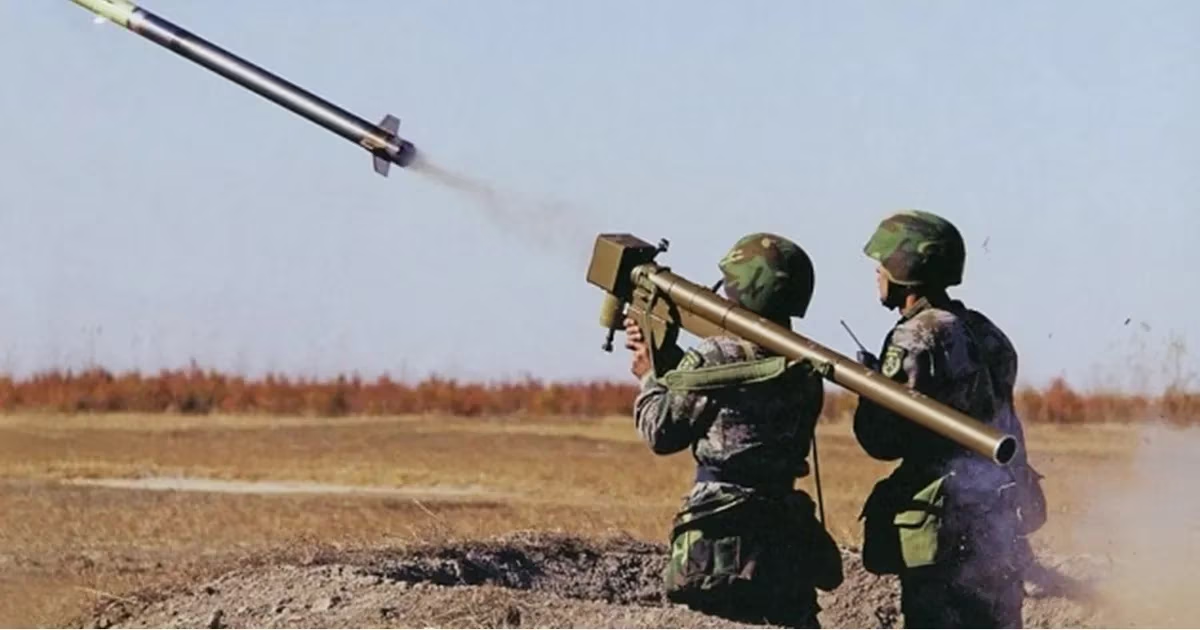







International media sources reported that Beijing is on the verge of finalizing a deal to deliver advanced 'MANPADS' air defense systems to Tehran in the near future. This move comes as Iran seeks to bolster its military arsenal and replenish its stock of defensive weapons, utilizing periods of field calm to develop its combat systems.
Portable shoulder-launched air defense systems (MANPADS) are classified as one of the most important pillars of short-range air defense in modern warfare. Chinese military industries have been developing these systems since the 1970s to compete with their Russian and American counterparts in accuracy and field effectiveness.
China's journey in this field began with the first generation known as (HN-5), a system primarily based on reverse engineering of the famous Soviet 'Strela-2' missile. This generation was characterized by an effective range of up to 4.4 kilometers and the ability to hit targets at an altitude of 2.5 kilometers, despite lacking modern digital technologies.
The 1990s witnessed a qualitative leap with the entry of the (QW) series, or 'Vanguard,' into active military service. The QW-1 model is considered the first relatively modern Chinese system, as it was equipped with an advanced infrared seeker and an engagement range exceeding 5 kilometers against hostile targets.
Development continued, leading to the QW-2 model, which primarily focused on enhancing the ability to counter defensive countermeasures. This system possesses high accuracy in neutralizing targets that use flares and thermal balloons for deception, making it very effective against helicopters at low altitudes.
The QW-3 system represents a major technological shift in the family of Chinese systems, as it relies on semi-active infrared guidance. Its unique advantage lies in its ability to engage aircraft from the front rather than just pursuing them from behind, a performance comparable to advanced Western systems.
These industries culminated in the advanced (FN) generation, specifically the FN-6 system, which has gained widespread international fame in recent regional conflicts. This missile has a range of 6 kilometers with an altitude ceiling of 3.5 kilometers, making it a real threat to jet fighters and suicide drones.
Modern generations of these missiles are characterized by a superior ability to resist complex electronic and thermal jamming imposed by modern electronic warfare systems. Intelligence reports have detected the presence of these systems in several hot spots in the Middle East, with a particular focus on their increasing presence in the Iranian arsenal.
Through acquiring these Chinese technologies, Iran seeks to fill gaps in its field air defenses and protect its vital facilities from surprise attacks. These weapons provide high flexibility for ground forces due to their ease of portability and their ability to deal with a wide range of modern aerial threats.
These systems represent an extension of Soviet designs that Beijing developed into smart generations equipped with digital technologies to counter drones and fighter jets.





Share your opinion
Chinese Defensive Reinforcements for Iran: What are the Capabilities of Portable 'MANPADS' Systems?