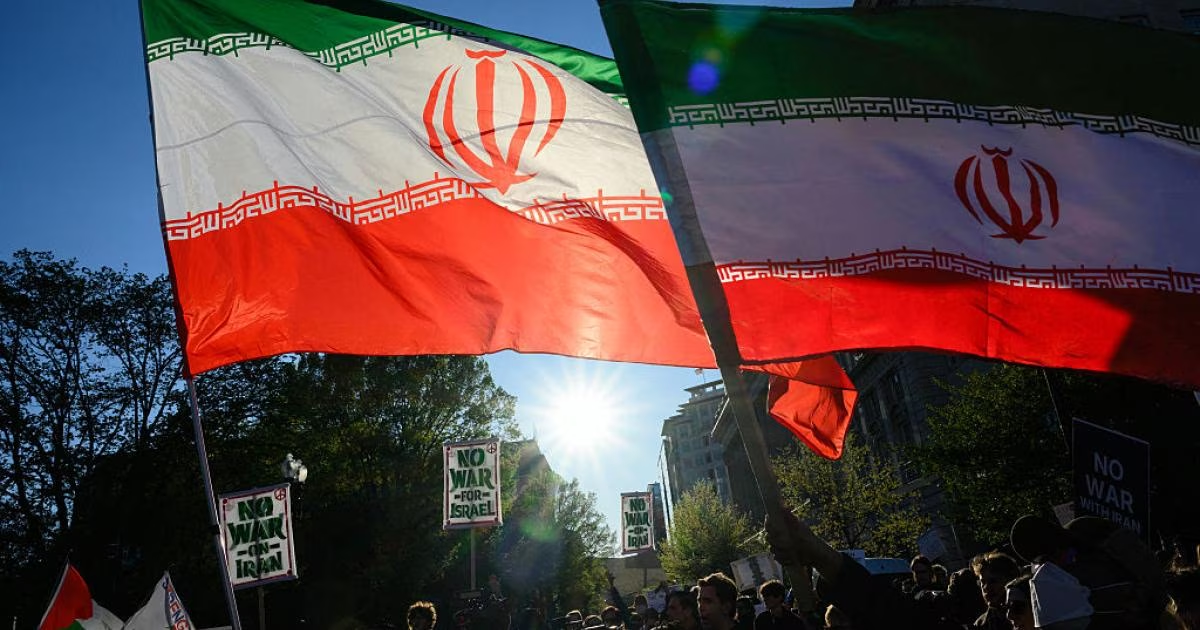







The Iranian authorities announced early Wednesday morning the submission of a ten-point political document to American negotiators, aimed at ending the direct military confrontation with the United States and Israel. Tehran's proposal stipulates Washington's recognition of its right to a uranium enrichment program, in addition to the comprehensive lifting of all economic sanctions imposed on it as part of a comprehensive settlement.
The Supreme National Security Council of Iran clarified that the proposed plan guarantees Iran's full sovereignty over the strategic Strait of Hormuz, which is considered the global energy artery. The official statement also stressed the necessity of a resolution from the UN Security Council to give any agreement reached a binding legal character, to ensure that international parties do not backtrack on their commitments in the future.
The demands, conveyed through Pakistani mediation, included a complete withdrawal of American forces from the Middle East region, and a halt to all military operations targeting Iranian territory or its allied forces in the region. Tehran also demanded the immediate release of all its frozen financial assets in international banks, considering this an essential step to prove American good intentions in the negotiation process.
Regarding the nuclear file, responsible sources indicated that Iran has officially expressed its readiness to commit to not seeking to acquire nuclear weapons, in exchange for Washington accepting its right to peaceful enrichment. The level and technical ratios of enrichment will be subject to negotiation, in a framework that seeks to balance Iranian demands with international concerns about the nuclear program.
The Iranian plan addressed the economic aspect by proposing the establishment of an international investment and financial fund aimed at compensating Iran for the massive losses incurred by its economy due to years of sanctions and war. Tehran linked the implementation of the ceasefire to the official acceptance of the terms of this plan by the American administration, which seems to have opened a new door for faltering diplomacy.
For his part, US President Donald Trump announced the suspension of a large-scale military strike that was planned against Iranian targets, describing the Iranian proposal as forming a 'practical basis' for starting a serious negotiation process. This shift came after strong American warnings, indicating that Pakistani mediation succeeded in defusing an escalation that would have led to a comprehensive confrontation.
On the ground, Iranian Foreign Minister Abbas Araqchi confirmed that his country would allow safe passage for ships through the Strait of Hormuz for two weeks, provided prior coordination with the Iranian armed forces. This step comes to relieve pressure on global energy markets, as the strait has remained closed to navigation since the outbreak of hostilities in late February.
The adoption of a Security Council resolution will make these agreements binding under international law and will constitute a diplomatic victory for the Iranian nation.


Share your opinion
10-point plan.. Details of the Iranian proposal to end the confrontation with Washington