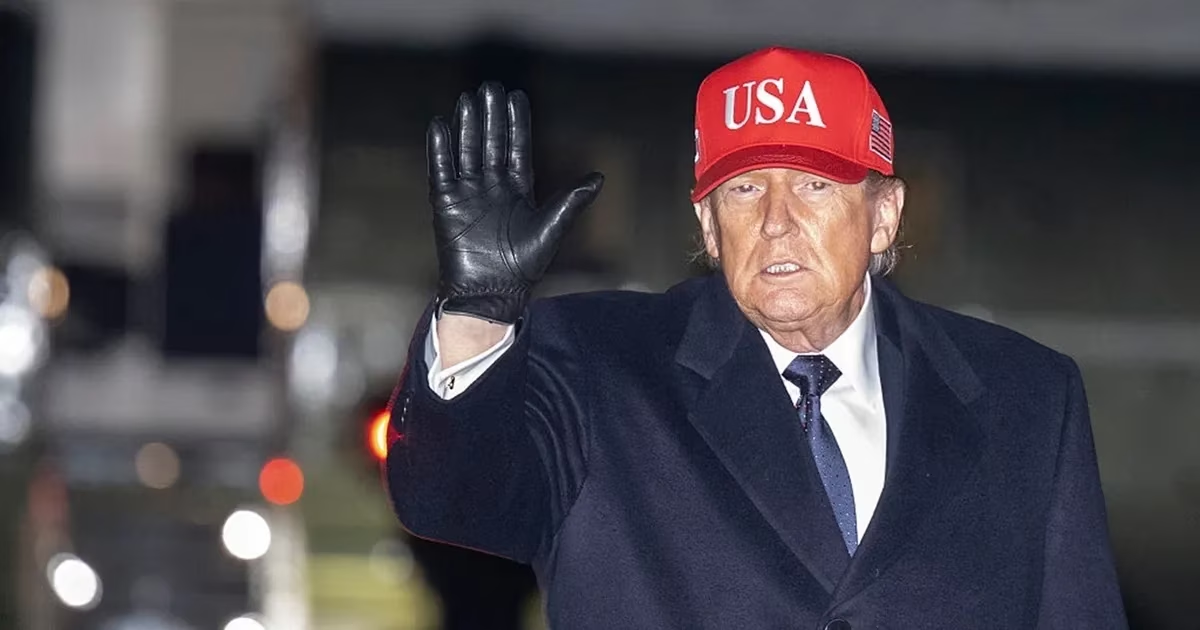







American Professor Jeffrey Sachs conveys a grim medical and psychological view of US President Donald Trump's personality, pointing to conclusions by psychiatrists confirming his suffering from a severe mental disorder. These reports describe Trump as an impulsive personality afflicted with megalomania and paranoia, rendering him incapable of making rational decisions, which could push the United States towards catastrophic confrontations.
Trump's scandals and behaviors do not seem strange given his early upbringing and professional background; he is a president who came from the worlds of betting, gambling, wrestling rings, and beauty pageants. This professional path, far from traditional political corridors, made him an exceptional media personality, entering the political scene with tools alien to internationally recognized diplomatic norms.
The article considers Trump a model of the 'psychopath' who does not hesitate to use vulgar language in his speeches, as recently happened on his 'Truth Social' platform. This behavior reflects the image of the spoiled president who sees himself as America's savior, while surrounding himself with an aura of religious and social sanctity that sometimes reaches the point of performing strange promotional rituals.
In comparing the Biden and Trump eras, a sharp division appears in American society regarding identity and values, as Biden sought to adopt controversial social and genetic policies. This direction made broad segments of the 'founding whites' feel threatened, leading them to prefer a president who seeks to change geographical and political maps rather than tamper with genetic and social identity.
The writer likens Trump's situation in America to that of the 'only male' who arrives after a long wait in popular heritage, where he receives excessive pampering that prevents him from political maturity. This leadership style relies on the constant display of power and boasting before adversaries and allies alike, turning international politics into an arena for intellectual adolescence.
This phenomenon is not limited to the United States but extends to other international leaders such as Russian President Vladimir Putin, who is described as a strong man born from suffering. Putin, who restored the glory of the tsars and united the Russian nation, now finds himself stuck in the quagmire of the Ukrainian crisis, a paradox that reflects the limits of individual power in the face of complex realities.
The creation of the 'child president' or spoiled leader is systematically done through media that exaggerates the leader's image and portrays him as the sole savior of the nation after ages of weakness. This reproduction of 'virile' leaders always comes as a reaction to periods of rule described as lenient or hesitant, as happened in the transition from Yeltsin to Putin in Russia.
In the Egyptian scene, the article highlights the shift from a rule characterized by religious piety to a military rule described as harsh, where the writer believes that the media contributed to creating the image of the 'male' for the new ruler. This ruler, who sometimes threatens his opponents with soft language, appears in other situations begging for support from major international powers, specifically from the American administration.
This dependency is evident in the discourse directed at Trump, where he is seen as the sole force capable of stopping wars in Gaza and Iran and securing the basic needs of allied countries. This contradiction between the image of the strong internally and the dependent externally reflects the leadership crisis in the Arab region, which always looks for a 'father' in Washington.
As for northern Syria, the experience of the 'Rojava Kingdom' led by Mazloum Abdi appears as another model of leadership that stands out as a unique case in the history of the Kurdish region. Despite the imported party roots, control over vast areas and great wealth has made this leadership an 'only son' who enjoys exceptional international support under complex regional circumstances.
The phenomenon of the 'awaited male' in politics often leads to leaders remaining in a state of political infancy, where they are controlled by the intoxication of power that surpasses any loss of consciousness in its effect. This self-absorption makes it difficult for these leaders to realize the extent of the dangers they surround their peoples and countries with, given their possession of weapons of mass destruction.
The United States, once known for its established institutions, has transformed into a country whose decisions are reduced to a single individual characterized by vulgarity and impulsiveness in his international stances. This transformation poses major questions to the world about the future of democracy in light of the rise of populist figures who rely on tickling emotions rather than sound political programs.
In contrast, the article presents a vision of other countries accused of theocracy but possessing institutions and consultation, in reference to the disparity between the mental image and political reality. This contradiction clarifies that the true strength of nations lies in the stability of their institutions and not in the charisma of the 'male' leader who may lead his country to the abyss.
In conclusion, the writer warns against being drawn into the creation of illusory leaders who feed on political and social vacuum, considering that the world is living in an era of 'child presidents'. The continuation of this approach to governance threatens the collapse of the international system, where the destinies of peoples become hostage to personal whims and psychological disorders of leaders who do not realize the magnitude of the responsibility placed upon them.
Psychiatrists concluded that Trump suffers from a severe mental disorder, describing him as an impulsive personality incapable of rational thought.
Share your opinion
The Psychology of the 'Spoiled President': A Reading on Trump's Rise and the Phenomenon of the Sole Leader