






Washington - Said Arikat - 3/30/2026
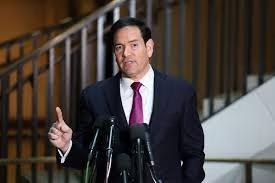
US Secretary of State Marco Rubio acknowledged the existence of indirect communication channels between Washington and Tehran through intermediaries, at a time when President Donald Trump prefers to prioritize the diplomatic path, considering that an opportunity for progress in this direction was available in previous stages.
In an interview with Al Jazeera, Rubio indicated that the United States is open to any shift within Iran that leads to the emergence of a new leadership with a different orientation, affirming his country's readiness to benefit from such a development if it occurs. However, he noted the ambiguity of the decision-making mechanism within the Iranian regime, stressing that US policies were not fundamentally built on targeting the leadership itself.
He added that the picture of the internal scene in Iran is unclear, saying that the identity of the actual decision-maker is still in question, in the absence of public indicators regarding the supreme leadership, which further complicates American assessments.
Rubio reiterated his country's categorical rejection of Iran possessing nuclear weapons, calling on it to stop supporting armed groups in the region and to cease policies of threatening neighboring countries.
In the context of his criticisms, Rubio considered that the Iranian missile program, especially short-range missiles, poses a direct threat to the Gulf states, accusing Tehran of seeking to develop nuclear capabilities with the aim of exerting international pressure, and warning of serious repercussions if this approach continues.
He called on Tehran to take practical steps to abandon its nuclear ambitions and stop developing drones and missiles, considering that a complete abandonment of armament programs could open the door to better opportunities for the country's future.
He also stressed that the United States is working closely with its allies to strengthen defenses and counter attacks, affirming support for the security of the region's countries and international freedom of navigation, and warning of an escalation of the situation if the Houthis' involvement in Yemen intensifies.
Regarding Israel, Rubio explained that its priorities partially differ from Washington's, as Tel Aviv focuses on the threat of medium-range missiles, while the United States seeks to coordinate actions with it to avoid any field conflict.
Rubio's statements reflect the continuation of the American approach based on combining pressure and openness, where Washington keeps the door of diplomacy open in parallel with hinting at deterrent measures. This balance is not new, but today it faces greater challenges in light of the complexity of the regional scene and the multiplicity of actors. The talk about indirect channels also confirms that communication has not been cut off, despite the rhetorical escalation, which indicates that both parties recognize the difficulty of military decisive action and the danger of sliding into a comprehensive confrontation.
Referring to the possibility of a new Iranian leadership emerging carries deep political implications, as it suggests an American bet on internal transformations that could change Tehran's external behavior. However, this bet remains fraught with risks, given the complex nature of the Iranian regime, where official institutions intertwine with undeclared centers of influence. Therefore, any change in faces does not necessarily guarantee a radical shift in policies, especially in sovereign files such as security and the nuclear program.
The American focus on missiles and drones reflects a shift in regional security priorities, as the nuclear file is no longer the sole source of major concern. These military tools have come to play a pivotal role in unconventional conflicts, giving Tehran the ability to exert influence through local proxies. Therefore, American demands to stop these programs reflect an effort to reduce indirect Iranian influence, and not just to limit its major strategic capabilities.
The disparity between Washington's and Tel Aviv's priorities highlights the complexities of their alliance, especially regarding the definition of the nature of the Iranian threat. While Israel focuses on direct risks associated with missiles, the United States looks at the broader picture that includes regional balances and freedom of navigation. This difference does not necessarily mean a conflict, but it requires a high level of coordination to avoid any unilateral steps that could lead to an uncalculated escalation in the region.
Share your opinion
Rubio acknowledges communication channels with Tehran and demands it abandon drones and ballistic missiles