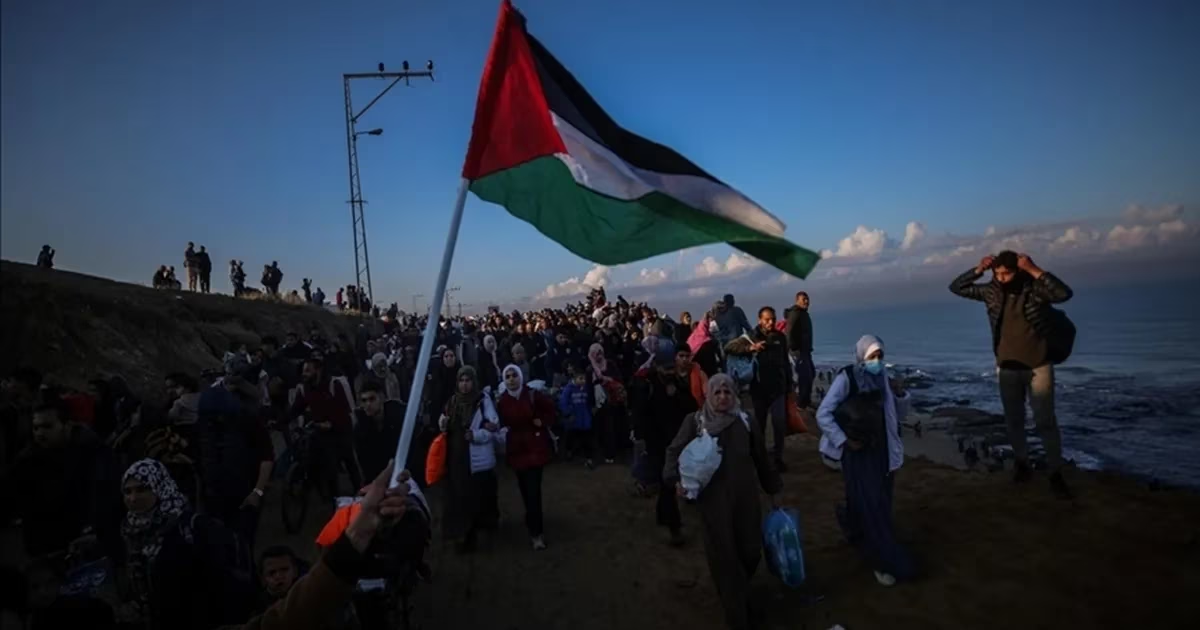







When a voice that called for dignity and awakened a sense of belonging in people falls silent, the departure is not merely a fleeting event, but a moment of deep reflection on the essence of the legacy left behind. Thus departs Ahmed Kaabour, the author of the poem 'I Call Out to You,' which became an anthem for the Palestinian and Arab conscience, his voice remaining a testament to the power of words to create an awareness that resists breaking.
In the presence of this absence, the question of the secret behind the steadfastness of nations is not an intellectual luxury, but an extension of a humanitarian call that believed that the weak, when they cling to their dignity, refuse defeat. From here, the reading opens up to an attempt to understand the hidden power that makes societies resist and remain standing despite the imbalance of material power.
Some contemporary historical facts seem thought-provoking; the Taliban stood firm against the most violent military power in the world, represented by the United States and NATO. In Palestine, Hamas confronts the Israeli occupation and has managed to shake the myth of an army long described as invincible, despite the enormous technological disparities.
These examples, in addition to the Iranian case facing international isolation and direct threats, raise a fundamental question about the source of this capability. While central regimes collapse with astonishing speed, as happened in Iraq previously, these local forces show a superior ability to persist and engage in long-term confrontation.
A superficial explanation might limit the reason to 'patriotism' alone, but love of land is not enough to explain steadfastness against militarily and numerically superior forces. There is a deeper matter that fuels this determination, which is the societal, cultural, and religious dimension that gives these forces an existential meaning that transcends the defense of geographical borders.
In the Afghan case, we find a social dynamic based on a solid tribal and faith-based network that views resistance as a duty to impose its authentic values. The individual there feels part of a historical project that connects faith in divine power with societal duty towards family and land, making defeat an unthinkable option.
As for Palestine, resistance represents a response to a deep sense of historical injustice extending from the Nakba of 1948 to the present day. The Palestinian people experience steadfastness as a moral and national duty, where small victories turn into legends that nourish the morale of successive generations and create a sense of capability despite the siege.
Palestinian steadfastness is a collective experience shared by all generations, resulting from a mixture of historical awareness and belief in the justice of the cause. This belief gives resistance a dimension that transcends international laws and transient policies, making staying on the land an act of struggle in itself.
The Iranian regime represents another model, where the leadership builds its policies on an extended national identity supported by a deep religious dimension that links the nation to a common destiny. Power here lies not only in the arsenal of weapons but in transforming the conflict into a collective cultural project that views standing against hegemony as a moral duty.
In contrast, we find that hierarchical systems that rely on absolute individual authority collapse as soon as the head of the hierarchy falls. The absence of a cohesive social network and a shared faith-based project makes individuals lack a sense of continuous responsibility, leading to the disintegration of the state in the face of the first serious military test.
True steadfastness stems from the blending of national elements with a spiritual and cultural dimension that gives societies an invisible strength. This strength makes peoples see themselves as part of a project larger than mere material survival, which motivates them to confront injustice even if the adversary is materially and technologically superior.
These models teach us a human lesson that steadfastness is the product of social and spiritual complexity where identity intertwines with history. Defending dignity becomes an existential project, which explains how resource-limited societies can confront formidable international powers and continue to refuse submission.
Ultimately, steadfastness transforms from an exceptional heroic choice into a simple daily act repeated in people's stories and faces. It is a silent will that chooses each time to endure pain and not surrender to invaders, believing that what is preserved within is what makes continuity possible.
This is not a story of an invincible military force, but a story of human dignity that refuses to be violated, no matter how long the road and how many wounds. Enduring pain is always easier than being held captive by humiliation, and this is the golden rule that preserves societies' survival in the face of political storms and wars.
Steadfastness is not merely military capabilities, but the product of social, cultural, and spiritual complexity where nationalism intertwines with religious identity.
Share your opinion
The Philosophy of Steadfastness: Why Do Nations Refuse to Break Before Great Powers?