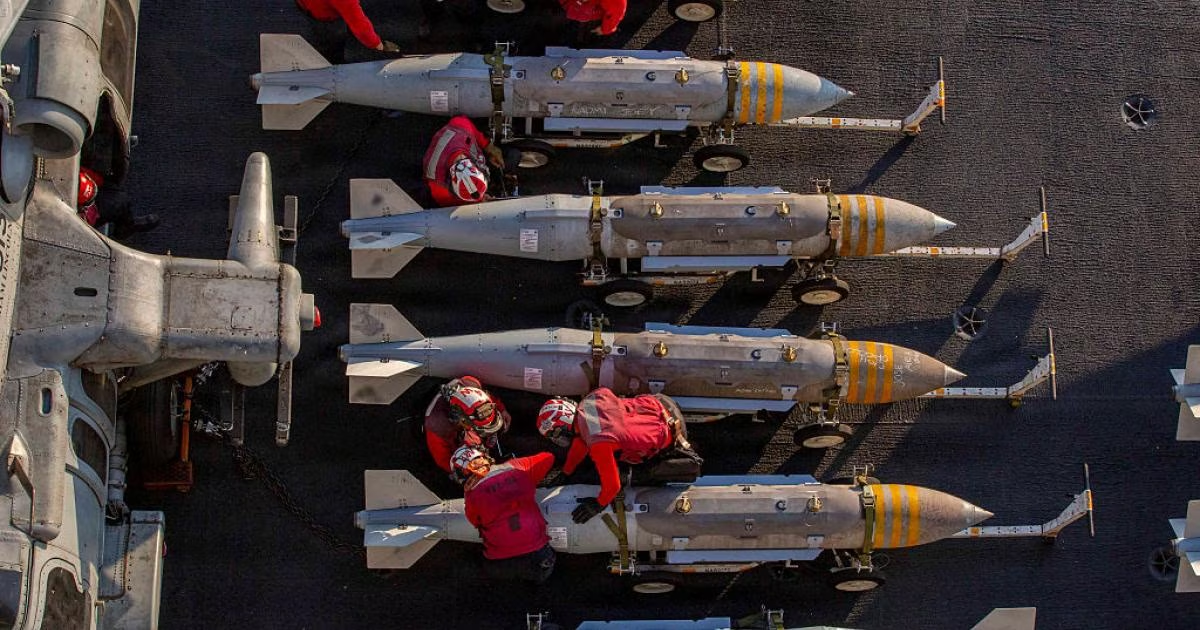







The US administration has officially announced its approval of a series of arms and military equipment sales deals to both the United Arab Emirates and the State of Kuwait, with a total value of $16.46 billion. This strategic move comes within Washington's efforts to enhance the defensive capabilities of its allies in the Gulf region, especially after the recent security tensions witnessed in the region, which affected the defensive infrastructure of both countries.
This American military move followed a wave of field escalation, as international reports monitored Iran launching barrages of ballistic missiles and drones towards regional targets. Sources explained that these attacks came as a reaction to previous air operations, which resulted in human and material losses in some Gulf countries, and necessitated a widespread military mobilization to secure airspace and vital facilities.
In a remarkable procedural development, US Secretary of State Marco Rubio revealed his use of exceptional powers to urgently pass these deals. Rubio affirmed that he provided legal justifications proving the existence of an emergency affecting national security, which allows the Department of Defense to proceed with immediate supply and implementation procedures without the need to wait for the traditional review by the US Congress, which could take a long time.
According to official data issued by the State Department, Kuwait acquired the largest share of these contracts through a single deal worth approximately $8 billion. This deal focused on providing the Kuwaiti army with advanced sensing radars specialized in air and missile defense. These systems are characterized by their high ability to detect and track targets moving at high speeds and provide accurate data to interception platforms.
As for the Emirati side, its deals included a diverse package of advanced military technologies, the most prominent of which was a long-range discrimination radar specialized in confronting ballistic missile threats, valued at $4.5 billion. The contracts also included the allocation of $2.1 billion for specialized systems to neutralize and shoot down small drones, which have become an increasing security challenge, in addition to advanced air-to-air missiles to enhance air superiority, valued at $1.22 billion.
The Emirati deals were not limited to defensive systems only, but also included the development of offensive and operational capabilities for the air force. The purchase of smart munitions and technical upgrades for 'F-16' fighters, valued at $644 million, was approved. These upgrades aim to ensure the readiness of the Emirati air fleet to deal with various modern combat scenarios and their integration with the new detection and tracking systems included in the major deal.
It provided a detailed justification confirming the existence of an emergency that necessitates the immediate implementation of the deal without waiting for congressional approval.



Share your opinion
Washington approves massive arms deals for UAE and Kuwait worth $16.5 billion to counter threats