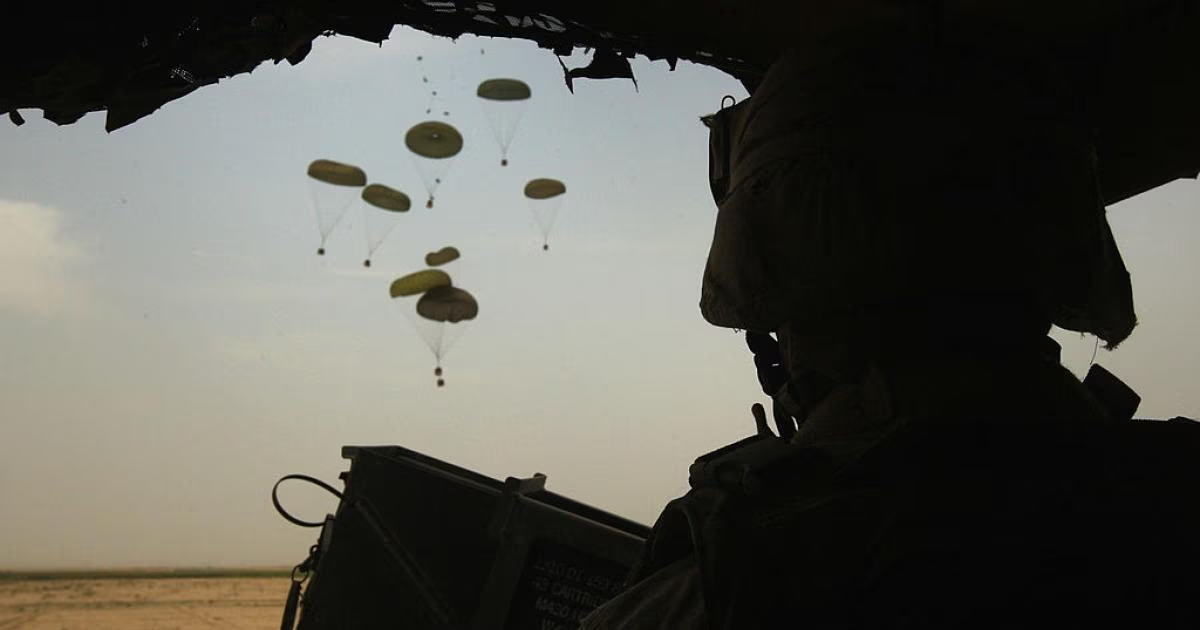







International speculation has recently escalated regarding the possibility of the United States carrying out special military operations or occupying the Iranian island of Kharg. These expectations come in the context of recalling Washington's military history, which relies heavily on airborne landings as a strategic tool to decide battles and change the balance of power in record time.
The abduction of Venezuelan President Nicolas Maduro on January 3rd is the latest controversial example in this context. A US commando force of about one hundred soldiers carried out a surprise landing in the capital Caracas under intense air cover, leading to his arrest and capture in an operation that shocked international political circles.
In the Syrian arena, US forces have adopted an airborne landing strategy since 2014 to pursue leaders of the Islamic State organization. Among the most prominent of these operations was the one that resulted in the killing of the organization's leader, Abu Ibrahim al-Qurashi, in the northwest of the country, operations that rely on extreme speed and accurate intelligence to achieve their objectives.
The operation that changed the face of the conflict with Al-Qaeda was at dawn on May 2, 2011, in the Pakistani city of Abbottabad. US commandos were able to eliminate Osama bin Laden in a special operation that did not exceed 40 minutes, reflecting Washington's ability to reach its targets deep within other countries' territories.
Returning to the invasion of Iraq in 2003, the 'Airborne Dragon' operation emerged as one of the largest preliminary landing operations for the ground invasion. Special units were deployed in strategic areas within Iraqi territory to secure roads and facilitate the advance of main ground forces towards the capital Baghdad to ensure its rapid fall.
In the aftermath of the September 11, 2001 attacks, the Afghan mountains were the scene of landings by US special units in support of local armed factions. These operations aimed to undermine the Taliban's rule at the beginning of what later became known as the longest war fought by the United States in its military history outside its borders.
However, the history of US landings has not always been fraught with easy success, as the Somali capital Mogadishu witnessed a major setback in October 1993. The operation, known as 'Black Hawk Down,' turned from a quick arrest mission into a bloody street battle that resulted in the deaths of 18 American soldiers and injuries to dozens, which constituted a major embarrassment for the US administration at the time.
In late 1989, Washington carried out the invasion of Panama through large-scale airborne landing operations that included the capital Panama City and other vital areas. The mission aimed directly at overthrowing the rule of Manuel Noriega, who was wanted by the US judiciary on charges related to drug trafficking and international extortion.
These operations are an integral part of the American military doctrine that prefers the use of special forces and airborne landings to achieve rapid political and military results. These tactics allow Washington to overcome geographical complexities and traditional fortifications of adversaries, making them the first choice in explosive international crises.
Reports indicate that reliance on this type of operation reduces human casualties among attacking forces compared to comprehensive traditional wars. However, the success of these operations remains dependent on the accuracy of intelligence information and the ability to deal with field surprises that may arise during execution.
Finally, the question remains whether the circulating scenarios regarding Iran will join the list of these historical operations. While Washington works to use these threats as political leverage, the option of military landing remains on the table for American decision-makers as a decisive tool in confronting regional challenges.
Landings have never been merely a tactical option, but rather an expression of a military doctrine aimed at neutralizing adversaries with lightning speed.





Share your opinion
From Panama to Venezuela.. The History of US Military Landings and Their Strategic Objectives