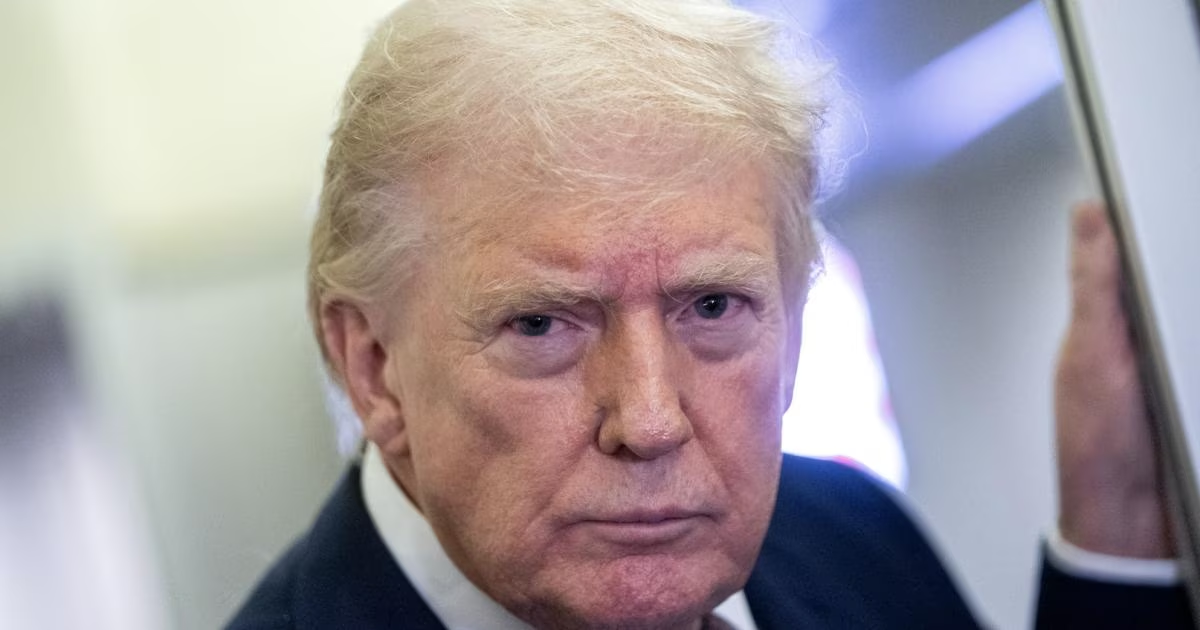







US President Donald Trump has escalated his rhetoric towards US allies in NATO and the People's Republic of China, demanding immediate action to contribute to securing global oil supplies passing through the Strait of Hormuz. These moves come amid a state of near-total paralysis affecting navigation in the strategic waterway since the recent military confrontations erupted in the region.
In statements to the 'Financial Times', Trump warned that NATO could face a bleak future if its members do not provide the necessary support to open the strait and secure the passage of tankers. The US President indicated that continued stalemate in responding to US demands would inevitably lead to a comprehensive review of the nature of the relationship with the alliance and its impact on its future stability.
Trump stressed that countries benefiting from Gulf oil, primarily European countries and China, must bear their direct responsibilities in protecting these vital interests. He clarified that the United States no longer relies heavily on the region's oil as it did in the past, which places the greater burden on international powers whose economies are entirely dependent on the continuity of flows through Hormuz.
Regarding relations with Beijing, Trump directly linked the holding of the scheduled summit with his Chinese counterpart Xi Jinping to the extent of China's cooperation on the strait issue. He hinted at the possibility of postponing the summit, which was supposed to start on March 31, emphasizing his desire to see concrete steps from the Chinese side before sitting down at the negotiating table.
The US President pointed out that China imports about 90% of its oil needs through this waterway, which makes its silence or non-participation unacceptable to the US administration. He added that Washington is awaiting a clear response before the summit, noting that the economic and political consequences would be significant if supply disruptions continue.
On the ground, Trump revealed that the US Navy is preparing to begin escort operations for oil tankers through the Strait of Hormuz very soon. He called on several countries, including France, Japan, the United Kingdom, and South Korea, to send naval warships to participate in this international mission aimed at ensuring the stability of global energy markets.
In a related context regarding diplomatic solutions, Trump expressed deep skepticism about Tehran's willingness to engage in serious negotiations to end the current conflict. Despite confirming the existence of existing communication channels between Washington and Tehran, he considered that the Iranian leadership does not yet seem ready to make the necessary concessions to reach a comprehensive agreement.
For his part, Iranian Foreign Minister Abbas Araqchi responded in a firm tone, asserting that Tehran sees no reason to talk to the Americans at the present time. Araqchi clarified in a television interview that his country is in a stable and strong position, and that it exercises its legitimate right to defend its people and interests in the face of what he described as American aggression.
Araqchi pointed out that Iran was open to dialogue before the attacks began, but the current situation on the ground dictates different priorities related to defense and deterrence. He stressed that his country will not succumb to the pressures exerted by Washington through mobilizing international forces in the region, considering that these moves increase the complexity of the regional scene.
As part of Iranian diplomatic efforts, Araqchi called on world countries, during a call with his French counterpart, to exercise restraint and refrain from any steps that could lead to an expansion of the conflict. The Iranian Foreign Ministry warned that sending additional warships to the region could be understood as an escalatory step that increases the risks of direct confrontation.
To date, none of the countries Trump called upon have officially responded to sending naval forces, with the exception of South Korea, which confirmed it is carefully considering the request. Anticipation remains the order of the day, awaiting what the coming days will bring in terms of military or diplomatic moves that could change the course of the crisis in one of the world's most important waterways.
It is entirely natural for those who benefit from this strait to ensure that no unfortunate incident occurs there, otherwise the consequences will be dire for the future of NATO.



Share your opinion
Trump threatens NATO and conditions China to protect the Strait of Hormuz to ensure the upcoming summit