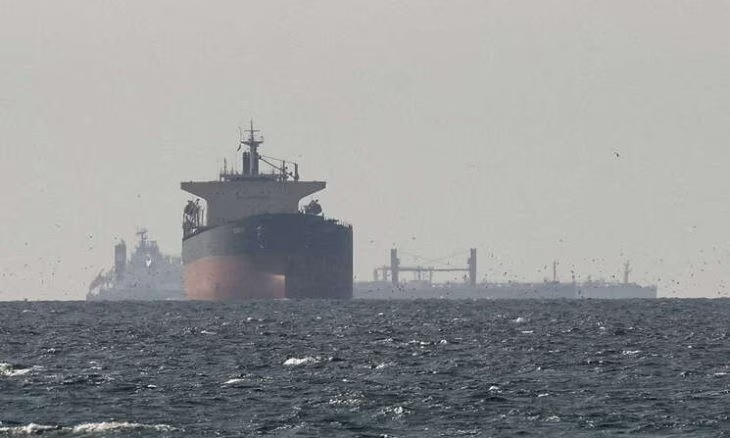







The American administration announced that it has not yet begun implementing military escort operations for oil tankers crossing the Strait of Hormuz, despite escalating tensions in the region. This step comes amid warnings of the danger of the maritime passage, which has become a potential confrontation arena, as Washington fears its ships will be subjected to direct attacks by drones or cruise missiles launched from nearby Iranian coasts.
US President Donald Trump had earlier proposed using naval force to secure navigation and reopen the strait, with the aim of avoiding a global energy crisis resulting from rising oil prices. However, US military movements so far have been limited to carrying out limited strikes targeting ships accused of planting naval mines near vital passages in the region.
For his part, US Treasury Secretary Scott Bessent clarified that there is no specific timetable for the start of naval escort missions, noting that the US Navy seeks to build an international coalition for this purpose. Bessent affirmed that operations will begin as soon as full military readiness and the ability to confront direct threats surrounding commercial vessels are available.
Military experts believe that the biggest challenge lies in the complex geography of the region, where Iranian missile launch platforms are located very close to shipping lanes. The distance at some critical points is less than 4 miles, meaning that missiles and drones can reach their targets within a few minutes, making interception difficult.
The Strait of Hormuz is the world's most important energy artery, connecting the Arabian Gulf to the Gulf of Oman and the Arabian Sea, with about 20% of total global oil consumption passing through it. The de facto closure of the strait by the Iranian side about two weeks ago led to severe disruptions in global markets and a significant increase in shipping and insurance costs.
The past few days have witnessed a field escalation, as six oil tankers were attacked in Gulf waters, some of which were directly attributed to the Iranian Revolutionary Guard. These attacks come as part of the pressure strategy adopted by Tehran in response to ongoing US and Israeli military operations against targets associated with it in the region.
In a related context, the Iranian Revolutionary Guard affirmed that it would not allow any oil shipments to pass through the strait unless external attacks ceased, a position supported by the new Supreme Leader Mojtaba Khamenei. This Iranian insistence places the US administration before difficult choices between direct military escalation or accepting the continuation of the naval blockade.
Former military commanders at the Pentagon indicate that the narrowness of the waterway, which is no more than 21 miles wide at its narrowest points, makes ships easy targets for naval mines and guided missiles. They explained that the mere feeling of danger prompted many international shipping companies to avoid passing through the strait even before actual attacks occurred, which further complicated the crisis.
Proposed US plans to secure navigation include providing continuous air support and surveillance patrols of launch sites on the Iranian coast for proactive intervention when necessary. Despite White House attempts to reassure global markets that the situation is under control, the field reality indicates that the mission is fraught with risks that could lead to a wider conflict.
The mission is costly, complex, and not guaranteed to succeed, as drone and missile attacks can cause significant damage even to a single ship.

Share your opinion
Washington anticipates risks accompanying oil tankers in the Strait of Hormuz amid Iranian threats