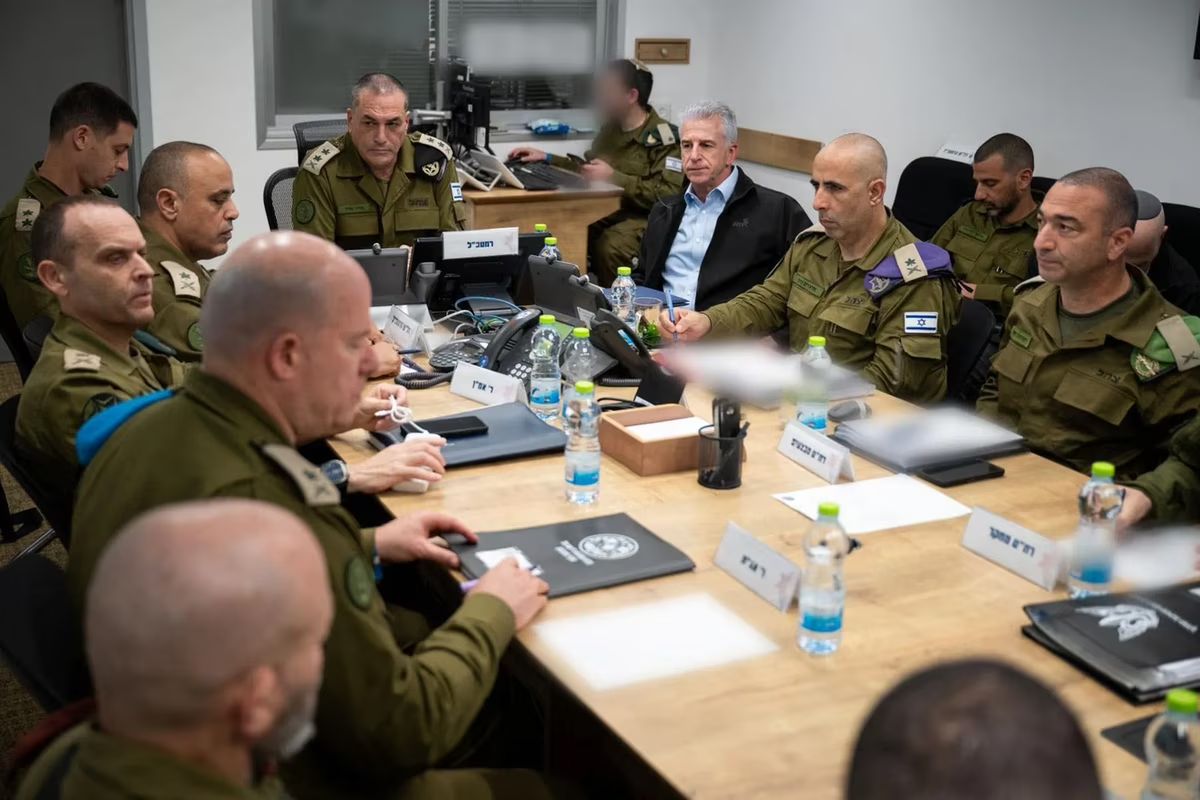







Media and analytical sources have revealed details of the extensive military operation launched by Tel Aviv under the name 'Lion's Roar,' which explicitly aims to overthrow the Iranian regime. This operation comes in full coordination with the American leadership, as the decision to expand or limit the scope of attacks is linked to the White House, amidst fears of the region sliding into a comprehensive regional escalation involving additional powers.
The initial phases of the airstrikes included targeting the Iranian regime's supreme leadership and security and political power centers in Tehran. The attack follows a gradual path seeking to radically weaken the Islamic Republic's defensive capabilities, paving the way for long-term strategic changes in the structure of power there.
For its part, Tehran did not stand idly by, responding with a counter-military operation it named 'True Promise 4.' Joint forces are currently imposing a tight siege on Iran, while continuing to target security systems to create an environment conducive to potential internal movements against the ruling regime.
The intensive aerial assault began on Saturday morning, with the first wave focusing on neutralizing Iranian air defenses to ensure complete air superiority. Following this, American forces intervened to enhance the impact of the strikes and expand their scope, specifically targeting missile depots and launch platforms that were ready for execution.
According to military analysts, the 'Lion's Roar' pattern relies on two main phases, beginning with a concentrated Israeli effort followed by full American military weight. This tactic aims to prevent Iran from executing a rapid and intense response, by destroying underground hidden platforms and short- and long-range defensive systems.
Sources reported that the operation targeted what are known as sensitive 'regime targets' to secure safe corridors for long-range American 'Tomahawk' missiles. This continuous military pressure forces the Iranian side to constantly reposition under fire, reducing its ability to coordinate large-scale missile attacks simultaneously.
Estimates indicate that Iranian missile salvos are now being launched in limited and intermittent numbers instead of the dense waves previously expected. Although this pattern forces settlers to remain in shelters for longer periods, it reduces the risk of exposure to concentrated and devastating strikes at once.
Observers believe that the final decision in the course of this war remains in the hands of US President Donald Trump, who has the authority to determine the ceiling of military operations. The United States is leading the bulk of the attacks through squadrons of fighter jets and drones that have targeted hundreds of vital targets deep inside Iran.
Tehran sensed the seriousness of the joint move, which prompted it to expand its response to include American bases and countries that had not officially declared their participation in the conflict. This development reflects the widening scope of engagement and the possibility of other regional parties, such as the Houthis in Yemen, entering the direct confrontation line.
Operation 'Lion's Roar' surpasses all previous operations in complexity and scale, including the 'Rising Lion' attack executed in mid-2025. The Israeli military establishment considers assassinations and concentrated strikes as part of a comprehensive strategy aimed at undermining the pillars of the regime in preparation for its collapse.
In contrast, Iran raised its military challenge by launching a barrage of missiles towards Israeli and American targets in the region. Experts suggest that the conflict will move towards greater geographical intensity, with the Israeli army preparing to open additional potential fronts from Lebanon, Iraq, and Yemen.
The direct attack on Iran represents a pivotal moment in the history of the conflict in the Middle East, with profound implications for the stability of the international system. The American side is betting on weakening the regime's central grip, while Tehran is preparing counter-scenarios to withstand this unprecedented military and political pressure.
The operational plan, which has been in place for months, includes striking missile infrastructure to prevent any threat to oil fields in the Arabian Gulf or strategic bases. The timing of the attack was chosen for the morning hours to achieve the element of tactical surprise, despite the state of maximum alert declared by Iranian agencies.
The third phase of the campaign aims to impose international isolation and a suffocating siege on Iran, coinciding with targeting security power centers. Through these continuous pressures, planners seek to create conditions to push the Iranian street towards a radical change in power, as part of a comprehensive path to end the current regime's influence.
The goal goes beyond a traditional military strike to an attempt to change the structure of governance in Tehran, as this confrontation constitutes a pivotal moment in the balances of the international system.



Share your opinion
Operation 'Lion's Roar': A Reading of the Dimensions of the Joint Israeli-American Attack on Iran