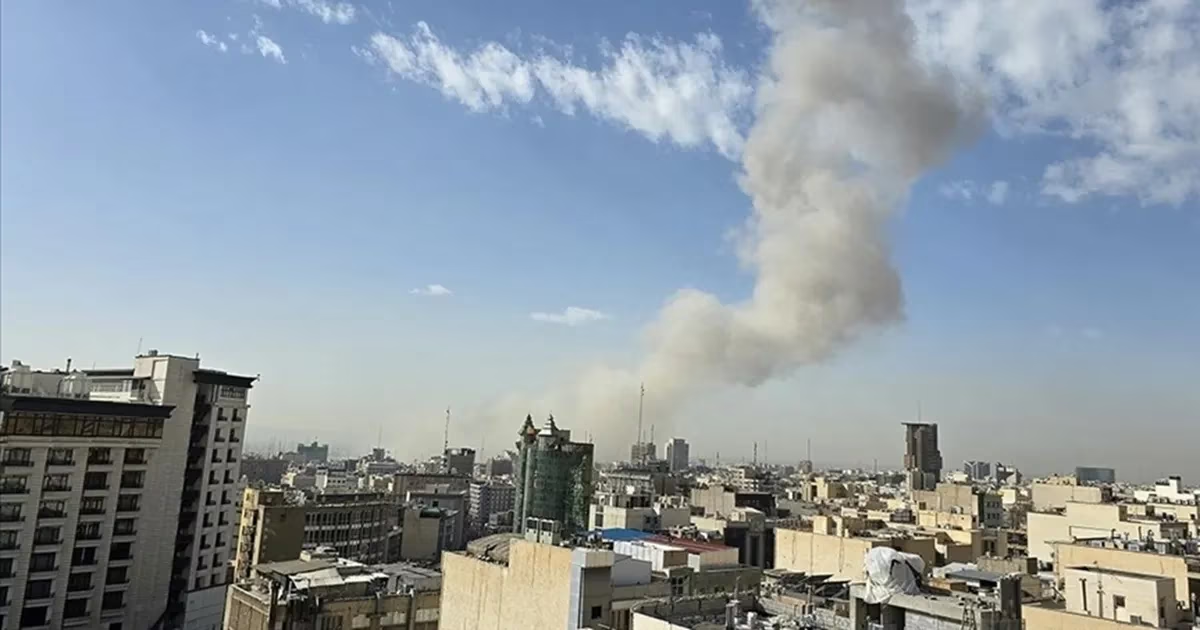







International media sources have revealed widespread doubts surrounding the justifications put forth by the administration of US President Donald Trump to pave the way for military action against Iran. An extensive report indicated that recent claims made by the White House were described as unproven or lacking scientific and intelligence accuracy.
The US administration's narrative focused on three main axes, claiming that Tehran had fully resumed its nuclear program and was capable of producing a nuclear bomb within a few days. Trump also alleged that Iran was developing long-range ballistic missiles capable of targeting American cities very soon.
In contrast, American and European officials painted a completely different picture of the situation on the ground, asserting that there was no concrete evidence of Tehran's pursuit of building a nuclear explosive device. Sources clarified that current Iranian activity is limited to restoring some sites damaged in previous attacks without achieving a strategic technical breakthrough.
Reports from the International Atomic Energy Agency confirmed that Iran's stockpile of 60% enriched uranium, estimated at about a thousand pounds, remains stored underground at the Isfahan facility. Sources added that extracting these materials and converting them into warheads would require many months, refuting claims of the ability to manufacture a bomb within days.
Regarding missile capabilities, intelligence sources reported that Trump significantly exaggerated the Iranian threat to American territory. Defense Intelligence Agency assessments concluded that the development of intercontinental missiles would require a decade and intensive technical efforts that Tehran has not yet begun.
Intelligence analysts expressed concern about the possibility of information being selectively or distortedly presented to the political leadership to justify preconceived decisions. Sources likened this atmosphere to what preceded the invasion of Iraq in 2003, when false claims about weapons of mass destruction were used to justify military action.
For his part, Representative Jim Himes, the ranking Democrat on the House Intelligence Committee, expressed deep concern following closed-door meetings with administration officials. Himes affirmed that he had not heard any convincing justification for the United States to engage in a new war in the already volatile Middle East region.
Despite Trump's assurances in his last speech that previous strikes had eliminated Iran's nuclear program, he returned to warn of Tehran's renewed ambitions. This contradiction in statements raised questions about the true objectives of the verbal and on-the-ground escalation pursued by the current administration regarding the Iranian file.
Data indicates that the sensitive Fordow nuclear site has remained out of service since the attacks that targeted it last June. Sources confirm that Iran has not established any new nuclear sites since then, despite observations of attempts to dig deeper to protect future facilities from bunker-buster bombs.
In a related context, observers noted that Trump's recent speech was characterized by a focus on the language of numbers and huge financial gains, reflecting his controversial political approach. The speech received widespread public attention, despite sharp international criticism of his foreign policies, including his use of the veto to halt the war in Gaza.
Secretary of State Marco Rubio later admitted in statements that there was no conclusive evidence of Iran enriching nuclear fuel at present. However, he continued to warn that Tehran is on a path to developing weapons that may one day reach the continental United States, without specifying a precise timeline.
Some Republican lawmakers questioned the reports relied upon by White House advisors, with Senator Marsha Blackburn stating that she had not seen any data supporting the imminent bomb hypothesis. This division within the Republican Party reflects a state of uncertainty regarding the accuracy of the information on which decisions of war and peace are based.
Historically, Iran has focused its missile capabilities on short and medium-range missiles to enhance regional deterrence against its adversaries in the region. Sources confirm that shifting this focus to intercontinental missiles has not yet become a top priority for Tehran, contrary to what the US administration promotes in international forums.
Tension remains high in Washington, with increasing pressure to provide transparent evidence before taking any military step that could ignite the region. Sources continue to warn that relying on questionable claims could lead to strategic disasters, repeating past mistakes in foreign military interventions.
Wars in the Middle East are not in the interest of presidents or the country, and we have not heard any convincing justification for another war now.



Share your opinion
Intelligence Reports Refute Trump Administration Claims on Iranian Nuclear and Missile Threat