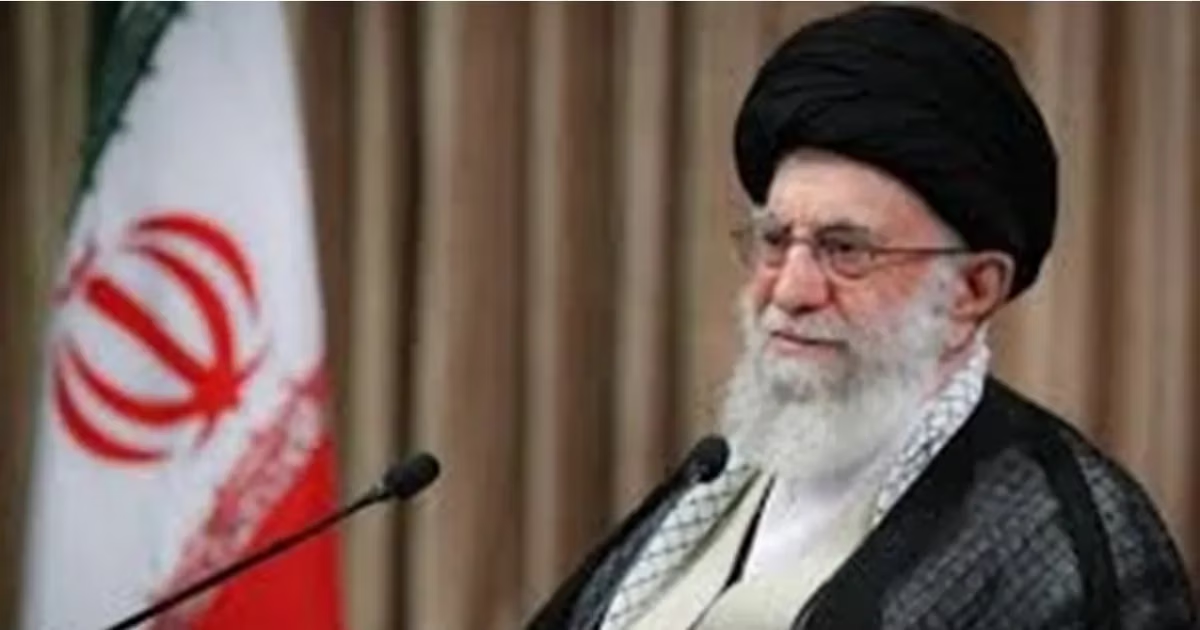







Informed press sources revealed that US President Donald Trump has informed his advisors of exploring advanced military options against Iran, including the possibility of overthrowing Supreme Leader Ali Khamenei if diplomatic efforts falter. These threats come at a sensitive time when Washington is seeking to impose its conditions regarding Iran's nuclear file and missile program, amidst international anticipation of the outcomes of the current escalation.
The targets under scrutiny by the US administration vary between Iranian Revolutionary Guard headquarters and vital nuclear facilities, extending to ballistic missile development sites. Reports indicated that Trump has left the door open for a large-scale military attack later this year, directly aimed at destabilizing the regime and changing the top leadership in Tehran.
Despite the escalatory tone, doubts have emerged within the US administration regarding the effectiveness of isolated airstrikes in achieving the goal of regime change. Observers believe that relying on air power alone may not be sufficient to bring about radical political change, which places decision-makers in Washington before complex strategic choices that require precise calculations of field and political outcomes.
In an attempt to avoid armed conflict, a new proposal is on the table for discussion, which includes allowing Tehran a very limited nuclear enrichment program. This proposal stipulates that enrichment operations would be restricted to medical purposes and research treatments only, which could provide a technical solution that satisfies both parties and prevents the region from sliding into an all-out war with unpredictable consequences.
The Swiss city of Geneva is scheduled to host a round of negotiations next Thursday, described as a 'last-minute opportunity' between senior negotiators from the American and Iranian sides. This meeting aims to discuss new proposals and create a political path that spares the region an imminent military conflict, especially with increasing international pressure to de-escalate.
In parallel with the diplomatic track, the United States continues to strengthen its military presence in the region by mobilizing two aircraft carrier groups within targeting range of Iranian territory. Washington considers this military move a means of pressuring Tehran to accept American conditions, while Iran views it as an unjustified escalation that complicates opportunities for reaching peaceful understandings.
For his part, Iranian Foreign Minister Abbas Araghchi affirmed that his country is ready for the upcoming round of talks in Geneva, considering it a real opportunity to reach a comprehensive diplomatic solution. Araghchi stressed that the principle of 'mutual gain' is the only basis upon which any sustainable agreement can be built, noting that diplomatic solutions have proven effective in previous experiences.
In response to American threats of military attack, Araghchi downplayed the importance of military buildups in the region, asserting that they will not contribute to advancing the negotiation process or exerting pressure on his country. He clarified that Iran's nuclear program is peaceful in nature, and any attempt to impose political will through military force will be met with Iranian steadfastness based on legitimate international rights.
If they want to find a solution for a peaceful nuclear program, the only way is diplomacy, and we have proven that in the past.

Share your opinion
Trump hints at targeting Iranian Supreme Leader, and the option of overthrowing the regime returns to the table